
Categories: AI For Finance, AI Predictions, AI Shopping Assistant
LowerEBill Review: AI to Cut Your Electricity Bill?

If you live in Texas or another state with a deregulated energy market, you know the special kind of headache that comes with picking an electricity plan. It feels less like shopping and more like taking a high-stakes exam you didn’t study for. You’re bombarded with promises of “low fixed rates,” “free nights and weekends,” and other gimmicks that feel designed to trip you up.
I’ve been in the SEO and traffic game for years, and I’ve seen every trick in the book to get clicks. The energy sector feels like the wild west of digital marketing. Every provider is shouting that they’re the cheapest, but the fine print tells a different story. Tiered rates, base charges, transmission fees… it’s a minefield. I once spent an entire Saturday with a spreadsheet trying to compare three different plans, and by the end, I think I was just more confused. Sound familiar?
So, when I heard about a tool called LowerEBill that uses AI to do the heavy lifting, my inner skeptic raised an eyebrow. Another gimmick? But my curiosity got the better of me. A tool that promises to simplify this mess? For free? I had to see for myself.
The Absolute Nightmare of Choosing an Electricity Plan
Before we get into the tool itself, let’s commiserate. The entire system feels rigged. Providers know that most of us will just look at the advertised cents per kilowatt-hour (kWh) and pick the lowest number. But that number is often a lie.
It might only apply if you use an exact, narrow band of electricity—say, between 1001 and 1999 kWh. Use 998 kWh? BAM! A higher rate or a massive base charge kicks in. Use 2002 kWh? Congrats, you’re on a different, more expensive tier. And those “free nights” plans often come with a daytime rate so high it makes your air conditioner weep. It’s a game, and the house almost always wins because they have all the data. We just have our last bill.
So, What Exactly is LowerEBill?
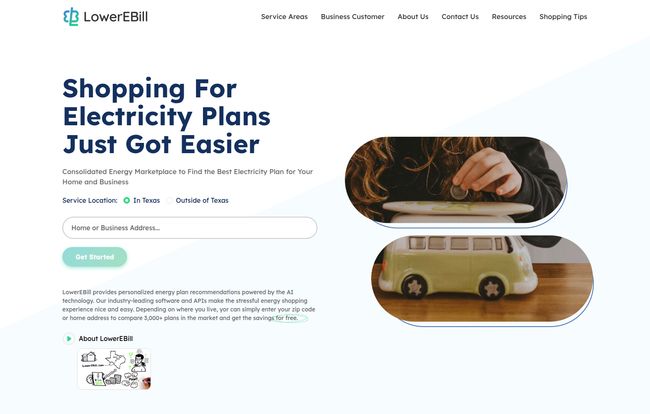
This is where things get interesting. LowerEBill isn’t just another comparison website that lists a bunch of plans. It’s a smart tool designed to be your personal energy analyst. The whole premise is simple: instead of guessing your future usage, it securely connects to your utility provider (like AEP or CenterPoint in Texas) to pull your actual, historical electricity usage data from the past year.
It then takes that real-world data and runs it through its AI model against more than 3,000 available plans. It’s not just looking at the advertised rate. It’s calculating what your total bill—fees and all—would have been on each of those plans, based on your unique consumption habits. The result? A personalized recommendation for the plan that will genuinely be the cheapest for you.
How Does the AI Magic Actually Work?
Think of it like this: trying to pick a plan on your own is like trying to buy a full wardrobe online based on one blurry photo. You have no idea how anything will actually fit.
LowerEBill, on the other hand, is like having a personal tailor who already has all your measurements. It doesn’t guess. It knows. It analyzes your summer AC blasts, your winter heater spikes, and your average daily usage. It sees the real patterns. Then, it crunches the numbers on every confusing, tiered, gimmick-filled plan out there to find the one that fits your usage profile perfectly. It turns a chaotic marketplace into a simple, informed decision. The whole process, they claim, takes just a few seconds. And honestly, from my run-through, they’re not exaggerating much.
My Honest Take: A Hands-On LowerEBill Review
Alright, enough theory. I took it for a spin. I punched in my Texas address, gave it permission to connect to my utility account (which felt a little weird, but I’ll get to that), and waited. In less time than it took to make a cup of coffee, it spat out a list of plans, rank-ordered by my projected annual cost. It even showed me how much I stood to save compared to my current, soon-to-expire plan. A cool $213.61, apparently. Not bad.
The Good Stuff (There’s a Lot of It)
First off, the user experience is clean and simple. No clutter, no confusing jargon. It’s genuinely user-friendly. The biggest win, obviously, is that it’s free. No membership fees, no one-time charges, no credit card required. This immediately lowers the barrier to entry and removes that “what’s the catch?” feeling. The time-saving aspect is immense. What took me a full Saturday with a spreadsheet, LowerEBill did in about 15 seconds. It presents the information clearly, showing you the projected bill for each month on a new plan, so you can see how it performs in high-usage vs. low-usage months. That’s a level of transparency you just dont get from the providers themselves.
Visit LowerEBill
A Few Things to Keep in Mind
No tool is perfect, right? I’d be a bad reviewer if I didn’t point out a few things. First, the whole system hinges on your historical data. If you’ve just moved into a new home, the forecast won’t be as accurate because it has no history to analyze. This is a pretty significant limitation for new movers. Second, the site notes that “the offered plans on our website may not be the only offers available in the market.” This is a nod to transparency, but it’s good to remember they have a curated marketplace. Its a huge marketplace, but maybe not 100% exhaustive. Lastly, for the tech-heads, yes, it requires JavaScript to run. For 99% of people this is a non-issue, but worth mentioning.
Who is This Tool Actually For?
Honestly? Pretty much any homeowner or small business owner in Texas, Ohio, Pennsylvania, Illinois, or Maryland who pays their own electricity bill. If you’re tired of the guessing game, if you suspect you’re overpaying (you probably are), or if your current plan is about to expire, you are the prime candidate. It’s for people who value their time and would rather not get a PhD in energy tariff structures just to keep the lights on.
The Big Question: How is LowerEBill Free?
This is the million-dollar question, isn’t it? In my world, if a service is free, you are often the product. But here, the model seems more straightforward and, frankly, better aligned. Like other comparison sites, LowerEBill likely earns a standard commission from the energy provider when you sign up for a plan through their platform.
But here’s the key difference: their success depends on giving you the right recommendation. Because their whole selling point is finding you the actual cheapest plan, their incentive is to be accurate. If they recommended bad plans, they’d lose trust and users would vanish. So they make money by being a good, honest broker, not by pushing the plan from the provider who pays them the highest commission. It’s a subtle but powerful distinction.
LowerEBill vs. The Government’s ‘Power to Choose’ Site
For Texans, the default is often the state-run Power to Choose website. And let me tell you, it’s a mess. While well-intentioned, it’s easily manipulated by providers who design plans that look good on paper but are terrible in practice. It’s a simple list that can’t account for your personal usage patterns. Comparing the two is like comparing a pocket calculator to a supercomputer. One gives you raw, often misleading numbers, while the other gives you a personalized, actionable answer.
A Quick Look at The Benefits
| Feature | What It Means For You |
|---|---|
| AI-Powered Analysis | No more guesswork. It finds the plan that’s cheapest for your specific usage. |
| Historical Data Integration | Uses your real-world energy habits for an accurate cost forecast. |
| Free to Use | Zero risk. You can check your potential savings without any commitment. |
| Time Savings | Turns hours of frustrating research into a few seconds of waiting. |
Frequently Asked Questions (FAQ)
- Is LowerEBill really free to use?
- Yes, it is 100% free for users. There are no membership fees or hidden charges. They make their money from a standard commission from the energy provider you choose to sign up with.
- What states does LowerEBill operate in?
- As of now, LowerEBill serves deregulated markets in Texas, Ohio, Maryland, Pennsylvania, and Illinois.
- Do I have to switch providers if I use the tool?
- Nope. There’s no obligation at all. You can use it purely as a research tool to see what your options are or to confirm if your current plan is still a good deal. Information is power.
- How does LowerEBill get my usage data? Is it secure?
- It uses a secure API to connect to your utility’s online portal with your permission, similar to how budgeting apps like Mint connect to your bank. It’s a read-only connection to pull your past usage data.
- What if I’m moving to a new house with no usage history?
- This is the main scenario where the tool is less effective. Since its recommendations are based on past usage, it can’t create an accurate forecast for a new property. You could perhaps use it to find generally well-structured plans, but the personalized savings projection won’t be there.
Is It Time to Switch How You Switch?
After diving in, my initial skepticism has turned into genuine appreciation. LowerEBill isn’t a gimmick. It’s a smart application of technology to solve a genuinely frustrating consumer problem. It takes the power away from confusing marketing and puts it back into the hands of the homeowner by using the one thing that matters: your own data.
It won’t solve every problem—new movers are still in a tough spot—but for the vast majority of us who are just trying not to get ripped off on our power bill, it’s a powerful ally. It’s a tool that brings clarity to chaos. And in the wild world of electricity shopping, that’s worth its weight in gold. Or at least, a couple hundred bucks saved per year.


