
Categories: AI Healthcare, AI Image Recognition, AI Medical Diagnosis
Lunit: Is This AI the Future of Cancer Detection?

As someone who spends way too much time tracking trends in tech and traffic, I’ve seen the term ‘AI’ get slapped onto everything. AI-powered toasters, AI-driven marketing copy… you name it. Most of it is just marketing noise. But every once in a while, you stumble upon something that makes you sit up and pay attention. Something that feels… significant.
That’s the feeling I got when I started digging into Lunit. We’re not talking about an AI that helps you choose a movie. We’re talking about an AI designed to look cancer square in the eye and help doctors fight it more effectively. It’s a bold claim, and frankly, I’m a bit of a cynic when it comes to med-tech hype. But the more I looked, the more I realised this might be the real deal.
So, What Exactly is Lunit?
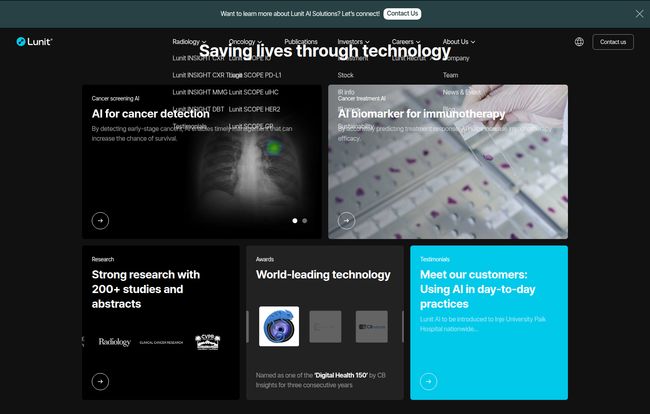
At its core, Lunit is a publicly traded company on a mission to, in their words, “conquer cancer.” A lofty goal, for sure. They do this by developing medical AI software that operates on two main fronts: early detection and treatment optimization. Think of it as having two highly specialized experts on your team.
It’s not just a startup with a cool idea, either. They’re deployed in over 3,800 sites across more than 50 countries. This isn’t a lab experiment; it’s technology being used in the wild, right now.
Visit Lunit
Lunit INSIGHT: The AI That Sees the Invisible
First up is Lunit INSIGHT. This is the detection piece of the puzzle. Imagine a radiologist who has to look at hundreds of chest X-rays or mammograms a day. It’s a monumental task, and the pressure to not miss a single, tiny, life-altering speck is immense. Lunit INSIGHT acts as a second pair of eyes. But these aren’t just any eyes—they’re AI-powered eyes that have been trained on millions of images. It can flag suspicious areas that might be nearly invisible to a human, even a highly trained one. It’s like having a bloodhound that can sniff out the faintest trail of disease. It doesn’t make the diagnosis, but it points the doctor in the right direction and says, “Hey, you might want to look a little closer at this.”
Lunit SCOPE: Predicting the Future of Treatment
Finding the cancer is only half the battle. The other half is figuring out the best way to treat it. That’s where Lunit SCOPE comes in. This tool is for the oncologists. It uses AI to analyze tissue samples and predict how a patient might respond to different treatments, particularly immunotherapy. This is the heart of personalized medicine. Instead of a one-size-fits-all approach, doctors can get data-driven insights to help them choose a therapy that’s more likely to work for that specific individual. It’s a game-changer, potentially saving patients from grueling treatments that wouldn’t have been effective anyway.
The Real-World Impact and Why It Matters
Okay, so the tech sounds cool. But what really gives Lunit its weight are its partnerships and credentials. When a company like Microsoft decides to collaborate with you, people take notice. Add to that names like Guardant, Agfa, and Sectra, and you have a serious ecosystem of trust. This isn’t just about a slick algorithm; it’s about integrating that algorithm into the complex world of healthcare.
They’ve also been named one of CB Insights’ “Digital Health 150,” and they’re not shy about publishing their research. A quick look at their site shows a ton of studies and abstracts. For a data nerd like me, this is gold. It shows they’re willing to have their work scrutinized by the scientific community, which builds a lot more trust than a flashy marketing campaign ever could.
The Good, The Bad, and The Complicated
No tool is perfect, and it would be dishonest to paint Lunit as a flawless silver bullet. Like any powerful technology, it comes with its own set of challenges and considerations.
The Good Stuff
The upsides are pretty clear and incredibly compelling. We’re talking about demonstrably high accuracy in spotting early-stage cancers, which directly translates to better patient outcomes. When cancer is caught early, survival rates skyrocket. It’s that simple. Furthermore, empowering doctors with better data from Lunit SCOPE means more informed, personalized, and effective treatment plans. This is AI in its best form: augmenting human expertise, not replacing it.
The Not-So-Simple Stuff
Now, for the reality check. First, integration is a beast. Hospitals and clinics often run on a patchwork of legacy IT systems. You can’t just airdrop a sophisticated AI platform into that environment and expect it to work. It requires careful planning, resources, and technical know-how.
Then there’s the human element—what I call the ‘Trust Gap’. There’s an ongoing debate in the medical community about how much to trust an algorithm. A 2021 study in Nature Medicine touched on this very issue, highlighting that building confidence between clinicians and AI is critical for adoption. A radiologist with 20 years of experience isn’t just going to blindly accept an AI’s suggestion. And they shouldn’t! Lunit has to act as a reliable partner, and that trust takes time to build. It also means there’s a learning curve. Doctors and technicians might need specialized training to use teh platform to its full potential.
What’s the Price Tag on This AI?
This is the question everyone always asks. And the answer is… it’s complicated. Lunit doesn’t list a price on their website, and that’s not surprising. This isn’t a SaaS tool you buy with a credit card.
Pricing for enterprise-level medical software like this is almost always custom. It would depend on a huge number of factors: the size of the hospital, the number of scans being analyzed, the specific modules needed (INSIGHT, SCOPE, or both), the level of system integration required, and ongoing support. The only way to know for sure is to contact their sales team for a quote tailored to a specific institution’s needs.
My Final Thoughts as an SEO and Tech Watcher
So, where do I land on Lunit? I’m genuinely impressed. In a sea of AI hype, Lunit feels grounded in science and focused on a problem that truly matters. The challenges of integration and trust are real and shouldn’t be underestimated. But they are solvable problems.
This is the kind of AI that gets me excited. It’s not about replacing jobs; it’s about making jobs more effective. It’s about giving one of our most brilliant professions—medicine—a new set of tools to work with. It’s a collaboration between human intelligence and artificial intelligence, and if that isn’t the future, I don’t know what is.
Frequently Asked Questions About Lunit
- What is Lunit’s main goal?
- Lunit’s stated mission is to ‘conquer cancer’ by developing and deploying AI-powered software that assists in the early detection and treatment of various cancers.
- Is Lunit meant to replace radiologists or oncologists?
- Absolutely not. The platform is designed as an assistive tool to augment the skills of medical professionals. It acts as a second reader or a data analysis tool to help them make more informed decisions, not to make decisions for them.
- How does Lunit INSIGHT actually work?
- Lunit INSIGHT analyzes medical images, such as chest X-rays and mammograms, using a deep-learning algorithm. It flags areas that have a high probability of being abnormal, drawing the radiologist’s attention to potential issues that might be subtle or easily missed.
- How does Lunit ensure patient data privacy?
- As a medical technology company, Lunit and its partners must operate under strict data privacy regulations like HIPAA in the United States and GDPR in Europe. All patient data is anonymized and handled with the highest level of security to ensure confidentiality.
- How credible is Lunit’s technology?
- Lunit’s credibility is supported by numerous peer-reviewed studies and abstracts, major partnerships with companies like Microsoft and Agfa, and its use in thousands of medical facilities worldwide.
- Who can use Lunit’s software?
- Lunit’s solutions are designed for medical institutions, such as hospitals, clinics, and diagnostic centers, rather than for individual consumers.


