
Categories: AI Knowledge Management, AI Research Tool, AI Writing Assistants, Whiteboard AI
Lxi.ai Review: A New AI Canvas for Your Brain?

The AI hype train is moving at a thousand miles an hour, and most of us are just trying to hang on. We’ve got ChatGPT for writing, Midjourney for images, and a dozen other tools that are brilliant in their own little boxes. But here’s the problem I keep running into: they’re all disconnected. My research lives in one place (a chaotic folder of PDFs and notes), my brainstorming in another, and my AI assistant is basically a brilliant intern I have to re-brief for every single task. It’s exhausting.
So when I stumbled upon a new tool called lxi.ai, my curiosity was definitely piqued. The landing page didn’t scream “AI writer” or “chatbot.” Instead, it said, “Your Canvas to Collaborate with AI.” A canvas? Now that sounds different. It sounded less like a tool and more like a workspace. Maybe even a solution to my scattered digital brain.
After getting early access and playing around with it for a bit, I’m ready to share my thoughts. Is this the integrated AI workspace we’ve all been secretly hoping for? Let’s find out.
What Exactly is Lxi.ai? (And Why Should You Care?)
Imagine your desk when you’re deep in a project. You’ve got your primary research papers spread out, sticky notes with half-formed ideas, a notepad for scribbling connections, and a super-smart assistant sitting next to you, ready to answer questions about any of the documents you point to. That’s the best analogy for lxi.ai.
At its core, lxi.ai is a platform that combines three powerful ideas:
- A personal knowledge library: You upload your documents—research papers, reports, transcripts, whatever—and it builds a private, searchable library just for you.
- An intelligent query engine: You can ask questions in natural language, and the AI (powered by models like ChatGPT) answers based on the information inside your documents. Crucially, it tells you which documents it used to find the answer. Game-changer.
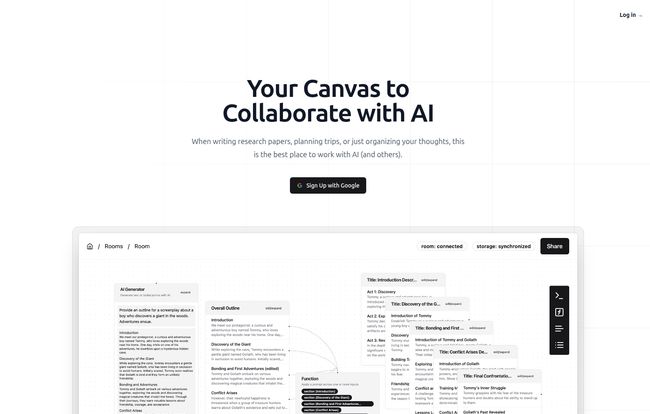
- A collaborative visual canvas: This is the star of the show. It’s a freeform space where you can arrange your thoughts, generate content, and connect ideas visually, almost like a mind map on steroids.
It’s this combination that stops it from being just another AI wrapper. It’s an environment built for deep work and thinking, not just spitting out quick answers.
Visit lxi.ai
The Standout Features: A Hands-On Look
Okay, let’s get into the nuts and bolts. A fancy concept is one thing, but how does it actually work in practice? I found a few features that really stood out during my testing.
Your Personal, Queryable Knowledge Base
The first thing you do is feed the beast. I started by uploading a handful of recent SEO trend reports and some case studies I’ve been meaning to synthesize. The process was straightforward. Once they’re in, they form your personal library. This isn’t just a file dump; it’s an active repository.
I then asked it: “What are the top 3 emerging strategies for B2B content in 2024 based on these reports?” Within seconds, it produced a concise summary. But here’s teh magic part: beneath the answer were little tags indicating it pulled information from ‘Report A.pdf’ and ‘Case Study C.pdf’. For anyone who’s ever had to backtrack and find a source, you know how valuable this is. No more AI hallucinations presented as fact; you can check the receipts.
The Collaborative Canvas: Where the Magic Happens
This is where lxi.ai truly differentiates itself. The canvas is a visual workspace. You can drag in your source documents, create text nodes, and ask the AI to generate content right there on the board. For example, I pulled in two different reports on Google’s SGE (Search Generative Experience) and created a prompt node in between them that said, “Compare and contrast the main arguments of these two documents.”
It generated a new text block on my canvas with a detailed comparison. I could then draw arrows, add my own commentary in another node, and start building out a full-blown article outline right there. It felt less like prompting an AI and more like a true brainstorming partner.
They also tout real-time collaboration. I can see this being incredible for agency teams or research partners. You could literally see your teammate’s cursor moving, adding ideas to the canvas while you prompt the AI to flesh out another section. It’s like Miro meets Google Docs meets your own personal AI researcher.
Function Nodes: Automating the Grunt Work
This feature is a bit more advanced but incredibly powerful. A “Function Node” lets you apply the same prompt across multiple inputs at once. Think about the repetitive tasks you do. Summarizing ten articles? Analyzing sentiment from twenty customer reviews? Instead of doing them one by one, you can set up a function node to do it all in a single click. It’s a massive time-saver for anyone working with data at scale.
The Real-World Experience: What’s It Actually Like to Use?
So, does it live up to the promise? For the most part, yes. The core concept is solid and, when it works, it feels like a glimpse into the future of knowledge work.
However, it’s important to remember this is a tool in its infancy. The site says it’s in early access, and you can feel it. It has a few rough edges. Things can be a little slow at times, and I even hit a 404 page when I was trying to find more info on their future plans. But that’s to be expected with a beta product, right? It shows it’s being actively built, not just a polished but static piece of software.
There are also the bigger questions to consider. Uploading proprietary or sensitive documents to any third-party platform requires a level of trust. You have to be comfortable with their data policies. And of course, there’s the perennial fear that relying too heavily on AI to synthesize information for us might make our own critical thinking muscles a bit flabby. My take? It’s a copilot. It’s there to find the connections and do the heavy lifting, but you’re still the one who has to fly the plane.
Lxi.ai Pricing: How Much Does It Cost?
Here’s the million-dollar question. As of right now, lxi.ai does not have public pricing information available.
This is pretty standard for a platform in an “early access” or beta phase. They’re likely focused on gathering user feedback and refining the product before rolling out paid tiers. Currently, you can sign up on their website to request access. I’d expect them to introduce a freemium or tiered subscription model down the line, similar to other SaaS tools in the productivity space.
Who is Lxi.ai For? (And Who Should Skip It?)
This isn’t a one-size-fits-all tool. Based on my experience, here’s who I think will get the most out of it:
- Researchers and Academics: The ability to query a library of papers and have sources cited is a dream come true for literature reviews.
- Content Strategists and SEOs: Perfect for synthesizing trend reports, competitor analysis, and SERP data into actionable strategies.
- Students: An incredible study aid for organizing notes and research for a thesis or big project.
- Product Managers and UX Researchers: Great for clustering user feedback, interview transcripts, and market research on a collaborative canvas.
Who might want to hold off? If you just need a quick AI to write a social media post or an email, this is probably overkill. It’s built for deeper, more complex work involving multiple sources of information.
A Promising, If Imperfect, Glimpse of the Future
So, my final verdict? Lxi.ai is one of the most interesting new AI tools I’ve seen this year. It’s not just another chatbot. It’s an ambitious attempt to build a truly integrated thinking environment. The visual canvas is the secret sauce, turning the abstract process of research and synthesis into something tangible and collaborative.
It’s still a bit raw, a bit unfinished. But I’d rather have a brilliant and slightly imperfect concept than another polished but uninspired AI writer. Lxi.ai feels like it’s on to something big. It’s a tool that respects the messiness of the creative process and offers a way to bring a little AI-powered order to the chaos. I, for one, will be keeping a very close eye on it.
Frequently Asked Questions about Lxi.ai
- What is lxi.ai?
- Lxi.ai is an AI-powered platform that acts as a collaborative visual canvas. It allows you to upload documents, build a personal knowledge library, and use AI to ask questions, generate content, and organize your ideas in a shared workspace.
- Can I collaborate with my team on lxi.ai?
- Yes, real-time collaboration is a key feature. You and your teammates can work on the same canvas simultaneously, seeing each other’s changes as they happen, making it ideal for team projects.
- Is lxi.ai free?
- Currently, lxi.ai is in an early access beta phase, and pricing has not been publicly announced. You can request access on their website. It’s likely they will introduce subscription plans in the future.
- How does lxi.ai handle my data and privacy?
- As with any platform where you upload documents, you should review their privacy policy. Since it’s in beta, users should be mindful of uploading highly sensitive or proprietary information until the platform is more established.
- What makes lxi.ai different from just using ChatGPT?
- The main difference is the context and workspace. ChatGPT’s knowledge is general and its memory is limited to a single conversation. Lxi.ai creates a persistent library from your documents and lets you work with that specific information on a visual canvas, citing its sources from your uploads.
- Is lxi.ai difficult to learn?
- The basic features like uploading documents and asking questions are very intuitive. The visual canvas might have a slight learning curve if you’re not used to mind-mapping or whiteboard tools, but its visual nature makes it fairly easy to pick up.
Reference and Sources
- Lxi.ai Official Website: https://lxi.ai/


