
Categories: AI Course, AI Developer Tools, AI For Finance, AI Stock Trading, Large Language Models (LLMs)
Lycee AI Review: Is This the Future of AI Learning?

The AI learning space is noisy. Insanely noisy. Every other day, a new ‘guru’ pops up with a course promising to help you ‘master’ AI by tomorrow. Most of it, if we’re speaking candidly, is just rehashed fluff about prompt engineering. It’s useful, sure, but it’s becoming the baseline.
So, when I stumbled upon Lycee AI, something felt… different. The tagline wasn’t about just using AI; it was about learning, practicing, and mastering it. And when I looked at the courses, I didn’t just see the usual suspects. I saw things like DSPy, RAG, and FastAPI. My curiosity was definitely piqued.
For years, I’ve been on the front lines of SEO and traffic generation, watching technologies come and go. I’ve seen what separates the fads from the fundamentals. The real value, the real career growth, comes from getting your hands dirty and building things. So, is Lycee AI just another platform in the crowd, or is it a genuine workshop for the next generation of AI developers and architects? Let’s take a look.
So, What Is Lycee AI, Really?
On the surface, Lycee AI calls itself a learning management system (LMS). But that feels a bit too corporate and sterile for what it seems to be. To me, Lycee AI feels less like a sprawling university library and more like a specialist’s workshop. You don’t go there for a general education on the history of neural networks; you go there to learn how to forge a specific, powerful tool that can actually do something.
The whole vibe is geared towards improving productivity by building, not just by prompting. It’s a subtle but massive distinction. It’s the difference between learning to drive a car and learning how to build an engine.
Visit Lycee AI
A Peek Inside the Course Catalog
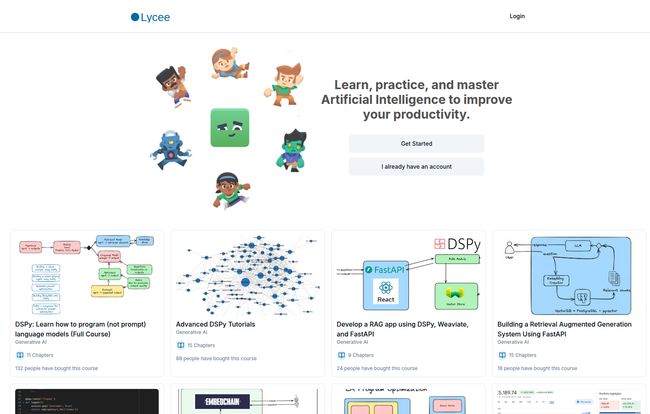
This is where things get interesting. The course list reads like a what’s-what of modern, practical AI development. It’s not just theory; it’s a collection of project-based blueprints.
The Heavy Hitters: DSPy and RAG
Right away, the focus on DSPy (which stands for Declare, Self-improve, and Program over a set of models, for the uninitiated) stands out. If you’ve been in the AI trenches lately, you know the industry is having a quiet debate. Is the future in crafting ever-more-complex prompts (prompt engineering), or is it in programming language models in a more structured, reliable way? DSPy, a framework from Stanford, is the champion of the latter. It aims to make LLM applications less brittle and more systematic. Lycee offering a full course on “how to program (not prompt)” language models is a bold statement, and I am here for it.
Then you’ve got several courses on RAG, or Retrieval-Augmented Generation. This is arguably one of the most important patterns in GenAI right now. It’s how you get chatbots and AI assistants to use your own up-to-date data, rather than just relying on their old, generic training. Seeing courses on building RAG systems with tools like FastAPI and Weaviate tells me Lycee understands what professional developers need to build production-ready apps.
Practical Projects and Even a Side Hustle
Beyond the core frameworks, there are courses like “Building AI Applications with Flask” and, get this, “How I Made Money On The Stock Market Using AI.” I have to admit, that last one made me chuckle. It’s bold, a little clickbaity maybe, but it also speaks to the platform’s core ethos: using AI to get tangible results. It shows an awareness that many people learning these skills are looking for a direct ROI, whether that’s a better job or a new revenue stream.
The Things I Genuinely Like About Lycee AI
After poking around, a few things really jumped out at me as major positives. It’s not just the course topics, but the philosophy behind them.
- A Focus on Real-World Application. This isn’t academic naval-gazing. Every course title suggests an action, a project, a thing you will build. In our world of SEO and digital business, talk is cheap. It’s the people who can execute and ship that win. This platform seems built for them.
- Cutting-Edge and Niche Topics. Honestly, finding a comprehensive DSPy tutorial can be a pain. You’re usually stuck patching together documentation, a few blog posts, and maybe a YouTube video. Lycee is one of the first platforms I’ve seen to centralize this knowledge into a structured course. That’s a huge time-saver and shows they are on the pulse of the developer community.
- It Respects Your Intelligence. The platform isn’t afraid to be technical. It assumes a certain level of knowledge for its more advanced courses, which is a good thing. It means the content isn’t dumbed down for mass appeal, which often renders it useless for those who are serious about learning.
A Few Things to Keep in Mind
No platform is perfect, and there are a couple of points worth considering before you jump in. These aren’t necessarily deal-breakers, but you should be aware of them.
First, the big one: Where’s the pricing? The site doesn’t make it obvious how much these courses cost or if there’s a subscription model. This lack of transparency is a bit of a pet peeve of mine. Is it free? Is it pay-per-course? Is it an enterprise-only thing? My gut tells me its a new platform still figuring things out, but it’s a friction point that needs to be addressed.
Second, as I mentioned, this might not be for absolute beginners. If you don’t know what Python is, a course on building a RAG app with FastAPI is going to feel like drinking from a firehose. This is a strength for its target audience, but a potential barrier for others. Set your expectations accordingly.
Finally, there’s the social proof. The number of people who have bought each course is listed, and the numbers are… modest. We’re talking dozens, not thousands. Now, you can look at this in two ways. The cynical view is that nobody is using it. My view? It feels more like we’re looking at a hidden gem. A platform in its early days, before it gets flooded. Getting in now could be like being an early adopter of a tool that blows up later.
So, Who Is Lycee AI Actually For?
After my analysis, I have a pretty clear picture of the ideal Lycee AI student.
This platform is tailor-made for:
- The Python developer who wants to pivot into a serious AI/ML engineering role.
- The data scientist who needs to get up to speed on the latest LLM application frameworks like DSPy.
- The tech entrepreneur or product manager who needs to genuinely understand how modern AI is built to lead their teams effectively.
- The freelancer or consultant who wants to offer high-value, cutting-edge AI development services.
Who is it not for? Probably the marketing manager who just wants to learn a few tricks for ChatGPT. And that’s okay! There are hundreds of other resources for that. Lycee AI knows its audience, and it’s unapologetically technical.
My Final Thoughts on Lycee AI
So what’s the verdict? I’m cautiously optimistic. I’m genuinely excited, even. Lycee AI appears to be a much-needed resource in a sea of superficial content. It’s a platform for builders, for people who want to move beyond the hype and learn the craft of creating robust, practical AI applications.
The focus on relevant, slightly-ahead-of-the-curve technologies like DSPy is a massive green flag for me. It shows the creators are practitioners, not just marketers. While the lack of clear pricing and the low user numbers are things to watch, they don’t detract from the quality and relevance of the content on offer. It feels like a platform with a strong point of view, and in the noisy world of AI education, that’s incredibly refreshing.
Frequently Asked Questions
- 1. What is Lycee AI?
- Lycee AI is an online learning platform focused on teaching practical, hands-on artificial intelligence skills. It offers courses on building AI applications using modern frameworks like DSPy and RAG, aimed at developers and technical professionals.
- 2. Is Lycee AI suitable for beginners?
- It depends on your definition of a beginner. If you are new to AI but have a background in programming (especially Python), you’ll likely find the courses manageable. If you have no coding experience, you might find the content too advanced.
- 3. What makes Lycee AI different from other AI course platforms?
- Its main differentiator is the focus on programming and building systems, rather than just prompt engineering. It covers cutting-edge, developer-centric frameworks like DSPy, which are not yet widely taught on other major platforms.
- 4. What is DSPy and why is it featured so prominently?
- DSPy is a framework from Stanford University for programming—not just prompting—language models. It helps developers build more reliable and systematic AI applications. Lycee AI’s focus on it suggests a commitment to teaching professional, production-level AI development skills.
- 5. How much do the courses on Lycee AI cost?
- As of this review, pricing information is not clearly available on the website. This is a key piece of information that prospective users will need to find out by signing up or contacting them.


