
Categories: AI App Builder, AI Code Assistant, AI Code Generator, AI Developer Tools, AI Website Builder, No-Code&Low-Code
MarsX Review: Build SaaS Faster with AI & Low-Code?

Okay, let’s have a real chat. In the world of SaaS and app development, we’re all chasing the same thing: speed. How quickly can we get a viable product from a caffeine-fueled idea to the hands of actual, paying users? For years, the answer was a long, winding road paved with custom code, overflowing bug trackers, and the ghosts of frameworks past. I’ve been there, knee-deep in PHP and project management tools, watching deadlines fly by.
Then the low-code and no-code revolution happened. It promised to democratize development, and for many, it did. But often, you’d hit a wall. A ceiling you couldn’t break through without… well, without going back to that long, winding road of code.
So when I first heard about MarsX, I’ll admit I was skeptical. Another platform promising the best of both worlds? Sure. But the more I looked into it, the more I realised this might be different. It’s not just another drag-and-drop builder; it’s a whole ecosystem that tries to blend AI, No-Code, and good old-fashioned Code into one surprisingly coherent package.
So, What Exactly is MarsX?
Imagine you’re building a house. Instead of milling the lumber, forging the nails, and weaving the electrical wires yourself, you go to a massive depot where you can grab pre-built, high-quality modules. You need a kitchen? Here’s a complete kitchen block. A bathroom? Snap this one in. You still design the layout, connect everything, and paint the walls your favorite shade of ‘millennial grey’, but you’re not starting from scratch. You’re assembling, not manufacturing.
That’s the core idea behind MarsX. It’s an AI-powered low-code platform built around the concept of “Micro-Apps.”
These aren’t just little UI widgets. We’re talking about complex, functional components like a complete social network feed, a video streaming service, or an NFT marketplace. You can grab these pre-built modules and stitch them together to form the backbone of your application. This frees you up to focus on what makes your project unique, rather than spending three months building a login system for the hundredth time.
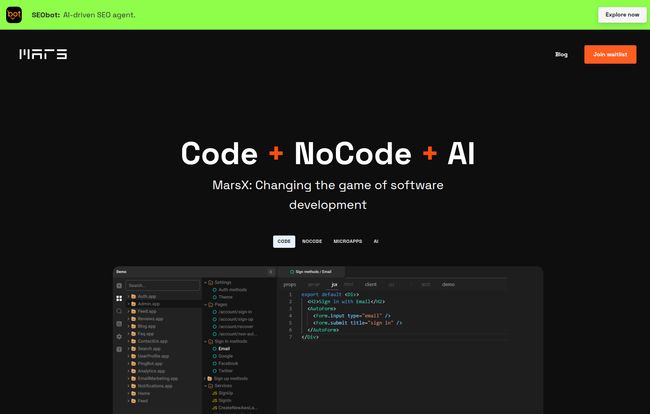
Visit MarsX
The Real Powerhouse: The Micro-App Marketplace
This is where things get really interesting from a business and community perspective. MarsX isn’t just building these micro-apps themselves. They’ve created a marketplace. This means any developer can build a functional micro-app and publish it for others to use. Some are free, others are premium.
Think of it like the WordPress plugin repository or the Shopify App Store, but for core application functionalities. This has a two-sided benefit:
- For Builders: You get access to a massive, ever-growing library of tools built by thousands of developers. Need a feature? There’s a good chance someone has already built a solid 80% of it for you. This dramatically cuts down on development time.
- For Developers: It’s a revenue stream! If you’re skilled at building a specific type of functionality, you can package it as a micro-app and generate income as other people build their businesses on top of your work. It’s a clever way to foster a community that actively contributes to the platform’s power.
A Smooth On-Ramp from No-Code to Full-Code
Here’s the part that really caught my attention as someone who has felt the limitations of pure no-code tools. MarsX isn’t a walled garden. It’s designed to be a launchpad. You can start by visually assembling micro-apps with their no-code interface, getting your MVP out the door in days, not months.
But when you need to get your hands dirty? You can. MarsX includes a full-stack IDE (Integrated Development Environment) and uses Git for version control. This means you can seamlessly transition from clicking buttons to writing custom code. You can pop the hood on a micro-app, tweak its logic, or build entirely new custom features right alongside the pre-built components. This flexible approach avoids the dreaded “no-code ceiling” where your project’s growth is permanently capped by the platform’s features. It grows with you. A pretty neat trick.
Let’s Talk Money: The MarsX Pricing Structure
Alright, the all-important question: what’s this going to cost me? The pricing model is refreshingly straightforward, which I appreciate. No confusing credit systems or per-user fees that scale into oblivion.
Based on their site, there are two main tiers:
| Plan | Cost | Best For |
|---|---|---|
| Free | $0 / month | Startups, solo founders, and those testing out ideas. It includes the cross-platform server, database, CMS, open-source micro-apps, and you can even deploy on your own server. It’s genuinely a free start. |
| Enterprise | Custom | Established businesses or complex projects needing more horsepower. This gets you everything in the free plan plus dedicated support, and they’ll even help match you with vetted Mars developers. |
The free tier is incredibly generous and removes any barrier to entry. The real cost will come from any premium micro-apps you choose to use from the marketplace, which is a fair, usage-based model.
The Good, The Bad, and The Codey
No tool is perfect. Let’s break down the reality of using MarsX, based on its features and the nature of these kinds of platforms.
The Upsides are Pretty Clear
The speed is the obvious win. The ability to assemble a complex SaaS application in a fraction of the traditional time is a huge advantage. The open-source engine is another massive plus in my book. One of the biggest fears with any platform-as-a-service is vendor lock-in. What happens if the company pivots, or gets acquired, or jacks up their prices? With MarsX, because it’s open-source and you can host it yourself, you retain control of your project. You’re not trapped. That peace of mind is invaluable. The flexibility to go from no-code to full-code is, as I’ve said, its killer feature.
Some Potential Hurdles to Consider
Of course, there are trade-offs. The no-code aspect is heavily reliant on the quality and availability of micro-apps in the marketplace. If a specific, niche function you need doesn’t exist as a micro-app, you’re going to have to build it yourself. This isn’t necessarily a con, but it’s a reality check. Also, the quality of these community-built apps can vary. You’ll need to do your due diligence. And while the core platform is free, building a truly complex app will likely involve purchasing some premium micro-apps, so you need to budget for that. Lastly, for those who want to dig into the code, there will be a learning curve associated with the Mars IDE and understanding its specific architecture. It’s not just standard React or Vue, it’s its own environment.
So, Who is This Really For?
I see MarsX fitting a few key profiles perfectly:
- The Scrappy Entrepreneur: You have a brilliant SaaS idea but not a six-figure development budget. MarsX lets you build a functional, scalable MVP for next to nothing.
- The Agile Developer/Freelancer: You build apps for clients. MarsX could be a secret weapon, allowing you to deliver complex projects on tight timelines and budgets, increasing your profitability.
- The Tech-Savvy Founder: You might not be a hardcore coder, but you understand logic and architecture. You can use the no-code layer to build most of your product and then hire a Mars developer for the custom-coded parts.
It’s probably not for the massive enterprise that already has a deeply entrenched, decade-old tech stack. But for anyone building new things in today’s fast-paced environment, it’s a very compelling option.
Frequently Asked Questions about MarsX
1. Is MarsX a No-Code or a Code platform?
It’s both. It’s designed as a hybrid. You can start with a completely no-code, visual approach by assembling micro-apps, and then switch to its built-in code IDE when you need to add custom logic or modify components. It’s a spectrum, not a binary choice.
2. Why is MarsX better than traditional coding like PHP or RoR?
“Better” is subjective, but the main advantage is speed and reusability. With MarsX, you’re not rebuilding common features like user authentication or payment gateways from scratch for every project. The micro-app approach saves hundreds of hours, letting you focus on your unique business logic.
3. Who owns the data I put into an app built on MarsX?
You do. According to their FAQ and open-source model, you have full ownership of your data. You can deploy the application on your own server, giving you complete control over your database and user information.
4. Can I really make money with MarsX?
Yes, in two primary ways. The first is by building and selling your own SaaS application on the platform. The second, which is unique to MarsX, is by developing and selling your own micro-apps on their marketplace for other builders to use.
5. Is there a big learning curve?
It depends on your goal. If you’re sticking to the no-code side and using existing micro-apps, the learning curve is relatively gentle. If you plan to dive into the Mars IDE and create complex, custom code, you’ll need to invest time in learning the platform’s specific architecture, just as you would with any new framework.
Final Thoughts: A Launchpad, Not Just a Tool
After spending years in the SEO and traffic generation space, I’ve seen countless tools that promise to be the next big thing. Very few actually stick. MarsX has my attention because it’s not just a tool; it’s an ecosystem. It addresses the single biggest bottleneck in launching a new digital product—development time—without painting you into a corner.
The combination of a modular, micro-app architecture with the freedom of an open-source, full-code environment is a powerful one. It feels less like a restrictive builder and more like a powerful launchpad for your next big idea. It’s defintely worth a look, especially with that generous free plan.


