
Categories: AI Agent, AI Assistant, AI Chatbot, AI Developer Tools, AI Knowledge Management, Large Language Models (LLMs)
MemoriPy: Give Your AI a Human-Like Memory (Review)

You’re deep in a conversation with a chatbot, you’ve explained your issue five different ways, and you feel like you’re finally making progress. Then you ask a follow-up question, and… poof. It’s gone. The AI has no earthly idea who you are or what you were just talking about. It’s like having a conversation with Dory from Finding Nemo. Frustrating, right?
For years, this statelessness has been the Achilles’ heel of so many AI applications. We have these incredibly powerful Large Language Models (LLMs) that can write poetry and code, but they can’t remember that you prefer your pizza with pineapple (you monster). This is not just a user experience problem; it’s a huge drain on resources. Every single time you interact, you’re often sending the entire conversation history back to the API, which costs time and, more importantly, money. Lots of it.
I’m always on the lookout for tools that tackle these core problems in a smart way. And recently, I stumbled upon a project that made me sit up and pay attention. It’s called MemoriPy, and it’s an open-source AI memory layer that claims to give your AI agents a human-like memory. A bold claim. So, of course, I had to take a look.
So, What Exactly Is This MemoriPy Thing?
At first glance, you might think, “Oh, it’s just a vector database.” But that’s not quite right. While it uses similar concepts, MemoriPy is designed to be a complete memory layer. Think of it less as a filing cabinet and more like a functional hippocampus for your AI. It’s a dedicated system for managing both short-term and long-term memories, allowing an AI to build context over time.
It’s an open-source project, which is always a plus in my book, built by developers for developers. The whole point is to stop building AI that resets every five seconds and start creating context-aware, intelligent assistants that actually learn and adapt. The kind of assistant that remembers you hate cilantro and won’t suggest it in a recipe. Now that’s progress.
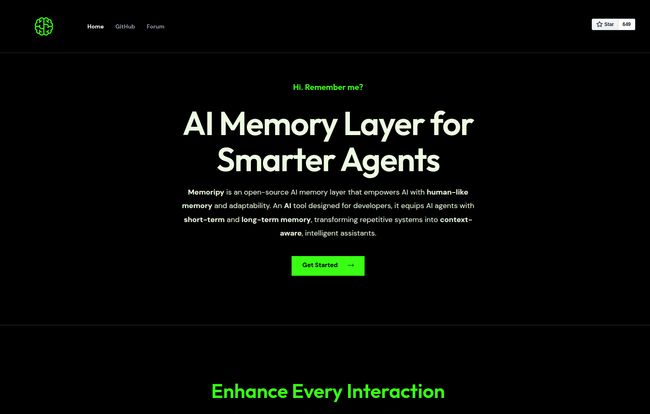
Visit MemoriPy
The Big Wins: Why This Should Be on Your Radar
Okay, so it gives AI a memory. Cool. But what does that actually mean for you, the person building the thing? This is where it gets really interesting.
Finally, Conversations That Don’t Drive You Insane
This is the most immediate and obvious benefit. With MemoriPy, a support bot can remember your previous interactions. You won’t have to repeat your ticket number or the issue you faced last Tuesday. A personal AI assistant can learn your preferences over time—your favorite music genres, your go-to lunch spots, the fact that you have a meeting every Friday at 10 AM. It shifts the AI from a simple Q&A machine to a genuine conversational partner. It’s the difference between asking a stranger for directions every day and having a friend who already knows your commute.
Your Wallet Will Thank You: Slashing LLM Costs
This one is huge. I’ve seen projects where the OpenAI bill gets out of control fast because of massive context windows. Every turn in a conversation means re-sending a huge chunk of text. MemoriPy tackles this head-on. By storing and intelligently retrieving only the most relevant pieces of information from its memory, it drastically cuts down on the number of tokens you need to send with each API call. It’s a smarter, more surgical approach. Instead of handing the LLM a 500-page book for one tiny fact, MemoriPy finds the right page and just hands that over. The cost savings here could be substatial.
Sharpening the AI’s Mind with Clustering and Decay
This is where the real secret sauce is. MemoriPy isn’t just dumping information into a bucket. It uses two clever concepts: semantic clustering and memory decay.
- Semantic Clustering: It groups related ideas and memories together. So, if you talk about ‘car maintenance’, ‘oil changes’, and ‘new tires’, MemoriPy understands these are all part of the same concept cluster. When you later ask about ‘fixing my vehicle’, it knows exactly which cluster of memories to pull from.
- Memory Decay: Just like humans, AIs shouldn’t remember everything forever. The fact that you searched for a cat meme two years ago is probably not relevant to your business query today. MemoriPy has an optional decay feature that lets old, irrelevant memories fade away, keeping the AI’s knowledge base clean and pertinent. It’s like tidying up its mental workspace.
Getting Your Hands Dirty with MemoriPy
For the devs in the room, this is probably what you’re waiting for. The good news is, getting started seems refreshingly simple. The homepage proudly displays the command:
pip install memoripy
You gotta love that. They also claim “Effortless Integration” with popular platforms like OpenAI and Ollama, which covers a huge portion of the AI development landscape. This isn’t some obscure tool that requires a complete overhaul of your stack. It’s designed to slot right into your existing workflow, which is a massive consideration for any new tool adoption.
Also Read: Third Garden Review: An AI Swiss Army Knife?
Real-World Applications: Where This Could Actually Work
The use cases presented are pretty compelling and realistic. I’m already picturing a few projects where this would have been a lifesaver.
| Use Case | How MemoriPy Helps |
|---|---|
| Support Bots | Remembers a user’s entire support history across multiple sessions, leading to faster resolutions and less customer frustration. |
| Personal Assistants | Evolves with the user, learning their habits, preferences, and schedule to provide truly personalized help. No more re-explaining yourself. |
| Learning Agents | For autonomous systems that need to learn from every interaction to improve their performance over time. Think AI agents in games or simulations. |
| Smart Retail | Builds a rich profile of a customer’s tastes to offer recommendations that are genuinely helpful, not just based on the last item they clicked. |
I could even see this being amazing for internal knowledge base bots. Imagine an HR bot that remembers you already completed your compliance training and doesn’t nag you about it every single week.
The Other Side of the Coin: A Quick Reality Check
Alright, let’s ground ourselves for a second. As exciting as MemoriPy is, it’s not a magic wand. The project itself is upfront about a few things. Firstly, this is a tool for developers. You’ll need some coding knowledge to implement it. This isn’t a no-code, drag-and-drop solution.
Secondly, its effectiveness hinges on two things: the quality of your data and your implementation. Garbage in, garbage out, as they say. You’ll likely need to do some fine-tuning to get it working perfectly for your specific use case. This is standard for any powerful tool, but it’s worth mentioning.
Also, in the spirit of full transparency, while exploring their site, I clicked on a few links that led to a “This page doesn’t seem to exist” page. It’s a small thing, and pretty common for newish open-source projects, but it’s a reminder that it’s a living project, likely maintained by a small, passionate team. It has that authentic, still-under-construction vibe, which I honestly find more charming than a slick corporate facade that never breaks.
So, What’s the Price Tag?
This is often the million-dollar question. With MemoriPy, the answer is… well, it’s open-source. That generally means it’s free to use, modify, and integrate into your own projects (though you should always check the specific license on their GitHub). I couldn’t find a pricing page—in fact, that might have been one of the broken links I hit—so there don’t appear to be any paid enterprise tiers at the moment. For developers and startups, this is fantastic news.
Frequently Asked Questions about MemoriPy
Is MemoriPy free to use?
Yes, MemoriPy is an open-source project. This means it’s typically free to use in your applications, but it’s always best to check the license details on their official GitHub repository for specifics on commercial use.
What kind of AI models does it work with?
MemoriPy is designed for flexible integration and works with major platforms like OpenAI’s models (e.g., GPT-4), Ollama for running local LLMs, and others. Its architecture is meant to be adaptable.
How is MemoriPy different from a standard vector database?
While a vector database is a component for storing and retrieving vectorized data, MemoriPy is a more comprehensive memory layer. It includes not just storage but also logic for short-term vs. long-term memory, semantic clustering of concepts, and optional memory decay, creating a more dynamic and human-like memory system.
Do I need to be an expert developer to use it?
You’ll need a solid understanding of Python and experience working with AI/LLM APIs. It’s not for absolute beginners, but if you’ve built a basic application with an LLM before, you should be able to get the hang of it by following their documentation.
Can it be used for small personal projects?
Absolutely. Because it’s open-source and helps manage costs, it’s a great tool for hobbyists and developers working on personal projects who want to add a layer of sophistication without a huge budget.
Where can I find the official documentation?
The best place for the latest information, documentation, and source code is the official MemoriPy GitHub page. You can also check their main website at memoripy.ai.
My Final Thoughts on MemoriPy
So, is MemoriPy the cure for AI amnesia? I think it’s a massive step in the right direction. It’s a smart, developer-focused tool that tackles a real, expensive problem. It’s not just about making chatbots less annoying; it’s about making AI more efficient, more intuitive, and ultimately, more useful.
The open-source nature makes it incredibly accessible, and its focus on practical features like cost reduction and intelligent memory management shows that the creators understand the real-world challenges of AI development. It may have a few rough edges, like any growing project, but the core idea is solid gold. If you’re a developer tired of building forgetful AI, I’d say giving MemoriPy a try is a no-brainer. You might just build something that actually remembers your name tomorrow.
Reference and Sources
- MemoriPy Official Website: https://memoripy.ai/
- MemoriPy on GitHub: https://github.com/MemoriPy/MemoriPy


