
Categories: AI Agent, AI Code Assistant, AI Code Review, AI Developer Tools, AI Github, AI Productivity Tools, AI Project Management, AI Report Generator, AI Workflow
Mendel Review: This AI Code Review Tool Worth the Hype?

Code reviews can be a drag. It’s that part of the development cycle where momentum slows to a crawl, bottlenecked by that one senior dev who has to meticulously comb through every pull request. We’ve all been there—waiting days for a simple ‘LGTM’, staring at a PR that’s getting stale, or worse, merging something with a subtle bug because everyone was too swamped to give it a proper look. It’s a systemic problem that has plagued engineering teams for years.
I’ve seen it a million times. The more a team scales, the worse the PR bottleneck gets. You either sacrifice speed or you sacrifice quality. There’s rarely a happy middle ground. So when I heard about Mendel, an AI-powered platform that calls itself an “engineering workflow enhancer,” my professional curiosity was definitely piqued. Another AI tool promising to solve all our problems? Color me skeptical but intrigued.
But Mendel isn’t just another linter on steroids. It claims to be an agentic AI, a sort of autonomous reviewing agent for your team. A bold claim. So, I decided to take a closer look, dig into its features, and figure out if this is just more marketing fluff or a genuinely useful tool for fast-moving teams. Here’s what I found.
So, What Exactly Is Mendel Anyway?
At its core, Mendel is a code intelligence platform. That’s a fancy way of saying it uses AI to read and understand your code. But its mission is very specific: to automate the grunt work of pull request (PR) reviews. Think of it as a tireless, hyper-caffeinated junior dev who lives to check for complexity, flag compliance issues, and ensure the code is clean and secure, freeing up your senior engineers to focus on the big architectural puzzles.
The tagline on their site is “Backend of better code,” and that really hits the nail on the head. It’s not about writing the code for you, like a GitHub Copilot might. It’s about improving the quality and security of the code that’s already been written, before it gets merged into your main branch. It hooks right into your Git workflow (GitHub, GitLab, etc.) and acts as a new team member that never sleeps, never complains, and never gets tired of pointing out potential issues. This isn’t just about catching typos; it’s about providing a deeper analysis of the code’s health and maintainability.
Visit Mendel
The Features That Actually Caught My Eye
A tool is only as good as its features, right? Mendel has a bunch, but a few stood out to me as genuinely game-changing for a modern development team.
Automated Pull Request Reviews That Don’t Suck
This is Mendel’s bread and butter. Once a developer opens a PR, Mendel’s AI gets to work. It scans the changes for potential bugs, security vulnerabilities, and code that’s just… well, overly complicated. We all know that one function that looks like a bowl of spaghetti. Mendel flags that stuff. It even suggests fixes, which is a nice touch.
What I find particularly slick is the Slack Thread Integration. Instead of having to live inside your Git platform, the review conversation happens right in Slack. It creates a thread for each PR, summarizing its findings. This makes the review process feel more conversational and less like a formal, rigid process. It keeps the communication flowing where the team already is, which is a small but brilliant piece of UX design.
Turning Code Activity into Real, Actionable Insights
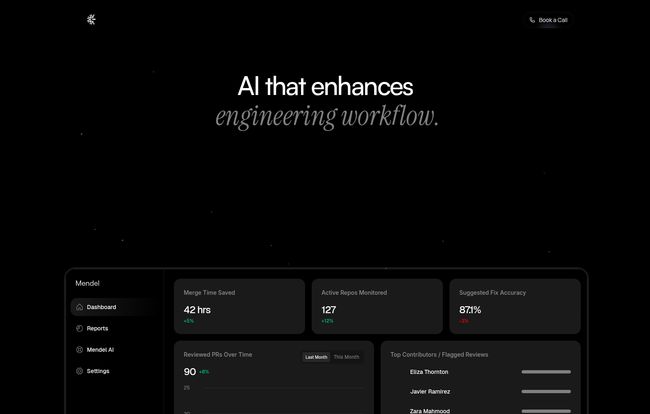
Okay, this is the part that gets the engineering manager in me excited. Mendel doesn’t just review code; it analyzes the entire engineering process. The dashboard shows metrics like:
- Time to Review: How long are PRs sitting idle?
- Rework Ratio: How much code is being rewritten after the initial review?
- Merge Intelligence: Who are your most effective reviewers? Who are the top contributors?
These aren’t just vanity metrics. A high ‘Rework Ratio’ might mean your initial requirements are unclear. A long ‘Time to Review’ is a direct indicator of a bottleneck. For years, managers have been trying to cobble this data together from different sources. Having it all in one place, automatically generated from your team’s actual activity, is incredibly powerful for spotting problems and improving team performance without being a micromanager.
More Than Just Code: Compliance and Dependency Checks
In today’s world, especially for companies in finance or healthcare, compliance isn’t optional. Mendel’s Smart Dependency & Compliance Checker is a huge deal. It automatically scans for dependencies with known vulnerabilities or licensing issues that could get your company in hot water. This is the kind of boring, tedious work that often gets overlooked in the rush to ship features, but it’s critically important. Automating it is a massive win for risk management.
My Honest Take: The Good, The Bad, and The AI
No tool is perfect. After poking around and thinking through the implications, here’s my balanced take on where Mendel shines and where you might hit a few bumps.
The Wins (What I Really Liked)
The biggest pro is the sheer amount of time and mental energy it saves. Automating the first pass of a code review is a phenomenal productivity booster. It lets human reviewers focus on the logic and architecture, not on whether someone used tabs instead of spaces or wrote a convoluted loop. It also standardizes the review process, which is great for growing teams. Everyone gets the same level of scrutiny from the AI, which helps establish a consistent quality bar.
And I have to say it again, the engineering metrics are a goldmine. Being able to visualize bottlenecks and team dynamics with actual data is something most managers dream of. It moves performance conversations from “I feel like we’re slowing down” to “Our average review time has increased by 15%; let’s figure out why.”
The Hurdles (Things to Watch Out For)
Of course, there are some potential downsides. Like any powerful tool, there’s an initial setup phase to connect it to your repositories and configure it to your team’s standards. This isn’t a magic wand you can just wave.
Also, let’s talk about the AI itself. The accuracy of its suggested fixes might vary. An AI, however smart, lacks human context. It might flag something as overly complex that is necessarily so because of a weird business requirement. It’s an assistant, a co-pilot, not the pilot. You can’t just blindly accept every suggestion. My biggest concern, though, is a philosophical one. Over-reliance on an AI reviewer might reduce those crucial teaching moments where a senior dev explains the why behind a change to a junior dev. That human mentorship is invaluable, and teams should be mindful not to let an AI replace it completely. It should augment, not amputate, human interaction.
So, What’s the Damage? Mendel’s Pricing
This is the part of the review where I’d normally break down the pricing tiers and tell you if it’s a bargain or a budget-buster. But here’s a curveball: as of this writing, their pricing page appears to be broken or unavailable. I was met with a classic “Page Not Found” error.
While that’s a bit of a letdown, it’s not uncommon for startups to be in flux with their pricing models. My guess is they are likely targeting a B2B SaaS model, probably priced per developer per month, with potential enterprise tiers. For the most current information, your best bet is to head directly to their website and hit that “Request a Demo” button. I’m sure their sales team would be happy to talk numbers.
Is Mendel Right For Your Team?
Who is this for, really? I think Mendel hits a sweet spot for a few types of teams. Fast-moving startups and scale-ups that are growing their engineering team and feeling the pains of PR bottlenecks will see immediate value. Engineering managers and VPs who are data-driven and want to get a real pulse on their team’s performance without breathing down everyone’s necks would love the insights dashboard. Finally, any organization where security and compliance are top priorities will appreciate the automated checks. If your team is still small and your review process is running smoothly, it might be overkill. But if you’re starting to feel the friction, Mendel is definitely worth a look.
Frequently Asked Questions About Mendel
How does Mendel integrate into an existing workflow?
It’s designed to be pretty smooth. Mendel integrates directly with Git-based platforms like GitHub, GitLab, and Bitbucket. The real magic for communication is its deep integration with Slack, which brings the review process right into your team’s daily chat hub.
Is Mendel just for finding bugs?
Not at all. While it does flag potential bugs and security issues, its analysis goes much deeper. It looks at code complexity, maintainability, adherence to best practices, and even potential compliance risks. Plus, it provides high-level metrics on the team’s overall engineering health.
Can I just blindly trust the AI’s suggestions?
I wouldn’t. Think of Mendel as an incredibly thorough and fast first-pass reviewer. It’s a powerful assistant, but it lacks the full context a human developer has. The best approach is to use its insights as a starting point for the human review, not as a replacement for it.
How is this different from something like GitHub Copilot?
They operate on different ends of the development process. GitHub Copilot is an AI pair programmer that helps you write code. Mendel is an AI code reviewer that helps you analyze and improve code that has already been written, specifically within pull requests.
Is it difficult to get started with Mendel?
There is an initial setup process. You’ll need to connect it to your code repositories and likely configure some rules or standards specific to your team. While the documentation suggests it’s straightforward, you should probably budget some time for configuration and onboarding.
Does Mendel replace the need for human code reviewers?
Nope, and it shouldn’t. The goal is to handle the tedious, repetitive checks so that your human reviewers can focus on more important things like architectural decisions, business logic, and mentoring. It’s about augmenting your team, not replacing it.
Final Thoughts: A Step in the Right Direction
So, is Mendel the holy grail of code review? No, because there’s no such thing. But is it a powerful, intelligently designed tool that could genuinely improve the speed and quality of your engineering team? I think so. It tackles a very real, very painful problem with a smart combination of AI analysis and workflow automation.
The move from manual, repetitive tasks to automated, intelligent systems is the direction our entire industry is heading. Mendel is a strong example of that trend applied to one of the most persistent bottlenecks in software development. If your team is drowning in PRs and you’re looking for a life raft, Mendel is absolutely worth sending a flare to by requesting a demo. It might just be the backend for your team’s better code.
References and Sources
For the most up-to-date information, to request a demo, or to check on that pricing page, visit the official website:
- Mendel Official Website: www.mendel.ai


