
Categories: AI Agent, AI API, AI Assistant, AI Chatbot, AI Copilot, AI Productivity Tools, AI Text Generator, AI Workflow, No-Code&Low-Code
Mindflow Review: AI Automation for Overworked IT Pros?

Let’s have a frank conversation. If you’ve ever worked in IT operations or a Security Operations Center (SOC), you know the feeling. The relentless firehose of alerts, the endless copy-pasting between dashboards, the soul-crushing manual tasks that make you question all your life choices. I’ve been there. I remember one Tuesday where I spent six hours pulling data for a compliance report that I knew, I just knew, nobody would read past the first page. It’s the kind of work that burns good people out.
For years, the answer has been “just write a script for it.” Simple, right? Except not everyone is a Python wizard, and who has the time to maintain dozens of brittle, custom scripts? That’s why the buzz around platforms like Mindflow has gotten so loud. They’re promising a different way—a no-code, AI-driven approach to automation that’s supposed to give us our time, and maybe our sanity, back. But as a seasoned pro in this space, I’m naturally skeptical of shiny new tools. So, I decided to take a closer look.
So What is Mindflow, in Plain English?
Okay, strip away the marketing jargon like “GenAI hyperautomation platform.” At its heart, Mindflow is a tool designed to connect all your other tools and make them work together automatically. Think of it as a super-intelligent switchboard operator for your entire tech stack. It’s built specifically for the high-stakes world of enterprise IT and cybersecurity, which immediately separates it from more general-purpose automation tools you might have played with.
Their big claim is helping you build a “10× Digital Workforce.” That sounds a bit like corporate bingo, but the idea is sound. Instead of a human manually reacting to an event—say, a suspicious login alert from your SIEM—a Mindflow workflow can instantly kick into gear. It can enrich the alert with threat intelligence, check user activity logs, and even open a ticket in Jira or post a summary in a Slack channel. All of this happens in seconds. That’s not a 10x employee; that’s an entire team of lightning-fast junior analysts working for you 24/7.
The No-Code Dream Meets Reality
The whole no-code movement has been a game-changer. It democratizes development, allowing the people who actually understand the process to build the solution. Mindflow leans heavily into this. You don’t need to be a developer to drag, drop, and connect actions to build a logical flow. This is huge. It means the security analyst who lives and breathes incident response can design the perfect automated response workflow, without having to translate their needs to a separate dev team.
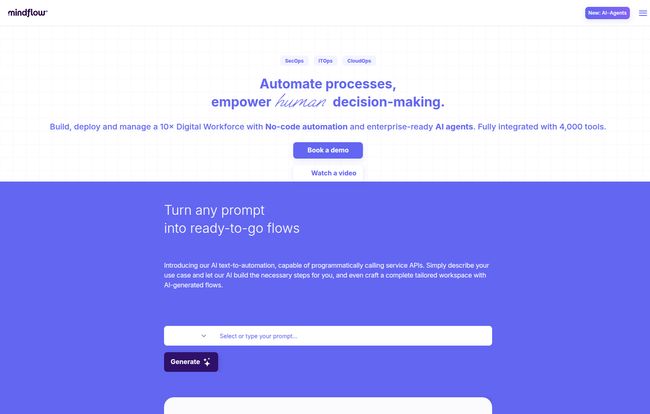
But the feature that really caught my eye on their site is the AI-powered flow builder. You literally type a prompt like, “When a high-priority alert appears in Sentinel, query VirusTotal for the file hash and if it’s malicious, isolate the endpoint with CrowdStrike and notify the on-call channel in Teams.” Mindflow then attempts to build that workflow for you. Wild, right?
Visit Mindflow
Can AI Really Build My Workflows?
This is where my inner cynic and optimist have a bit of a fight. The idea is brilliant. It lowers the barrier to entry to almost zero. Instead of learning the interface, you just describe the outcome you want. It’s like having a helpful assistant who does the initial tedious setup. Now, I have no doubt this requires some human oversight. I wouldn’t just let an AI-generated workflow run wild on my production network without testing it rigourously. But as a starting point? To build out 80% of the logic in 10 seconds? That’s incredibly powerful.
A Library of 4,000+ Integrations is No Joke
An automation platform is only as good as the things it can connect to. This is where Mindflow seems to shine. With over 4,000 integrations, they’re clearly aiming for comprehensive coverage. We’re talking your entire security stack (SIEMs, EDRs, firewalls, threat intel feeds) and your IT Ops tools (cloud providers, ticketing systems, communication platforms). This extensive library is the difference between automating a small part of a task and automating an entire end-to-end process. It’s the connective tissue that makes true hyperautomation possible.
Security for the Security-Conscious
One of the standout features mentioned is secure on-premise access. For anyone working in finance, healthcare, or government, this is a non-negotiable. Many cloud-native automation tools are a no-go because of data residency and compliance rules. By offering an on-premise option, Mindflow shows they understand their enterprise audience. It’s a serious feature for serious companies, and it builds a lot of trust.
The Good, The Quirks, and the Learning Curve
No tool is perfect, and it’s important to go in with eyes wide open. Based on the info and my experience with similar platforms, here’s my breakdown.
The upsides are pretty clear. You get to offload the mundane, repetitive work, allowing your team to focus on stuff that actually requires a human brain—like strategic planning or complex threat hunting. The ability for non-coders to build powerful automations is definately a huge win for operational agility. You can react and adapt so much faster.
On the flip side, let’s be realistic. There’s going to be a learning curve. The promise of “no-code” doesn’t mean “no-logic.” You still need to understand your processes inside and out to automate them effectively. And the reliance on AI means you are the ultimate quality check. You can’t just “trust the machine” blindly. You have to supervise, test, and refine. It’s a partnership, not a replacement for your expertise.
Who Should Be Looking at Mindflow?
If you’re a solo entrepreneur trying to automate your social media posts, this probably isn’t the tool for you. Mindflow is aimed squarely at medium-to-large enterprises with established IT and/or cybersecurity teams. Think:
- Security Operations Centers (SOCs): For automating alert triage, incident enrichment, and response actions. This is their sweet spot.
- IT Operations Teams: For things like user provisioning/deprovisioning, cloud resource management, and patch compliance.
- Managed Security Service Providers (MSSPs): To standardize processes and deliver services more efficiently across multiple clients.
The goal isn’t just to connect two apps; it’s to orchestrate complex, multi-stage processes that are core to the business’s security and stability.
And Now, the Big Question: What Does Mindflow Cost?
Ah, the million-dollar question. Or maybe hundred-thousand-dollar question. Here’s the thing: you won’t find a pricing page on their website. In fact, when I tried to look for one, I landed on an “Oops! Something went wrong” page, which gave me a bit of a chuckle. How fitting.
This is standard practice for enterprise-grade B2B software. Pricing is almost certainly customized based on factors like the number of users, the volume of automations (or “plays”), the specific integrations you need, and the level of support. You’ll have to get in touch with their sales team for a demo and a custom quote. Don’t expect a simple, three-tiered SaaS plan.
Frequently Asked Questions About Mindflow
I saw a few questions on their site and had some of my own. Let’s tackle them.
Is automation useful if I only have a few tools?
Absolutely. The value isn’t just in the number of tools, but in the process. Even automating a simple, two-step task that you do 50 times a day—like looking up a domain’s reputation—can save you hours each week. It’s about eliminating manual friction points.
If Mindflow handles my tasks, what do I do with my free time?
Haha, I love this question. The goal isn’t to make you redundant; it’s to make you more valuable. You get to work on the cool stuff! Instead of chasing alerts, you can proactively hunt for threats, fine-tune security policies, or research new attack vectors. You get to use your brain for strategy, not for being a human API.
Is Mindflow only for cybersecurity teams?
While cybersecurity is a major focus, the platform is built for “Enterprise Cyber IT Professionals.” This implies a broader scope. Any IT process that is repetitive, rule-based, and involves multiple systems is a potential candidate for automation, from helpdesk tasks to cloud infrastructure management.
How hard is it to learn?
While it’s no-code, any powerful platform requires some learning. Expect to spend some time understanding the logic and getting familiar with the interface. The AI prompt feature should significantly speed this up, but you should budget for a ramp-up period to become truly proficient.
Does it work with our company’s internal, custom-built tools?
This is a critical question for any large enterprise. While not explicitly stated in the top-level info, any serious enterprise automation platform worth its salt will have a way to interact with private APIs, usually through a generic HTTP request module. I would be very surprised if Mindflow didn’t support this.
Final Thoughts on Mindflow
Look, the world of IT and cybersecurity isn’t getting any simpler. The volume of data and alerts is only going up. We can’t just keep hiring more people to throw at the problem. We have to work smarter, and that’s where automation comes in.
Mindflow appears to be a very serious contender in the enterprise automation space. It’s not a toy. It’s a powerful platform with the right features—a massive integration library, on-premise security, and an intriguing AI-powered engine—to tackle real-world operational challenges. It won’t solve all your problems with a single click, but it seems like a hell of a co-pilot to have on your side. It might just be the thing that lets your team finally get ahead of the noise and focus on what truly matters.


