
Categories: AI Art Generator, AI Assistant, AI Chatbot, AI Copilot, AI Mental Health, AI Prompt Generator, AI Summarizer, AI Text Generator, AI Writing Assistants
Mindsera Review: An AI Journal That Actually Talks Back

How many half-filled notebooks do you have stashed away in a drawer? You know the ones. You started with the best of intentions, ready to pour your soul onto the page, track your habits, and become a more mindful, organized human. Then… life happened. Three days in, your profound thoughts are sandwiched between a grocery list and a doodle of a cat wearing a hat. The journal became a monologue. A one-way street to nowhere.
I’ve been there. As someone who’s spent years neck-deep in the world of online trends and traffic, I’ve seen countless apps promise to change our lives. Most of them are just digital versions of that same old dusty notebook. But every now and then, something comes along that makes you lean in a little closer. For me, that something was Mindsera.
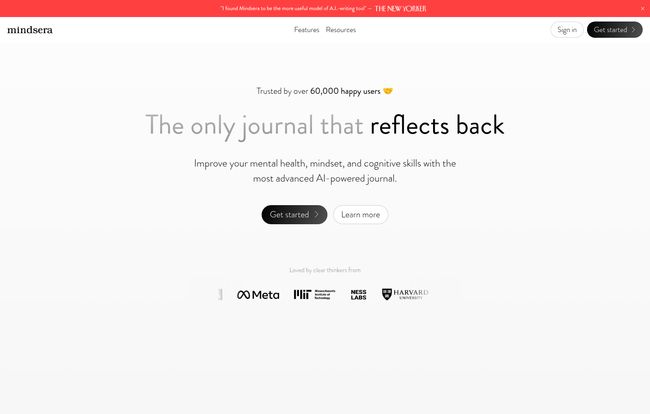
Their tagline is simple: “The only journal that reflects back.” And I gotta say, that got my attention. A journal that… talks back? It sounds a little sci-fi, a little weird, and a whole lot intriguing. So I dove in to see if this was just another gimmick or a genuine tool for what they call “mental fitness.”
So What Exactly Is Mindsera? (Hint: It’s Not Your Teenager’s Diary)
Okay, first things first. Calling Mindsera just a “journal” feels like calling a Ferrari just a “car.” It’s technically true, but it misses the entire point. Mindsera is an AI-powered journaling platform designed to be your cognitive co-pilot. It’s built not just for you to vent, but for you to understand the why behind your thoughts, feelings, and actions. It’s less of a diary and more of a dynamic, interactive space for self-discovery.
Instead of just being a passive recipient of your brain-dumps, Mindsera’s AI actively analyzes your writing. It helps you spot hidden thought patterns, understand your emotional landscape, and even uses proven mental models to help you think more clearly. With over 60,000 users and nods from people at places like Harvard and MIT, it’s clear they’re tapping into something powerful.
Visit Mindsera
The Journal That Actually Listens: My Favorite Features
This is where things get really interesting. I’m a features guy, but only when they actually solve a real problem. And Mindsera has a few that are genuinely game-changing for anyone who feels like their thoughts are a tangled ball of yarn.
Uncovering Your Inner World with AI Analysis
This is the core of the Mindsera experience. You write, and the AI listens. I mean, really listens. The “Deep Analysis” suite is made up of a few key components:
- Emotional Analysis: Ever written a long, frustrated entry and then wondered what was really going on? Mindsera visualizes the emotions detected in your writing over time. You might see that what you thought was just “a bad week” was actually a spike in anxiety tied to a specific recurring event. It’s like having a data scientist for your feelings.
- Chat with Your Journal: This is as cool as it sounds. You can literally ask your journal questions. Things like, “What are my biggest strengths based on my entries?” or “Remind me of a time I felt truly happy.” It searches your own past words and gives you insights. It’s a powerful way to reconnect with your own progress and memories.
- Automatic Summaries: Got a long, rambling entry? The AI creates a TL;DR (Too Long; Didn’t Read) bullet-point summary for you. Perfect for quickly reviewing your thoughts from the previous day or week without getting bogged down in the details.
From Mental Clutter to Mental Models
This is the feature that really sealed the deal for me. As someone fascinated by cognitive biases and structured thinking, the inclusion of mental models and frameworks is just brilliant. We’re talking about templates based on proven systems for thinking, like:
- First Principles Thinking: The Elon Musk favorite. Break a problem down to its most fundamental truths.
- Regret Minimization: A framework Jeff Bezos famously used, where you project yourself into the future to make better decisions today.
- Anti-Goals: Instead of focusing on what you want to achieve, you define what you want to avoid. It’s a surprisingly effective way to gain clarity.
They even quote the legendary investor Charlie Munger, a huge proponent of having a “latticework of mental models.” This elevates Mindsera from a simple feelings-journal to a serious tool for decision-making and personal growth. It’s about building a better mind, not just documenting a bad day.
Privacy First? In This Economy?
Okay, let’s talk about the elephant in the room. An AI that reads your deepest, darkest thoughts? Sounds… terrifying. I was skeptical too. But this is where Mindsera really impressed me. Their founder, Chris Reinberg, is very clear on this: your data is fully encrypted at rest and in transit. They state they’re an independent company that answers to its members, not shareholders chasing data-mining profits. Most importantly, they explicitly say, “your data is not used to train or improve AI models.”
In an age where our data is the product, this commitment to privacy is a massive green flag. It creates the psychological safety needed to be truly honest in your journal.
The Bottom Line: How Much Does This Mental Gym Cost?
Alright, so what’s the investment for this brain-training tool? Mindsera has a straightforward pricing structure with two main tiers. I think it’s pretty fairly priced for what you get.
| Plan | Price | Key Features |
|---|---|---|
| Curious | FREE | Basic Journal, Dark Mode, Habit Tracker, AI Prompts |
| Genius | $14.99 / month or $129 / year |
Everything in Free, plus all AI Analysis, Voice Journaling, Automatic Summaries, Mental Models, Weekly Reviews, and more. |
The Curious plan is a great way to dip your toes in the water. You get the core journaling function and the habit tracker. But the real magic, in my opinion, lies in the Genius plan. That’s where you get the emotional analysis, the chatbot, the mental models—all the stuff that makes Mindsera, well, Mindsera. The annual plan offers a pretty decent savings if you’re ready to commit.
The Good, The Not-So-Good, and The ‘Coming Soon’
No tool is perfect, and a good review is an honest one. So here’s my quick breakdown.
What I love is obvious: the AI-powered analysis is unlike anything else out there, the mental models are a fantastic addition for structured thinkers, and the focus on privacy is a breath of fresh air. The ability to just talk out an entry using voice mode and have it transcribed is a huge plus for people who think faster than they type (me!).
However, there are a few things to be aware of. Right now, the AI features are primarily optimized for English. So if you’re a multilingual journaler, you might not get the full benefit. Also, for all my fellow Apple fans, a native iOS app is still in development. The web app works fine on mobile, but a dedicated app would be a welcome addition. Lastly, one of its listed features, “Recurring Topics Analysis,” is still marked as “coming soon,” which is a bit of a tease. Still, its’ a small gripe in the grand scheme of things.
Frequently Asked Questions About Mindsera
1. Is Mindsera actually secure and private?
Yes. This is one of their biggest selling points. Mindsera uses full end-to-end encryption for your data both when it’s being sent (in transit) and when it’s stored (at rest). They also have a clear policy that your personal data is never used to train their AI models.
2. Who is Mindsera for?
While anyone could benefit, I think it’s especially powerful for entrepreneurs, developers, creatives, and knowledge workers. Basically, anyone who wants to not only understand their emotional state but also sharpen their thinking, improve their decision-making, and track their personal growth in a structured way.
3. Is there a mobile app?
Not a native one, yet. The company has stated that a native iOS app is in development. For now, their web-based platform is mobile-responsive, so you can access it from your phone’s browser.
4. What are ‘mental models’ and why do they matter?
A mental model is a framework for thinking. It’s a concept or a system you can use to understand the world and make decisions. By using different models (like First Principles or Anti-Goals), you can look at a problem from multiple angles, which often leads to more creative and effective solutions than just relying on your default way of thinking.
Final Thoughts: Is Mindsera Worth It?
After spending some quality time with Mindsera, I can confidently say it’s not just another digital diary. It’s an ambitious and impressively executed tool for anyone serious about self-improvement. It bridges the gap between emotional venting and cognitive training in a way I haven’t seen before.
It won’t magically solve all your problems. You still have to do the work of showing up and being honest with yourself. But it provides a structure, a feedback loop, and a level of insight that a blank page simply can’t match. It transforms journaling from a chore into a conversation—a conversation with the most complex and interesting person you’ll ever know: yourself.
If you’re ready to stop talking to a wall and start having a journal that actually reflects back, I think you’ll be pleasantly surprised by what you find.


