
Categories: AI API, AI Content Detector, AI Data Mining, AI Detector, AI Developer Tools, AI Document Extraction, AI Face Recognition, AI For Data Analytics, AI Image Recognition, AI Image Segmentation, AI Models, AI PDF, AI Search Engine, AI Speech-to-Text, AI Summarizer, AI Transcription, AI Video Search, AI Video Summarizer, Large Language Models (LLMs)
Mixpeek Review: The Future of Multimodal AI Search?

If you’ve been in the dev world for more than a few years, you’ve seen the data swamp. You know what I’m talking about. That ever-growing S3 bucket filled to the brim with… stuff. Videos, PDFs, audio recordings, thousands of product images, customer support chats. It’s a digital attic of unstructured chaos. And searching it? A complete nightmare.
I’ve personally lost weeks of my life on projects trying to build a coherent search system across different file types. You end up with a clunky mess of different APIs, one for image recognition, another for audio transcription, a third for text analysis. It’s fragile, expensive, and a pain to maintain. Every time a new AI model comes out, you have to rip everything out and start again. So when I stumbled upon Mixpeek, my battle-worn skepticism was immediately piqued. Could this actually be the solution?
So, What Exactly is Mixpeek Anyway?
Let’s get this out of the way: Mixpeek isn’t just another search bar. Calling it that is like calling a library a room with books. The real magic is the librarian. Mixpeek is the librarian. It’s an intelligence layer that sits on top of your existing object storage (like AWS S3) and acts as a universal translator for all your messy, unstructured files.
It uses sophisticated NLP and computer vision models to actually understand the content of your files. We’re not talking about just metadata or filenames. We’re talking about the ability to look inside a video, listen to an audio file, or read a PDF and pull out meaningful information. It then packages all this understanding into a single, unified API. A multimodal data warehouse for the rest of us, if you will. The promise is simple: make all your data searchable with a single, simple API call. A pretty bold claim, right?
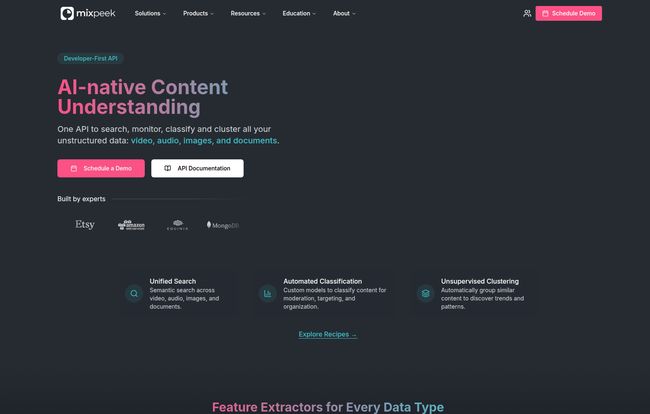
Visit Mixpeek
The Features That Genuinely Got My Attention
A flashy landing page is one thing, but the tech has to back it up. I dug into Mixpeek’s offerings, and a few things really stood out as solving real-world, hair-pulling-out kinds of problems.
The Unified API is a Breath of Fresh Air
This is the big one for me. The idea of ditching half a dozen specialized APIs for one is just… chef’s kiss. The platform is built around a simple GET /search endpoint. You can throw a query at it and get results from your text documents, videos, images, and audio files all at once. Imagine searching for “customer complaints about battery life” and getting back not just support tickets, but also time-stamped mentions in customer calls and even negative reviews visible in product photos. That’s powerful stuff. This directly addresses what they call “model chaos”—the headache of managing, updating, and ensuring compatibility between different AI models. Mixpeek handles all that in the background. A huge win.
Feature Extractors: This is the Secret Sauce
Here’s where it gets really granular and, frankly, very cool. Mixpeek isn’t just doing a generic analysis. It has specialized feature extractors for different data types. Think of them as little experts that know exactly what to look for in each file.
- For video: It can do object grouping, face grouping, and even activity grouping. So you can ask questions like, “Show me all video clips where a person is running near a blue car.”
- For audio: It does more than just transcribe. It can identify different speakers, sentiment, and key topics.
- For images: It can pull out objects, text (OCR), and visual concepts.
This level of detailed extraction is what separates a basic search from true content intelligence. It’s the difference between finding a needle in a haystack and having the haystack neatly categorize itself for you.
Forget Your Infrastructure Nightmares
If you’ve ever tried to deploy a large-scale embedding model yourself, you know the pain of infrastructure. Managing servers, ensuring uptime, scaling for peak loads… it’s a full-time job. Mixpeek is a fully managed service. It boasts automatic scaling, so it can handle massive query volumes without you needing to provision a single server. It scales down to zero, too, so you’re not paying for idle time. This philosophy of “pay only for what you use” is the foundation of the cloud, and it’s great to see it applied so cleanly to AI infrastructure.
Who is This Actually For? Some Real-World Ideas
This isn’t just a toy for side projects. The applications are broad and genuinely useful for businesses.
- Media & Entertainment: A production house could instantly search terabytes of B-roll footage for “a shot of a city at sunset” or “all scenes featuring this specific actor.” That saves an insane amount of time for video editors.
- Retail & E-commerce: Imagine analyzing thousands of user-submitted product photos to identify quality issues or common ways people use your product. You could search for “photos showing a torn seam” across your entire product line.
- Security & Surveillance: The ability to search hours of security footage for “a person wearing a red jacket” or “a white van arriving” is a game-changer for incident response.
Let’s Talk Money: Mixpeek’s Pricing
Okay, the tech is cool, but can anyone afford it? The pricing model is refreshingly straightforward, especially for a tool this powerful. It’s important to note up front: Mixpeek is currently in private beta, so you’ll need to request access to get started.
Here’s the breakdown:
| Plan | Cost | Key Features |
|---|---|---|
| Free | $0 / month | 100 MB storage, 5,000 API calls/month, 2 pipelines, 1 collection, community support. Perfect for testing and small projects. |
| Enterprise | Custom | For large-scale needs with volume discounts, dedicated infrastructure, SLAs, and premium support. |
The free tier is genuinely generous. 5,000 API calls is more than enough to kick the tires and build a proof-of-concept. Beyond the free tier, it moves to a usage-based model. This is where you have to be mindful. The pricing is based on the amount of data you index. For companies with petabytes of data, this could get expensive. But for most, it’s a fair model that scales with your needs.
The Good, The Bad, and The Beta
No tool is perfect. Let’s weigh the pros and cons from my perspective.
The Upsides
The biggest pro is the sheer simplification of a complex problem. The unified API, the managed infrastructure, and the cross-model compatibility are massive wins. It lets developers focus on building features, not wrestling with MLOps. The feature extractors provide a depth of analysis that would be incredibly difficult to build in-house.
Things to Keep in Mind
The main ‘con’, if you can call it that, is its private beta status. You can’t just sign up and start today; you have to be let in. This implies it’s still an early-stage product, so you might encounter a few rough edges. Secondly, the usage-based pricing, while fair, means you need to have a good handle on your data volume to predict costs accurately. Lastly, it requires integration with an object store like S3. This isn’t a huge barrier for most tech companies, but it is a prerequisite to keep in mind.
My Final Take: Is Mixpeek Worth Your Time?
I’ve seen a lot of AI tools come and go. Many are just thin wrappers around an OpenAI API. Mixpeek feels different. It feels like it was built by developers who have actually experienced the pain of multimodal data firsthand. It’s solving a deep, technical problem with an elegant and simple solution.
Yes, it’s in beta. Yes, you need to think about your data scale. But the potential here is enormous. If you or your team are currently drowning in a data swamp of unstructured files, I think getting on the waitlist for Mixpeek is a no-brainer. It has the potential to save you countless hours of development and unlock insights you never thought possible.
Frequently Asked Questions about Mixpeek
- Is Mixpeek completely free to use?
- It has a very generous free tier that includes 100 MB of storage and 5,000 API calls per month, which is great for small projects or just trying it out. After that, it’s a usage-based model.
- What kind of files can Mixpeek actually understand?
- A whole bunch! The core strength is its multimodal capability, so it’s designed to process and extract features from text, images, video, audio, and even PDFs.
- Do I need to be a machine learning expert to use it?
- Nope, and that’s teh whole point. Mixpeek abstracts away the complexity of managing different AI models. If you can make a REST API call, you can use Mixpeek. It’s designed for developers, not just data scientists.
- What does ‘private beta’ mean for me as a user?
- It means you have to request access through their website and join a waitlist. It also suggests the platform is still evolving, so new features are likely being added and you might be one of the first to try them.
- How does the usage-based billing work if I go over the free limit?
- According to their site, if you exceed the limits of the free plan, you’ll simply be billed for your actual usage at the end of the billing cycle. There are no long-term commitments, so you can scale up or down as needed.
- Can I get a discount for paying annually?
- Yes, they offer a 15% discount if you opt for annual billing. You’d need to contact their sales team to set that up, likely as part of an enterprise plan.
Wrapping It Up
Mixpeek is one of the more exciting developer tools I’ve seen in a while. It’s tackling a problem that is only going to get bigger as we generate more and more unstructured data. By providing a simple, intelligent layer to make it all searchable, it’s not just offering a tool; it’s offering clarity in the chaos. And for any developer who’s been lost in that chaos, that’s a very welcome thing indeed.
Reference and Sources
- Mixpeek Official Website: https://mixpeek.com/
- Mixpeek Pricing Page: https://mixpeek.com/pricing


