
Categories: AI API, AI Translate, Large Language Models (LLMs)
Neurooo Review: A GPT-4o Translator to Rival DeepL?

Okay, let’s have a real chat. For years, we’ve been in a weird love-hate relationship with machine translation. One minute, you’re zipping through a foreign news site, feeling like a globetrotting genius. The next, you’re trying to decipher a translated email that sounds like a robot having a stroke. We’ve all been there, pasting text into Google Translate or DeepL, crossing our fingers, and hoping for the best.
It’s the subtle stuff they always miss, right? The idioms, the tone, the vibe. That’s the final frontier. So when a new tool like Neurooo.com pops up on my radar, claiming to be a “translation companion” powered by the beastly GPT-4o, my professional curiosity gets the better of me. Another contender in the ring? You bet I’m going to put it through its paces.
So, What’s the Big Deal with Neurooo Anyway?
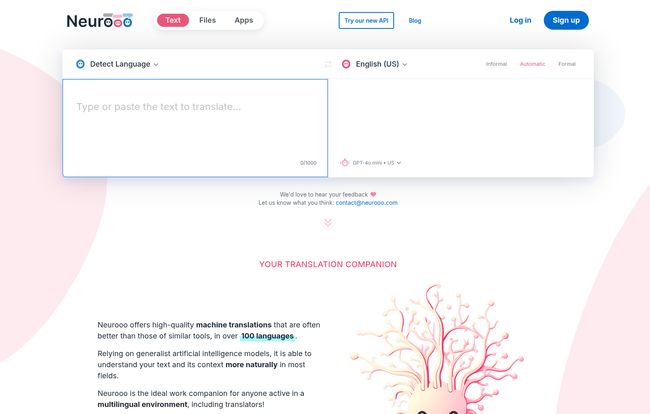
At first glance, Neurooo looks clean. It’s not cluttered. It presents itself as a more thoughtful alternative to the copy-paste-and-pray method. The core promise is simple: high-quality translation that actually understands context. It’s not just swapping words; it’s trying to grasp the meaning behind them.
The site mentions it uses GPT models—specifically name-dropping GPT-4o as its default engine. Now, for those of us who live and breathe this stuff, that’s a big tell. We’re not talking about some dusty old model; we’re talking about OpenAI’s latest and greatest. That alone was enough to make me sit up and pay attention. They claim their version is developed solely for translation purposes, which suggests some serious fine-tuning is happening behind the scenes.
It’s clearly positioning itself as a direct competitor to DeepL, which has long been the darling of many professionals for its more nuanced translations compared to Google. But does it deliver?
My First Impressions and Why It Feels Different
The user experience is pretty straightforward. You’ve got your input box, your output box, and language selectors. Standard stuff. But the magic starts happening when you throw some tricky text at it.
It Actually Understands You (Typos and All)
One of the first things I noticed was its tolerance for… well, for being human. We make typos. We use slang. We write imperfectly. Neurooo seems built for this. I tested it with a few sentences with deliberate spelling mistakes, and it didn’t just fail; it corrected them and translated the intended meaning.
The example on their own homepage is fantastic. They use the French phrase “entre chien et loup,” which literally translates to “between dog and wolf.” A basic translator might give you that nonsense. Neurooo correctly interprets it as “in the twilight.” That’s not just translation; that’s cultural and contextual interpretation. That’s the good stuff.
Visit Neurooo.com
Finding the Right Voice with the Tone Shifter
Here’s a feature I’ve been wanting in a mainstream tool for ages. Neurooo has a toggle to switch between an informal and formal tone. This is a game-changer for anyone doing business across cultures. Translating an email to a potential client in Germany? You better believe you want the formal “Sie” not the casual “du.”
It’s a simple switch, but it saves so much time in post-editing. I will say, the site points out this feature is for paying users. We’ll get to the murky topic of pricing in a bit, but the feature itself is a massive win and shows they understand the needs of professional users.
Beyond Just Words: Fine-Tuning and Future Promises
A good tool shouldn’t be a black box. You need some level of control. I was really happy to see Neurooo offers a couple of ways to nudge the AI in the right direction.
Getting Granular with Fine-Tuning
After a translation is generated, you can click on individual words and get a list of alternatives. This is incredibly useful. The AI might choose a perfectly good synonym, but it might not be the exact one you want for your brand’s voice or a specific technical document. Instead of having to rephrase the whole sentence and try again, you can just make a quick swap. It’s a small detail that shows a deep respect for the user’s expertise.
What’s on the Horizon?
I’m a sucker for a public roadmap. It shows confidence. Neurooo has a whole section on their homepage listing what they’re working on next, and it’s ambitious. They’re looking at an API for developers (yes please!), on-premise solutions for enterprises, auto-translating files, and even more advanced fine-tuning. This tells me they’re not just a weekend project; they’re building for the long haul.
The Elephant in the Room: Neurooo vs DeepL and Google Translate
Alright, the ultimate showdown. In my experience, Google Translate is the fast-food of translation—it’s everywhere, it’s fast, and it gets the job done in a pinch. But you wouldn’t take a date there.
DeepL has been the classy bistro. It’s more refined, the results are more palatable, and it generally understands nuance better. For years, it’s been my go-to for anything important.
Neurooo feels like it’s aiming to be the personal chef. By using a powerful, creative engine like GPT-4o and then focusing it squarely on translation, it achieves a fluency that feels very, very natural. For creative copy, marketing materials, or personal communication, I think Neurooo might just have the edge. The translations have a certain flow that often eludes even DeepL. It’s less about literal accuracy and more about conversational, human accuracy.
So, What’s the Catch? (And How Much Is It?)
No tool is perfect. Let’s be real. Since it runs on GPT models, it’s susceptible to the same occasional weirdness or “hallucinations” all large language models are. It’s rare, but you still need a human eye on critical translations.
And now, for the big question: the price. This is where things get a bit… strange. The site mentions features for “paying users,” which clearly implies a freemium or subscription model. But as of writing this, there’s no pricing page to be found. I even clicked around and hit a 404 page at one point, which makes me think the site is either brand spanking new or they’re still ironing out the details. My guess? They’ll likely have a generous free tier for casual use and then paid plans for power users who need features like the tone shifter and higher volume limits. But for now, it’s a mystery.
For now, you can use the main translator on their site without hitting any obvious paywalls. So I’d say jump in and try it while the gettin’s good.
My Final Take
I’m genuinely excited about Neurooo. It’s a serious and impressive new player in a field that’s been dominated by two giants for too long. It’s not just another soulless API slapped onto a webpage; there’s real thought here about what makes a translation feel right.
Is it going to replace DeepL for me overnight? Maybe not for everything. But for translating content where tone and natural flow are king—like ad copy, social media posts, and important emails—I’ll be reaching for Neurooo more and more. It’s a sharp, intuitive tool that feels like a true companion, not just a utility.
Frequently Asked Questions
- What is Neurooo?
- Neurooo is an advanced AI translation tool that uses GPT models, including GPT-4o, to provide natural, context-aware translations. It’s designed to compete with services like Google Translate and DeepL, focusing on high-quality output for over 100 languages.
- What makes Neurooo different from Google Translate?
- The main difference is the focus on context and natural language. While Google Translate is great for literal, quick translations, Neurooo excels at understanding idioms, correcting typos in the source text, and producing a more fluent, human-sounding output. Its tone-adjustment feature is also a significant advantage.
- Is Neurooo free to use?
- Neurooo appears to operate on a freemium model. The basic translation service is currently free to use on their website. However, certain advanced features, like the ability to adjust the translation’s tone (formal/informal), are reserved for paying users. A public pricing page is not yet available.
- What languages does Neurooo support?
- Neurooo supports translation for over 100 languages, making it a versatile tool for global communication.
- Can Neurooo translate documents?
- Yes, the platform indicates it can handle translations for text, files, and even apps. The homepage shows options for both text and file uploads.
- What AI model does Neurooo use?
- According to its website, Neurooo’s default translation engine is powered by OpenAI’s GPT-4o model, which is one of the most advanced language models currently available.
Reference and Sources
- Neurooo Official Website
- OpenAI’s Announcement on GPT-4o
- Digidop (Company from the testimonial)


