
Categories: AI API, AI Assistant, AI Productivity Tools
OLINTEK SkyLoad iQ Review: AI for Air Cargo Profit?

If you’ve ever worked in air freight, you know the game. I’m not talking about market speculation or client negotiations. I’m talking about the high-stakes, real-life game of Tetris that is loading an aircraft. It’s a spatial reasoning nightmare where the blocks weigh tonnes, some can’t touch others, and every unused cubic inch feels like you’re just setting fire to a pile of cash. For years, we’ve relied on experience, complex spreadsheets, and a whole lot of institutional knowledge. It works. Most of the time. But it’s slow, stressful, and rarely, if ever, perfectly optimal.
Then along comes AI, promising to change everything. We’ve seen it disrupt marketing, finance, you name it. So, can it really tackle the beast that is air cargo logistics? I was recently looking at a platform called OLINTEK, and their suite of tools, particularly SkyLoad iQ, caught my eye. They claim to use AI for a smarter, faster, and more profitable way to load planes. Let’s peel back the layers and see if it’s all just marketing fluff or the real deal.
The Ageless Headaches of Air Cargo Logistics
Before we get into the solution, let’s commiserate for a second. The challenges OLINTEK highlights on their site are painfully familiar. They bucket them into two main categories: Reliability and Safety. And boy, do they hit home.
On the reliability front, you’re juggling cargo with wildly different dimensions, weights, and priorities. You have that one high-priority shipment that has to make the flight, but it’s awkwardly shaped. You have dense cargo, fragile cargo, and cargo that’s just… weird. Trying to fit it all while respecting the aircraft’s center of gravity is a delicate dance. A dance that often leads to under-utilized ULDs (Unit Load Devices) and, consequently, lost revenue.
Then there’s safety. This isn’t just about making sure boxes don’t fall over. We’re talking about strict IATA regulations, dangerous goods compatibility (you can’t just park explosives next to flammable liquids, shocker), and aircraft-specific stacking rules. One mistake here doesn’t just cost money; it can have catastrophic consequences. The mental load on a human planner is immense.
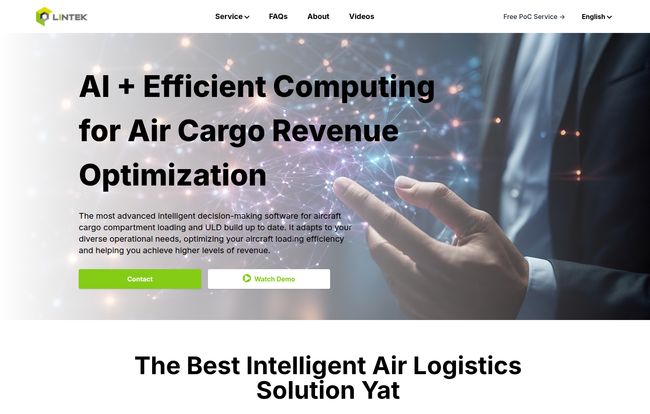
Visit OLINTEK
OLINTEK’s AI ‘Co-Pilot’ Approach
So, how does OLINTEK propose to fix this? They don’t just offer one monolithic piece of software. It’s a suite of intelligent tools designed to work together, which I appreciate. It’s not a one-size-fits-all solution.
- SkyLoad iQ: This seems to be the flagship. It’s the master planner that looks at the entire aircraft, all the scheduled cargo, and generates the optimal load plan for the whole flight. Think of it as the air traffic controller for your cargo hold.
- SkyCube iQ: This is more granular. It’s focused on planning individual shipments and building up ULDs. This thing is brilliant for the front-end of the process, like when you need to quickly generate a charter flight quotation. It can tell you if and how a potential shipment will fit before you even commit.
- SkyOptimizer: This is the secret sauce. The brains behind the operation. It’s the powerful optimization engine that churns through all the data—cargo characteristics, aircraft type, priority, safety rules—to find the best possible configuration.
It’s a smart separation of concerns. You can plan the pieces (SkyCube iQ) and then assemble the whole puzzle (SkyLoad iQ), all powered by the same intelligent engine.
The Features That Actually Move the Needle
A long list of features is one thing, but which ones actually make a difference in the day-to-day grind? Having been around the block a few times, a few things stood out to me.
First, the 3D visualization. It’s easy to dismiss this as just a cool graphic, but its value is huge. Seeing a 3D mock-up of a fully loaded ULD or aircraft hold provides instant clarity. You can visually confirm clearances, spot potential issues, and gain a level of confidence that a list of numbers on a spreadsheet just can’t provide. It’s also an incredible tool for training and for aligning teams. The ramp agent sees exactly what the planner intended. That alone can prevent a world of hurt.
Second, the raw power of the Smart Optimization Engine. The OLINTEK site talks about the “Exceptional Computational Power,” and this is where the AI really earns its keep. A human simply cannot compute the millions of possible loading combinations to find the absolute best one. The AI can. It juggles weight and balance, ULD contours, stacking rules, and cargo priorities simultaneously. This is how you go from a “pretty good” load to a truly optimized one, squeezing out every last drop of revenue potential from the aircraft’s hold.
Finally, the integration with existing enterprise management systems. This is a big one. No one wants another isolated data silo. A tool that can’t talk to your booking or warehouse system is a non-starter. The ability to pull data from and push data to your existing infrastructure makes the whole operation smoother and less prone to manual entry errors.
The Good, The Bad, and The Brutally Honest
No tool is perfect. So let’s get real about what to expect. Based on the info available and my own industry experience, here’s my take.
Why You’ll Probably Get Excited
The biggest win here is obvious: improved ULD utilization and revenue. By packing more efficiently, you can literally fly more cargo on the same flight. That’s not just an efficiency gain; it’s pure profit hitting the bottom line. The AI’s ability to maximize cargo in a weight-and-balance-optimized way is the core value proposition. The user-friendly interface is another huge plus. A complex tool that nobody can figure out how to use is just expensive shelfware. The 3D view makes it intuitive, which is key for adoption across a team.
A Necessary Reality Check
Now, for the counterpoints. First, the system relies on accurate input data. This is the golden rule of any AI or data-driven system: garbage in, garbage out. If your team is entering incorrect cargo dimensions or weights, the AI’s perfect plan will be based on flawed information. Process discipline is key.
Second, there’s likely a learning curve. It may be user-friendly, but it’s still a professional-grade tool. Expect some time for your team to get fully comfortable and trust teh system’s recommendations. It’s not a magic button you press on day one without any training.
Finally, and this is important, the AI’s recommendations require human oversight. This software is a ridiculously powerful co-pilot, but it’s not the captain. An experienced loadmaster should always give the final sign-off. The goal of a tool like this is to augment human expertise, not replace it. It handles the 99% of complex calculations, freeing up the human expert to manage the exceptions and make the final call.
So, What’s the Price Tag?
Ah, the million-dollar question. Or is it? You won’t find a pricing page on the OLINTEK website, and that’s not surprising. For enterprise-level, highly specialized B2B software like this, pricing is almost always customized. The final cost will depend on the scale of your operation, the specific modules you need (just SkyCube iQ, or the full suite?), the level of integration required, and the number of users.
My advice? Don’t let the lack of a public price scare you off. See it as the start of a conversation. The best path forward is to use their “Contact” or “Watch Demo” options. This allows you to explain your specific needs and get a quote that actually reflects your business, rather than a generic price that doesn’t fit anyone perfectly.
Who Is OLINTEK SkyLoad iQ Really For?
Let’s be clear: this isn’t for a small business shipping a few boxes a week. This is a heavy-duty solution for operations feeling the pain of complexity and scale. We’re talking about:
- Airlines (Cargo and Passenger): The most obvious beneficiaries, looking to maximize revenue from their cargo holds on every single flight.
- Major Freight Forwarders: Especially those who charter aircraft and need to provide quick, accurate quotes and loading plans.
- Ground Handling Agents (GHAs): Teams responsible for the physical build-up of ULDs and loading aircraft according to the airline’s plan. This tool can make their process faster and more accurate.
If your daily work involves complex load plans, multiple aircraft types, and a constant push to improve cargo revenue, then you are the target audience for this kind of technology.
Is SkyLoad iQ the Final Piece of the Logistics Puzzle?
Look, the air cargo industry has been built on grit and human ingenuity for decades. But the complexity and speed of modern logistics are pushing the old methods to their limits. A tool like OLINTEK’s SkyLoad iQ isn’t about replacing that ingenuity; it’s about amplifying it.
By letting an AI handle the mind-numbing combinatorial mathematics of load planning, you free up your human experts to do what they do best: manage the unexpected, communicate with clients, and oversee the entire operation with wisdom and experience. It turns the chaotic game of Tetris into a calculated, strategic process. And in a business where every cubic meter and every kilogram counts, that could be the difference between a profitable flight and a costly one.
Frequently Asked Questions
- What is OLINTEK SkyLoad iQ?
- SkyLoad iQ is a software solution that uses Artificial Intelligence (AI) to create optimal load plans for air cargo. It considers cargo characteristics, aircraft type, safety regulations, and priority to maximize space and weight utilization in an aircraft’s hold.
- How does AI actually improve air cargo loading?
- AI can analyze millions of loading combinations in seconds, a task impossible for a human. It finds the most efficient way to pack ULDs and position them within the aircraft to maximize cargo volume and weight, all while respecting complex constraints like the center of gravity and dangerous goods compatibility. This leads to increased revenue and operational efficiency.
- Can SkyLoad iQ integrate with my current system?
- Yes, OLINTEK’s solutions are designed to integrate with existing enterprise management systems, such as booking, reservation, and warehouse management software. This allows for a more connected and automated workflow, reducing manual data entry.
- Is SkyLoad iQ difficult to learn?
- While any powerful software has a learning curve, SkyLoad iQ is designed with a user-friendly interface, including 3D visualizations. This makes the plans easier to understand and execute, which should help shorten the training period for load planners and ground staff.
- Will this software replace my human loadmaster?
- No. The tool is designed to be a powerful assistant, or “co-pilot,” for a human expert. The AI provides the optimal data-driven plan, but the experience and oversight of a human loadmaster are still crucial for final validation and managing real-world, on-the-ground situations.
- How can I find out the price for SkyLoad iQ?
- Pricing is customized based on your company’s specific needs. The best way to get a price is to contact OLINTEK directly through their website and request a demo or a quote tailored to your operational scale and requirements.


