
Categories: AI For Data Analytics, AI Interview Assistant, AI Predictions, AI Recruiting, AI Text Classifier
Pera Talent Review: AI Hiring Without the Guesswork?

Hiring is a grind. Anyone who tells you otherwise is either lying or has never stared into the abyss of a 200-applicant inbox for a single junior marketing role. You wade through resumes that all look suspiciously similar (thanks, Canva templates), you conduct interviews, and you rely on that tricky, unreliable thing we call ‘gut feeling’. And sometimes, that gut feeling is just indigestion.
We’ve all been there. You hire someone who looked perfect on paper, only to discover three months later that their problem-solving skills are, shall we say, a work in progress. It’s a costly, time-sucking mistake. So when a tool like Pera comes along, promising to use AI to get rid of the guesswork, my ears perk up. But as an SEO and traffic guy, I’m also a professional skeptic. Buzzwords like “AI-powered” and “data-driven” are thrown around like confetti these days.
So, I decided to take a proper look. Does Pera actually deliver on its promise to find top talent faster and more accurately? Or is it just another shiny object in the ever-growing HR tech stack? Let’s get into it.
So What Exactly is Pera Talent Assessment?
First off, Pera isn’t your typical personality test. You know the ones—’On a scale of 1 to 5, how much do you agree with this statement?’. I’ve always found those a bit easy to game. Pera takes a different path. It’s a pre-employment screening platform that aims to uncover a candidate’s core competencies. Not just their personality type, but how they actually think, reason, and communicate.
Think of it this way: a resume is a rearview mirror. It shows you where a person has been. A personality test might tell you if they’re an introvert or an extrovert. Pera is trying to be the car’s diagnostic system, showing you how the engine really runs. It does this by analyzing a candidate’s responses to just three open-ended questions. No multiple choice, no right or wrong answers. Just pure, unadulterated thought process.
How Pera’s Three-Question System Works
This is where it gets interesting. The whole process seems deceptively simple on the surface.
A candidate applies for a job and, as part of the process, they’re prompted to answer three questions. These aren’t brain teasers like ‘Why are manhole covers round?’. They’re designed to provoke thoughtful responses about hypothetical work situations or past experiences. The candidate types out their answers, and that’s their part done. Simple. Easy. Less stressful than a panel interview, for sure.
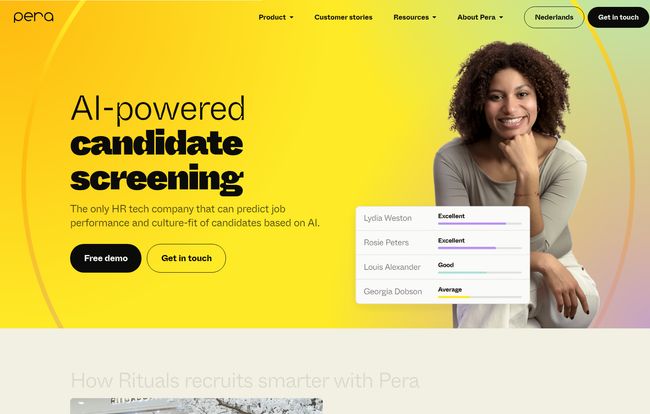
Then, Pera’s AI kicks in. It’s not just doing a keyword search. It uses natural language processing (NLP) to analyze the structure, the reasoning, and the underlying competencies revealed in the text. It then benchmarks this analysis against its massive database of over 8 million professionals. The result? A detailed report for the recruiter that outlines the candidate’s strengths in areas like critical thinking, creativity, and leadership potential—the stuff that actually predicts job performance.
Visit Pera Talent Assessment
The Good Stuff I Found with Pera
Okay, so the concept is cool. But what about the results? Pera’s website throws around some pretty bold numbers, and they’re worth paying attention to.
Cutting Down Recruitment Time Dramatically
Pera claims it can reduce recruitment time by up to 40%. For any hiring manager or talent acquisition specialist, that’s massive. It means less time sifting through unqualified resumes and more time engaging with a shortlist of genuinely promising candidates. This isn’t just about efficiency; it’s about getting the best people in the door before your competition does.
Actually Predicting Better Hires
This is the holy grail, isn’t it? Pera reports a +26% increase in the quality of hires. By focusing on deep-seated competencies rather than surface-level experience, the platform helps identify people who will not only do the job well but also fit the company culture. It’s a move away from hiring for where someone has been, to hiring for where they can go.
Fighting That Pesky Unconscious Bias
I think this is one of its most powerful features. The AI doesn’t see a name, a university, an age, or a gender. It sees text. That’s it. It analyzes the substance of what someone writes, completely removed from the demographic details that can trigger our unconscious biases. In an era where building diverse and inclusive teams is a top priority, a tool that helps level the playing field is a huge plus.
It Plays Nice with Your Existing Tools
Nobody wants to manage yet another login and a separate system that doesn’t talk to anything else. The fact that Pera offers integrations with major Applicant Tracking Systems (ATS) is a smart move. It means it can slide into your existing workflow without causing a major headache.
Where Pera Might Give You Pause
No tool is perfect, and it wouldn’t be an honest review if I didn’t raise a few questions. I have a healthy dose of skepticism for all tech, and Pera is no exception.
First, you have to place a certain amount of faith in the AI. It’s a bit of a “black box.” While the outcomes might be great, you are trusting an algorithm to make a crucial first-pass judgment. For some old-school recruiters, that’s a tough pill to swallow.
Second, what about the candidates? While Pera boasts a 90% completion rate, which is impressive, there’s always a chance that some excellent candidates might be put off by the open-question format. Some people are just not great writers, even if they’re brilliant thinkers or doers. It’s a factor to consider.
Finally, there’s likely a bit of a learning curve. Getting a detailed competency report is one thing; knowing how to interpret it and use it to ask better interview questions is another. Teams might need some initial training to get the most out of the insights Pera provides.
Who is Pera Really Built For?
Based on their website and case studies, Pera seems to have a few sweet spots. High-volume recruitment, like for graduate programs or call centers, is a no-brainer. It’s a fantastic way to automate the initial screening of hundreds or thousands of applicants. I can also see it being incredibly useful for sales recruitment, where competencies like resilience and communication are far more important than what’s on a CV.
The fact that they have logos like L’Oréal, Picnic, and Adyen on their site tells a story. These are fast-moving, competitive companies that need to hire the best, and do it efficiently. It’s some serious social proof.
Let’s Talk About the Pera Pricing
So, how much does all this AI goodness cost? I went looking for a pricing page, and… well, there isn’t one. This is pretty standard for B2B SaaS platforms that cater to larger businesses. Pricing is almost certainly customized based on the size of your company, the number of roles you’re hiring for, and the level of integration you need. Your best bet is to hit that “Get in touch” or “Free Demo” button on their site to get a custom quote. Don’t expect a simple three-tiered pricing list.
Pera vs. The Old Way of Hiring
To put it all in perspective, here’s a quick breakdown of how the Pera method stacks up against traditional recruiting.
| Aspect | Traditional Hiring | The Pera Method |
|---|---|---|
| Screening Basis | Resume keywords, past experience, ‘gut feel’ | Core competencies, reasoning skills, culture fit |
| Bias Risk | High (unconscious bias based on name, school, etc.) | Low (AI analyzes anonymous text data) |
| Speed | Slow, manual review of every application | Fast, automated shortlisting of top candidates |
| Predictive Power | Low (past performance isn’t a guarantee of future success) | High (competencies are strong predictors of job success) |
Frequently Asked Questions About Pera
What makes Pera different from other personality tests?
Pera focuses on measuring core competencies—like problem-solving and adaptability—by analyzing how a person constructs their thoughts in open-ended answers. It’s less about personality labels (like ‘introvert’) and more about tangible skills that predict job performance.
Is Pera’s AI assessment biased?
The platform is designed to significantly reduce bias. The AI analyzes anonymized text, ignoring demographic information like name, age, or background, which are common sources of unconscious human bias in the hiring process.
How long does the Pera assessment take for a candidate?
It’s quick! The assessment consists of just three open questions. While the time varies per person, it’s designed to be a short and low-stress experience, contributing to its high 90% completion rate.
Can Pera integrate with my current Applicant Tracking System (ATS)?
Yes, Pera is built to integrate with many of teh popular ATS platforms on the market. This allows for a more streamlined workflow, so you don’t have to jump between disconnected systems.
How is the security of candidate data handled?
While specific details require a direct inquiry, Pera’s website includes a dedicated FAQ on security. Like any reputable HR tech company, they take data privacy and security seriously to protect both the candidate and the hiring company.
Is Pera Worth It for Your Hiring Team?
After digging in, my skepticism has turned into genuine curiosity and, dare I say, a bit of excitement. Pera isn’t trying to replace recruiters; it’s trying to give them a better toolkit. It’s a sharp, focused instrument designed to solve one of the biggest problems in talent acquisition: how to quickly and reliably find the best needles in a giant haystack of applicants.
No, it’s not a magic wand. You still need skilled recruiters to interpret the data, conduct meaningful interviews, and close the deal. But it fundamentally shifts the starting point of the conversation from ‘what’s on your resume?’ to ‘how do you think?’. For me, any tool that challenges the ‘we’ve always done it this way’ pile of resumes is a win. In today’s relentless war for talent, changing the rules of engagement might be the only way to come out on top. Pera is, at the very least, a powerful conversation starter.


