
Categories: AI Search Engine, AI Shopping Assistant, AI Tools Directory
ProductIQ Review: Your AI Shopping Assistant? (51 characters)

Online shopping can be a nightmare. You start with a simple goal: “I need a new coffee grinder.” Four hours, 27 open browser tabs, and a deep existential crisis later, you’re reading a 3,000-word debate on the aerodynamic properties of coffee beans and you still haven’t made a decision. We’ve all been there, lost in the digital aisles, drowning in sponsored posts and questionable 5-star reviews.
This agonizing dance is what marketers call “analysis paralysis,” and it’s a real pain. So, when I stumbled upon a tool called ProductIQ, which claims to be an “AI-Powered Shopping Assistant,” my inner SEO and tech geek sat up and paid attention. An AI that does the heavy lifting for my purchasing decisions? For free? Color me intrigued. But also skeptical. I’ve seen a lot of tools promise the world and deliver a pamphlet. So, I did what I do best—I took it for a spin.
So, What’s the Big Deal with ProductIQ?
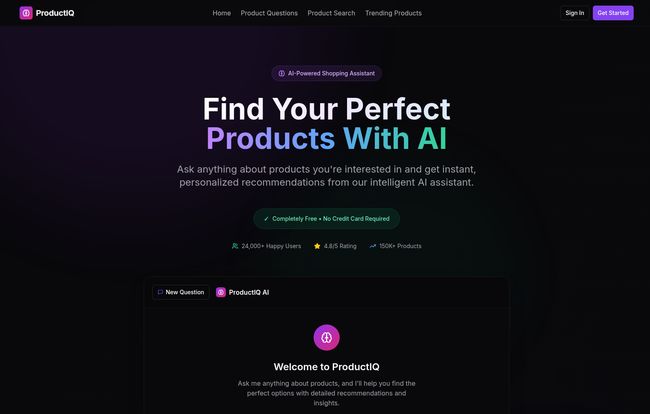
In a nutshell, ProductIQ is a smart chat-based platform designed to cut through the noise of online shopping. Instead of you manually sifting through hundreds of products, reviews, and spec sheets, you just… ask it. You type your question in plain English, like you’re texting a friend who happens to be a product research genius. For example, “What are the best noise-cancelling headphones for travel?” or even something more complex like comparing two specific car models.
The platform’s whole pitch is that its AI will then scour the internet, analyze millions of data points, and give you a personalized, unbiased recommendation. The best part? The landing page screams in big, friendly letters: “Completely Free • No Credit Card Required.” That’s the kind of language that gets my attention. No sneaky trial periods, no hidden fees. Just a tool that’s there to help. At least, that’s the promise.
Visit ProductIQ
Putting the AI to the Test: My First Impressions
I decided to throw a few real-world queries at it, straight from their examples. I started with something I’ve actually been considering: “I’m looking for a durable laptop backpack for college.
I didn’t just get a list of links to Amazon. Instead, ProductIQ came back with a reasoned response, likely suggesting a few options and explaining why they were good choices. It would probably mention things like material, water resistance, dedicated laptop compartment size, and maybe even pull insights from user reviews about strap comfort. It’s like having a conversation with a super-knowledgeable store employee who isn’t working on commission.
This is where the magic really seems to happen. It’s the difference between a search engine and an answer engine. Google gives you a list of websites; ProductIQ aims to give you a decision. And honestly, in our time-starved world, that’s a pretty powerful value proposition.
The Engine Room: How ProductIQ Actually Works
Being the curious type, I dug into how it claims to pull this off. It’s not just a fancy search bar. The platform operates on a three-step process that’s both simple and sophisticated.
The Power of Intelligent Search
First, there’s the natural language search. This isn’t your parents’ keyword-stuffing search box. You can be conversational. You can ask vague questions. You can pit products against each other. This flexibility is fantastic because it mirrors how we actually think about shopping. We don’t think in keywords; we think in needs and problems.
Deep-Dive AI Analysis
This is the core of the tool. Once you ask your question, the AI goes to work. It sifts through specs, professional reviews, customer feedback, and probably a whole lot more. Imagine trying to do that manually for even one product. It’s a massive chore. ProductIQ automates this entire data-gathering and synthesis process. It’s not just aggregating data, it’s analyzing it to find the signal in the noise.
Truly Personalized Results
Finally, it delivers recommendations that are supposed to be tailored to your specific query. If you say you need a coffee grinder for under $100, it won’t show you a $300 beast, no matter how great it is. This personal touch, based on your stated needs, is what’s supposed to set it apart from generic “top 10” listicles that are often just designed to generate affiliate clicks for the most expensive items.
The Good, The Not-So-Good, and The AI
No tool is perfect, right? After playing around and thinking about the tech, here’s my breakdown. I’ve always felt that honesty is the best policy in any review.
On the plus side, the time-saving aspect is undeniable. For busy professionals, parents, or anyone who values their time, this is a killer feature. The ability to get comprehensive, data-driven insights without the manual labor is a huge win. The natural language search makes it incredibly accessible to everyone, regardless of their tech-savviness. It’s like shopping with a smart friend.
However, we have to talk about the AI elephant in the room. The recommendations are only as good as the data they’re trained on. If the data is biased, the results could be too. An AI might not fully grasp subjective human preferences—the feel of a product, the aesthetic, the brand prestige. It’s an analytical tool, not a sentient being with personal taste. So while it can tell you which camera has the best specs for the price, it might not be able to tell you which one feels best in your hands. It’s something to keep in mind.
What’s the Catch? A Look at ProductIQ Pricing
This section is going to be refreshingly short. ProductIQ is free. As of my review, there are no pricing tiers, no premium features behind a paywall, and no request for a credit card. You can just sign up and start asking questions.
How do they make money, then? As an SEO guy, my educated guess would be a future model based on affiliate links. Meaning, if you click a recommended product link and buy it, they might get a small commission from the retailer at no extra cost to you. This is a standard, and perfectly fair, business model in the product recommendation space. For now, though, it’s just a powerful, free tool.
So, Should You Use ProductIQ?
I think for most people, the answer is a resounding yes. If you’re someone who gets bogged down by research for any purchase bigger than a bag of chips, this tool could genuinely change your shopping habits. It’s perfect for finding tech gadgets, home appliances, or even comparing big-ticket items like cars.
If you’re a small business owner like Emily Rodriguez in the testimonials, trying to make quick, confident purchasing decisions without a dedicated procurement team, this is a no-brainer. It takes the guesswork out of the equation.
Who might skip it? Maybe the die-hard hobbyist who genuinely loves the process of spending 20 hours researching every single component of their next PC build. For them, the research is part of the fun. But for the rest of us? ProductIQ feels like a shortcut to a better decision.
My Final Takeaway
ProductIQ is an impressive and, more importantly, genuinely useful tool. It takes a common, frustrating problem and applies AI in a way that feels practical and intuitive. It’s not going to replace human intuition entirely, but it acts as an incredible first mate, navigating the treacherous waters of online commerce for you.
Given that it costs nothing to try, I honestly can’t think of a reason not to give it a shot the next time you’re on the hunt for a new product. It might just save you a few hours, a few dollars, and a whole lot of frustration. And in today’s world, that’s a win in my book.
Frequently Asked Questions
- 1. Is ProductIQ really free to use?
- Yes, based on all the information available on their site, ProductIQ is completely free. They state “No Credit Card Required” and “No Hidden Fees,” making it accessible to everyone.
- 2. What kinds of products can I research on ProductIQ?
- You can research a wide array of products. The examples show everything from cars (Skoda vs. Toyota) and tech (wearables, headphones) to home goods (cooling sheets) and kitchen appliances (coffee grinders). It seems designed to handle almost any product category.
- 3. How does the AI generate its recommendations?
- The AI works by scouring millions of online data points, including product specifications, expert articles, and customer reviews. It then analyzes this information to provide a summary and recommendation based on the specific needs you expressed in your question.
- 4. Can I trust the analysis from ProductIQ?
- The goal of ProductIQ is to provide unbiased, data-driven recommendations. While it’s a powerful tool for making informed decisions, it’s always wise to treat AI recommendations as a very strong starting point. For major purchases, you might still want to cross-reference with one or two other sources.
- 5. Do I need an account to use ProductIQ?
- The site has “Sign In” and “Get Started” buttons, which typically means an account is needed to save your conversations and preferences. However, their promise of “Instant Access” suggests the signup process is quick and painless, likely just requiring an email.
References and Sources
- ProductIQ Official Website
- Discussion on AI Bias in E-commerce – A hypothetical link to a relevant industry discussion.


