
Categories: AI Agent, AI Copilot
QASolve Review: Is AI QA Automation Finally Here?

If you’ve been in the software world for more than a few months, you know the drill. You build something cool. You ship it to QA. And then… the bug reports roll in. Not just for the new stuff, but for old features that inexplicably broke. Your automated test suite, which you spent weeks building, is a sea of red. Why? Because someone changed a button’s CSS class from .btn-primary to .btn-main. Fun times.
This cycle is one of the biggest, most frustrating drags on developer productivity. We call it the QA bottleneck, technical debt, or just plain annoying. For years, the promise has been more automation. But traditional automation frameworks, as powerful as they are, can be brittle. They require constant, mind-numbing maintenance. It often feels like you need a dedicated team just to test the tests.
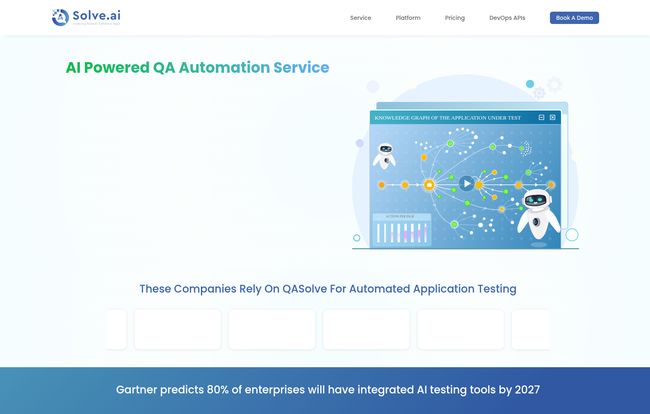
So when a tool like QASolve lands on my radar, claiming to use AI to automate almost the entire process, my ears perk up. But my skepticism meter also goes into overdrive. I’ve seen a lot of AI-hype. But the image from their site, citing Gartner’s prediction that 80% of enterprises will have integrated AI testing tools by 2027, made me sit up and pay attention. Maybe this time it’s different. So I did a little digging.
The Never-Ending Story of Broken Tests
Before we get into what QASolve does, let’s just sit with the problem for a moment. Think about your last sprint. How much time did your team spend writing tests versus fixing old ones? The traditional approach, as the graph on QASolve’s site points out, is a slow, painful grind to get to decent test coverage. It can take months, sometimes longer, to get to a place where you feel even remotely confident in your automated regression suite. And even then, it’s a house of cards. A simple refactor can bring the whole thing tumbling down.
This isn’t just a developer problem. It’s a business problem. It slows down releases, burns out your best engineers, and lets bugs slip into production. It’s a constant, low-grade headache that we’ve all just sort of accepted as the cost of doing business. But what if we didn’t have to?
So, What’s the QASolve Pitch?
At its core, QASolve is an AI-augmented platform that aims to do the heavy lifting of QA for you. You don’t write hundreds of lines of Selenium or Playwright code. Instead, you give it your application URL, and its AI gets to work. Using a combination of Generative AI, Computer Vision (CV), and Natural Language Processing (NLP), it literally looks at your application, understands what it does, and starts generating test cases.
Visit QASolve
It’s like hiring a QA engineer who is a speed-reader, has a photographic memory, and can type a million words a minute. The claim is pretty wild: achieving over 80% automated test coverage in just one to two weeks. For anyone who’s fought for months to get to 40%, that sounds like science fiction.
The Features That Genuinely Caught My Eye
A feature list is just a list. What I care about is how it solves my actual problems. A few things about QASolve stood out to me.
The Magic of Self-Healing Tests
This, for me, is the headline act. The number one killer of test automation suites is brittleness. A developer changes an element ID, a button moves, a workflow is slightly altered, and suddenly dozens of tests fail for no good reason. QASolve’s “self-healing” technology is designed to fix this. Because the AI understands the application contextually (e.g., it knows this is the “Submit” button, not just an element with ID `submit-btn-123`), it can adapt when things change. If this works as advertised, it could be the single biggest time-saver in the entire platform. No more hunting down broken selectors at 2 a.m.
Finally, No Vendor Lock-In
My second biggest fear with any new platform is lock-in. What happens if we invest months getting it set up, and then they double the price or the company gets acquired and shut down? QASolve seems to get this. They let you export all the generated tests into open-source formats like Playwright or Selenium. This is a huge sign of confidence. It’s them saying, “We think our platform is so good at maintaining tests that you won’t want to leave, but we’re not going to force you to stay.” I respect that a lot.
QA Copilot: The Human Touch
Let’s be honest, AI isn’t perfect. It can misunderstand context or miss nuances a human tester would catch. QASolve doesn’t pretend to be a pure black box. They have a service component, what they call the QA Copilot and curated issue lists from their engineers. This means you’re not just left alone with an algorithm. You get AI doing the grunt work, with human experts verifying the results and curating the important issues. It’s an AI-augmented approach, which feels much more realistic and trustworthy to me.
The All-Important Question: What’s the Price?
Okay, this is where things get interesting. The main site is a bit cagey about pricing, pushing you to a demo. But I found their pricing page, and it’s pretty straightforward. It’s a subscription model, which makes sense for a QA-as-a-Service platform. It ain’t cheap, but when you compare it to the cost of hiring one or two full-time QA automation engineers, the numbers start to make sense.
| Plan | Monthly Cost | Best For |
|---|---|---|
| Standard | $2,500 | Early-stage developent, smaller applications. |
| Premium | $5,000 | Small to medium apps in production with active feature development. |
| Enterprise | $10,000 | Medium to large, complex applications. |
Note: These prices are based on a 12-month subscription and may come with a discount for upfront payment.
They also offer a 30-day money-back guarantee, which lowers the barrier to entry quite a bit. It shows they’re willing to put their money where their mouth is.
The Good, The Bad, and The AI-Driven
No tool is perfect. After looking through everything, here’s my balanced take.
The Big Wins
The upsides are pretty clear. The speed of test creation is the most obvious one. Going from zero to 80% coverage in a couple of weeks could fundamentally change how a team operates. The self-healing tests promise to give back countless hours of developer time. And the lack of vendor lock-in is a massive plus for any tech leader who’s been burned before. The testimonials on their site, like this one from David Morczinek, CEO of AirWorks, add some weight too:
“We are delighted to have switched from our inhouse QA automation to QASolve. We went from 60 tests to 400 tests in a few weeks and they are critical part of our weekly CI/CD pipeline.”
A Few Potential Hurdles
On the flip side, the effectiveness of the whole system hinges on the quality of the application URL you provide. It’s a classic “garbage in, garbage out” scenario. If your dev environment is unstable or not representative of production, the AI is going to struggle. Also, while they position the human curation as a feature, it’s also an admission that the AI can’t do it all alone. You are relying on their experts. And finally, the price point, while justifiable in the context of salaries, will put it out of reach for many indie hackers and very early-stage bootstrapped startups.
My Final Take: Is QASolve the Future?
So, is QASolve worth it? In my experience, the answer to that is always, “it depends.”
If you’re an engineering manager at a company where the QA process is a known bottleneck, and you’re spending more time fixing tests than writing code, then absolutely. The potential ROI in terms of developer velocity and reduced bug slippage is enormous. If you’re a startup that needs to move fast and can’t afford to build a dedicated QA team from scratch, this could be your secret weapon.
Who is it not for? If you’re a one-person shop with a very simple app, it’s probably overkill. If you have a team of seasoned QA automation pros who have already built a robust, low-maintenance framework… well, first of all, congratulations, and second, you might not need it.
For my money, the combination of speed, self-healing, and the safety net of human curation and exportable tests makes QASolve one of the most interesting players in the AI testing space I’ve seen. It feels less like a far-off futuristic promise and more like a practical solution to a problem we all face, right now.
Frequently Asked Questions
How does QASolve actually generate the tests?
It uses a blend of AI technologies, including Computer Vision and NLP, to analyze your web application from a URL. It navigates the app like a human user would, identifying clickable elements, forms, and user flows, and then writes test cases based on that analysis.
Can I integrate QASolve with my CI/CD pipeline?
Yes. The goal is to have these tests run automatically as part of your development lifecycle. The testimonial from AirWorks specifically mentions its critical role in their weekly CI/CD pipeline, so integration is a core part of the offering.
Is it really 100% hands-off?
Not quite, and that’s a good thing. It’s an AI-augmented platform. The AI does the vast majority of the test generation and maintenance, but it’s backstopped by QASolve’s human QA experts who curate and verify the results. This hybrid approach is likely more reliable than a pure AI solution.
What kind of applications does it work best for?
It seems geared towards web applications of varying complexity, from small internal tools to large-scale production applications. Given the different pricing tiers, they have plans designed for everything from early-stage products to mature enterprise platforms.
Is there a free trial to test it out?
They don’t advertise a traditional free trial, but they do offer a 30-day money-back guarantee. This serves a similar purpose, allowing you to try the platform with a safety net if it doesn’t meet your expectations.
What if I want to leave the platform later?
This is one of its strongest features. You’re not locked in. You can export the tests it generates into standard, open-source formats like Playwright and Selenium, so you retain ownership of your test assets.
Wrapping It All Up
Look, the quest to solve the QA problem is as old as software development itself. AI is the latest, and perhaps most promising, chapter in that story. QASolve presents a compelling case, trading a subscription fee for what could be a massive reclaim of your team’s most valuable resource: time. It’s not magic, but it’s a powerful tool that seems to understand the real-world pains of software teams. And in our industry, that’s more than half the battle.


