
Categories: AI App Builder, AI Assistant, AI Copilot, AI CRM, AI Developer Tools, AI Forms, AI Task Management, AI Workflow, No-Code&Low-Code
QuickAppFlow Review: Build a SaaS App in One Week?

In the world of SaaS, speed is everything. The gap between a brilliant idea and a paying customer can feel like a vast, expensive canyon filled with developers, project managers, and endless sprints. I’ve been in this game for years, and I’ve seen more great ideas die on the vine due to development hell than I can count. We’re always looking for that silver bullet, that platform that promises to shrink that canyon into a crack in the pavement.
So, when a platform like QuickAppFlow comes along, waving a banner that says you can “launch SaaS apps in just one week,” my professional skepticism immediately kicks in. But so does my curiosity. Is this just another overhyped low-code solution, or is there something genuinely different under the hood? I decided to pop the hood and take a look.
So What Exactly is QuickAppFlow?
At its core, QuickAppFlow is an AI-powered low-code platform. Okay, I know, “AI-powered” is the marketing buzzword of the decade. But hang with me. The idea here is to give entrepreneurs and businesses the tools to build pretty serious, enterprise-level applications without needing a PhD in computer science. Think of it less as a simple website builder and more like a complete factory for creating business software.
They’re not just talking about simple forms or basic workflows. They’re aiming for full-blown, scalable, multi-tenant SaaS applications. The kind of stuff that usually costs a fortune and takes a dedicated dev team months, if not years, to build from scratch. It’s a bold claim, and it sits right at the heart of the growing “citizen developer” movement, where the people who actually need the tools are empowered to build them. I’m here for it.
The AI Magic Behind the Curtain
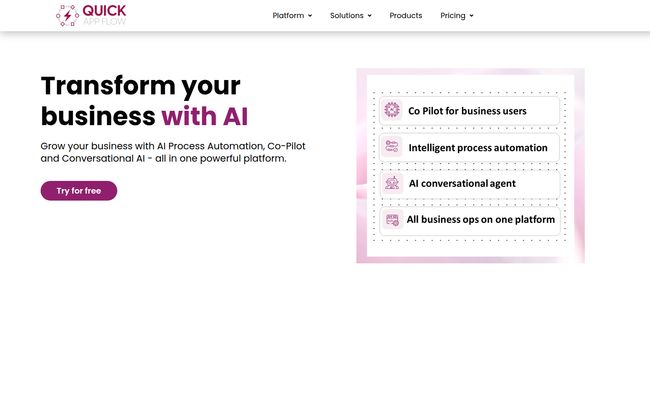
This is where things get interesting. QuickAppFlow isn’t just about dragging and dropping components. It’s about using AI to do the heavy lifting. Two features, in particular, stood out to me from their homepage.
Your New AI Co-Pilot
The first is the “AI Co-Pilot for business users.” This isn’t about generating code; it’s about using natural language to manage your business. Imagine telling your platform, “Show me all the sales leads from last quarter in the northeast region that haven’t been contacted this month,” and it just… does it. It’s like having a data analyst and a junior assistant rolled into one, always on, and never asking for a coffee break. For a small team, this could be a legitimate force multiplier.
Automating All The Boring Stuff
The second piece is the “Intelligent Process Automation.” Every business is bogged down by repetitive, soul-crushing tasks. Sending follow-up emails, updating CRM records, generating reports. QuickAppFlow aims to automate this away. By building custom workflows, you can connect different parts of your business and let the platform handle the tedious back-and-forth. This is where the real efficiency gains are made—freeing up your team to focus on growth, not paperwork.
Visit QuickAppFlow
It’s this combination that moves it beyond a simple builder. It’s an operating system for your business, powered by an AI that helps you run it.
Let’s Talk About The Pricing Structure
Alright, this is the part everyone secretly scrolls down to first. How much is this going to cost me? The pricing model is actually quite interesting and seems thoughtfully tiered for different stages of a startup’s life.
They have three main plans:
The Starter Plan: This one is clearly designed for testing an idea. For $1800 for 6 months (which works out to $300/month), you get to pick one of their 16 pre-built SaaS products and get it to market. The goal here isn’t to build your forever-business, but to test for product-market fit without betting the farm. You get the AI platform, the Co-Pilot, and enough storage and records to see if your idea has legs. A pretty smart way to dip your toes in.
The Launch Plan: Once you’ve got validation and you’re ready to go for real, this is your next step. At $750 per month, it’s a bigger commitment, but you get more for it. You get access to their full suite of 15 SaaS products as a base, more storage, more records, and more flexibility with hosting locations. This is for the serious entrepreneur who’s ready to scale.
The Build Plan: This is the “call us” plan, and it’s for custom jobs. You pay per feature, but here’s the kicker: they offer free development for up to 45 man-days. Let me say that again. 45 man-days of free development. In my world, that’s an insane amount of value. That could be tens of thousands of dollars in traditional development costs. This is for founders who have a unique vision that doesn’t fit a template and need to build something from the ground up, but still want the cost and speed benefits of the low-code platform.
Okay, But What’s the Catch?
I’ve been around the block, and no platform is perfect. While QuickAppFlow is impressive, there are a few things to keep in mind. Let’s call them considerations, not necessarily deal-breakers.
First, there’s the potential for platform dependency. When you build your entire business on a single platform, you’re tying your fate to theirs. Migrating a complex SaaS application off a proprietary low-code system would be… well, a nightmare. You have to trust that the platform will continue to evolve and support your needs.
Second, the extent of customization will always have a ceiling comapred to traditional coding. Yes, their ‘Build’ plan offers custom features, but for hyper-specific, truly novel functionalities, you might eventually hit a wall that only pure code can break through. You’re trading infinite flexibility for incredible speed and lower cost. For 95% of businesses, that’s a fantastic trade. For the other 5%, it’s a point to consider.
Finally, the classic “contact us for pricing” on the most powerful plan is a bit of a pet peeve of mine, but it’s standard practice in enterprise sales. It just means you need to be prepared to have a conversation to understand the full cost of your custom build.
So, Who Is This Really For?
After digging in, I have a pretty clear picture of the ideal QuickAppFlow user.
- Early-Stage Entrepreneurs: If you have a SaaS idea and a limited budget, the Starter plan is practically a no-brainer for validating your concept.
- Small to Medium Businesses: Teams that need to streamline internal operations with custom apps (like a bespoke CRM or project management tool) without a massive IT budget.
- The Citizen Developer: A product manager, marketing lead, or operations head who knows exactly what their department needs and is tired of waiting for the official dev queue to clear up.
It’s probably not for the dev purist who loves tinkering with every line of code or the massive corporation with a deeply entrenched, legacy tech stack that can’t be easily replaced.
Frequently Asked Questions about QuickAppFlow
How much does it really cost to build a B2B app?
If you use their ready-to-launch templates, you don’t pay for development—just the monthly hosting and support fee for the plan you choose (e.g., $750/month on the Launch plan). If you need a fully custom build, you’ll be on the ‘Build’ plan, where you pay per feature, but you get a significant head start with up to 45 man-days of development included for free.
Are the apps built on QuickAppFlow multi-tenant?
Yes, and this is a big deal. Multi-tenancy is a fundamental architecture for any real SaaS product, allowing you to serve multiple customers from a single instance of the application. The fact that this is baked in is a major advantage.
Can I build fully functional SaaS apps like HubSpot or ClickUp?
The platform is designed to build fully functional SaaS applications, and the FAQ on their site even mentions these names as examples. While you might not replicate every single feature of a behemoth like HubSpot on day one, the platform provides the foundation to build a powerful, competitive alternative much faster and cheaper.
Can I white-label the platform and the 16 available SaaS apps?
Yes, the FAQs on their pricing page confirm that you can white-label the apps. This is crucial for building your own brand and presenting a professional, cohesive product to your customers.
Where is my application data hosted?
The platform uses Microsoft’s Azure data centers. You can choose a specific location with the Starter plan, and any location with the Launch and Build plans, which is great for data sovereignty and performance.
My Final Verdict on QuickAppFlow
So, back to the original question: can you really launch a SaaS in a week? With QuickAppFlow, for a template-based application, the answer seems to be a resounding yes. And that’s pretty wild.
This isn’t just another website builder. It’s a serious tool for rapid application development that democratizes the ability to build and launch a software company. The combination of pre-built solutions, a powerful AI Co-Pilot, and an incredibly generous custom build offer makes it a compelling option in the low-code space.
Sure, you have to weigh the trade-offs of platform dependency. But for the speed, cost savings, and sheer power it puts in the hands of entrepreneurs and business operators, QuickAppFlow is a platform that anyone serious about launching a digital product should be paying close attention to. It might just be the tool that turns your brilliant idea into your next big success.


