
Categories: AI Chatbot, AI Code Assistant, AI Code Generator, AI Code Review, AI Copilot
Refact.ai Review: An AI Coder That Respects Your Privacy?

We’ve all been riding the AI coding assistant wave. From the moment GitHub Copilot dropped, it felt like the game had changed. And it did! But as the initial “wow” factor faded, a nagging question started to creep into the back of my mind, and probably yours too: Where is my code actually going?
It’s the classic tech dilemma, isn’t it? Trading privacy for convenience. For a lot of us, especially those working on proprietary projects or for clients with strict NDAs, sending snippets of our precious codebase to a massive third-party server is… well, a bit unsettling. I’ve been on the hunt for something that gives me the power of AI without the privacy headache. And I think I might have found a serious contender in Refact.ai.
I’ve spent some time kicking the tires on this thing, and it’s more than just another autocomplete tool. It bills itself as an “open-source, Autonomous AI Agent on your code,” which is a fancy way of saying it’s designed to be a smart partner, not just a parrot.
So, What is Refact.ai, Really?
Okay, cutting through the marketing buzz. Refact.ai is an AI coding assistant that integrates directly into your favorite IDE (yes, it supports VS Code and the whole JetBrains family). But instead of just finishing your lines of code, it’s a whole toolbox. Think code completion, refactoring, finding and fixing bugs, and even an AI chat that has context of your entire codebase.
I’ve always felt that the best tools are the ones that feel less like a tool and more like an extension of your own brain. Refact.ai is aiming for that. It’s less like a backseat driver shouting suggestions and more like a junior developer you can pair program with – one that never gets tired and has read a whole lot of documentation.
The Big Deal About Privacy and Self-Hosting
This, for me, is the absolute game-changer. The elephant in the room with many AI tools is the data privacy issue. We’ve all seen the discussions on Hacker News and Reddit. Refact.ai tackles this head-on by being open-source and offering a self-hosting option.
What does that mean? It means you can run the entire Refact AI engine on your own machine, or on your company’s private server (on-prem or in a private cloud). Your code never has to leave your controlled environment. It’s not sent to Refact’s servers for processing. Zero telemetry. Nothing. This is huge. For enterprise teams or security-conscious freelancers, this isn’t just a feature; it’s the entire reason to switch.
It’s the difference between discussing your secret project plans in a crowded cafe versus your own soundproof office. The peace of mind is, frankly, priceless.
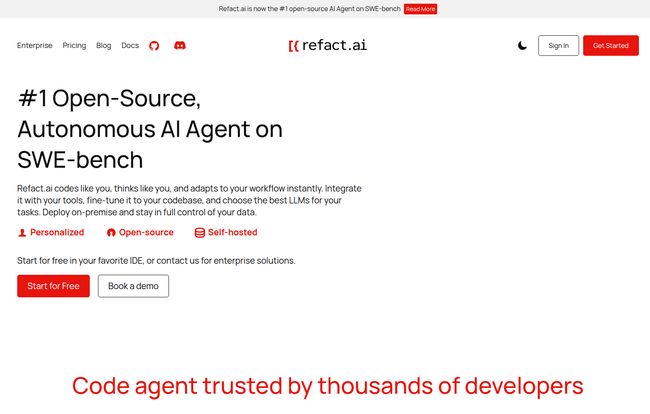
Visit Refact.ai
Core Features That Actually Move the Needle
Alright, privacy is great, but does it actually code well? The short answer is yes. It’s surprisingly powerful, and some of its abilities go beyond the standard fare.
Your AI-Powered Pair Programmer
The in-IDE AI chat is probably my favorite feature. Instead of toggling over to ChatGPT and pasting code with a prayer, you can just ask questions right there. “Hey, how can I refactor this function to be more efficient?” or “Explain this block of legacy code someone wrote ten years ago.” Because it has access to your codebase (the parts you allow, of course), its answers are contextually aware. It’s not giving you generic advice; its giving you advice for your project.
More Than Just Autocomplete
The code completion is fast and smart, as you’d expect. But the real magic is in the more complex tasks. It can help transform code, like converting code from one language to another or generating entire unit tests based on a function. On their site, they have a pretty bold claim: turn “80 hours of building from scratch” into “20 minutes.” While that’s probably the best-case scenario, the sentiment rings true. It automates the tedious, repetitive stuff, freeing you up to focus on the hard architectural problems.
An Agent That Learns Your Code
This is where things get a little nerdy, but it’s important. Refact.ai uses a “codebase-aware vector database (RAG)”—which is a technical way of saying it creates a map of your project’s code. This allows the AI to understand the relationships between different files and functions. It knows your custom classes and unique logic. This is why its suggestions feel so relevant and not just pulled from a generic open-source dataset. It learns your style.
Let’s Talk Money: The Refact.ai Pricing Tiers
Pricing is always a sticking point. I was pleasantly surprised here. The structure seems fair and scales well, from hobbyists to massive corporations.
Here’s a quick breakdown I put together:
| Plan | Price | Key Features |
|---|---|---|
| Free | $0 / month | Autonomous AI Agent, 2,000 coins for chat, unlimited autocompletion, self-hosting option available, Discord support. |
| Pro | $10 / month | Everything in Free, plus 10,000 coins/month, and access to more powerful “Thinking abilities”. |
| Enterprise | Custom | On-premise installation, LLM fine-tuning on your data, priority support, complete code privacy. |
The fact that the self-hosting option is available on the free plan is just incredible. It shows a real commitment to their privacy-first philosophy, not just using it as a carrot to get you to the expensive plans.
The Good, The Bad, and The Realistic
No tool is perfect, right? Here’s my honest breakdown.
What I Really Like
The privacy-first, self-hostable model is the clear winner. It’s a breath of fresh air. The open-source nature also gives me confidence in its longevity and transparency. And the contextual AI chat is genuinely useful, saving me countless trips to Stack Overflow.
Potential Hurdles
Let’s be realistic. Setting up a self-hosted server isn’t a one-click affair. It does require some technical know-how. If you’re not comfortable with Docker or managing a server, you might find it a bit daunting. Also, like any AI, its effectiveness is only as good as the underlying models (it uses a mix of its own and models like Claude and GPT). And the coin system for the chat/agent features might take some getting used to, though the free allotment is pretty generous.
So, Who Is This For?
After playing around with it, I have a pretty clear idea of who would get the most out of Refact.ai.
- The Privacy-Conscious Developer: This is you. If you’ve ever hesitated to use an AI tool because of data concerns, Refact is your answer.
- Freelancers and Small Teams: The Pro plan is very reasonably priced, and the productivity boost could easily pay for itself in a few hours of saved work.
- Large Organizations: The Enterprise plan is tailor-made for companies that need to maintain absolute control over their intellectual property while still giving their developers the best tools. The ability to fine-tune models on an internal codebase is a killer feature.
My Final Verdict
In a world crowded with AI assistants, Refact.ai has carved out a very important niche. It’s not just trying to be the smartest AI; it’s trying to be the most trustworthy. It successfully balances powerful, next-generation features with a deep respect for code privacy and developer control.
Is it going to write your entire application for you? No, and it shouldn’t. But it will absolutely make you a faster, more efficient, and potentially happier coder by taking care of the grunt work. For me, the combination of open-source transparency and a self-hostable architecture makes it more than just a tool—it feels like a step in the right direction for the future of software development.
Frequently Asked Questions
Is Refact.ai truly free to use?
Yes, there is a very generous Free tier that includes unlimited autocompletion, AI agent capabilities, and even the self-hosting option. It comes with a monthly allowance of coins for using more advanced AI chat and agent features.
How does Refact.ai protect my code’s privacy?
The main way is through its self-hosting feature. You can run the AI model on your own local machine or private server. This ensures your code is never sent to any third-party servers, giving you complete control and privacy.
What AI models does Refact.ai use?
Refact.ai supports a range of powerful models. According to their site, this includes models like Claude 3, GPT-4, and their own specialized models. The Pro and Enterprise plans often provide access to the more advanced models.
Can I use Refact.ai on my company’s private server?
Absolutely. This is one of its main selling points. The Enterprise plan is designed specifically for on-premise or private cloud deployment, offering maximum security and control for businesses.
Is it difficult to set up the self-hosted version?
It requires some technical comfort, particularly with tools like Docker. It’s not a simple one-click install for a non-technical user. However, for a developer or a DevOps professional, the documentation is straightforward and the process is manageable.


