
Categories: AI API, AI Assistant, AI Copilot, AI Developer Tools
Rehance Review: An AI Copilot for Your SaaS?

If you’ve ever built or managed a SaaS product, you know the feeling. You pour months, maybe years, into creating a powerful, feature-rich platform. You launch. You get your first users. And then… the support tickets roll in. “How do I do X?” “Where can I find Y?” “I’m trying to do Z but it’s not working.”
It’s a special kind of pain. Your beautiful, powerful application feels more like a cryptic puzzle to your users. They’re drowning in features they can’t find, leading to frustration, abandonment, and the dreaded C-word: churn. We’ve all been there, staring at analytics, wondering why people aren’t adopting that one killer feature. It’s because they can’t find the dang thing.
So, what if you could just… eliminate that confusion? What if a user could simply type what they want to do, in plain English, and the software would just… do it? It sounds a bit like science fiction, but that’s the promise of a new tool that recently caught my eye: Rehance.
So, What on Earth is Rehance?
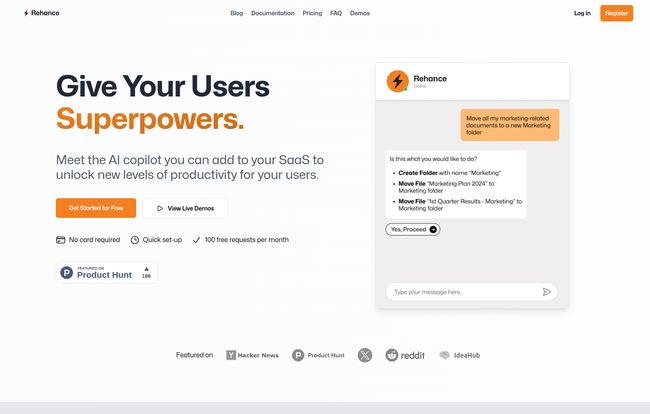
On the surface, Rehance calls itself an “AI copilot for SaaS.” Okay, buzzwords. We’ve heard ’em all before. But when I looked closer, I realized it’s something genuinely different. This isn’t just another glorified chatbot that pops up to ask, “Can I help you?” and then points you to a stale FAQ article.
Rehance is designed to be an action-taker. It’s the difference between asking a passenger for directions and having a self-driving car that just takes you there. The founders, Jason & Ernesto, put it perfectly: they’re building for SaaS what self-driving is to a car. A user can literally say, “Create a new invoice for Client ABC for $500,” and Rehance, if configured correctly, performs the action. Instantly.
No more hunting through menus. No more deciphering icon-only buttons. Just pure, unadulterated user intent turned into action. Now that got my attention.
Visit Rehance
The Chronic Headaches of Running a SaaS Platform
Running a software company is a constant battle against friction. Every confusing step in your UI, every moment of hesitation, is a potential exit point for a customer. You’re not just selling a tool; you’re selling an outcome, a workflow, a better way of doing things. And anything that gets in the way of that is a problem.
The classic approach is to throw more documentation at it. More tooltips, more video tutorials, more onboarding flows. But that’s just more stuff for the user to learn. It’s like handing someone a bigger, heavier manual when all they wanted was to turn the thing on. Rehance takes the opposite approach. It doesn’t give them a map; it teleports them to their destination.
How Rehance Aims to Be Your All-in-One Painkiller
This isn’t just about making things a little bit easier. The potential impact here touches on some of the biggest pain points in the SaaS world.
Instantly Unblocking Frustrated Users
Think of your newest user. They’re excited, they’ve just signed up, and they want to accomplish one specific task. They click around, get lost, and their initial excitement quickly turns to annoyance. That’s the moment you lose them. With a tool like Rehance, that user types, “How do I add a new team member?” and instead of getting a link, the tool says, “Sure, what’s their email?” and just does it. The user is unblocked. They feel smart and powerful. And they stick around.
The Hidden Gem: A Product Data Gold Mine
Here’s the part that really excites the product manager in me. Rehance doesn’t just help your users; it gives you an unprecedented look inside their heads. Every query they type is a direct expression of their intent.
Your analytics can show you where users click, but they can’t tell you what a user was trying to do when they rage-quit. Rehance logs can. Imagine discovering that 15% of your users are typing “export my data to Google Sheets” every week. If you don’t have that feature, you’ve just found your next big product update, backed by real data. Or maybe they’re using weird phrasing for a feature you already have—that’s a sign you need to improve your naming or UI copy. This is a qualitative data feedback loop on steroids.
Getting Technical: Is It a Pain to Set Up?
Okay, this all sounds great, but how hard is it to actually get working? The promise of a “drop-in script” is music to any dev team’s ears. And from what I see, the initial setup is indeed that simple. You add a bit of JavaScript to your app, and the Rehance widget appears.
But—and this is an important but—it isn’t pure magic. You do have to do some work. The AI needs to be taught what your app’s functions are. You have to define actions like `createProject` or `addUser` and connect them to the corresponding functions in your application’s code. This isn’t a no-code solution in the purest sense. It requires developer input to map user commands to your app’s capabilities.
Honestly, I see this as a good thing. It means you retain full control over what the AI can and cannot do, ensuring security and preventing unexpected behavior. It’s a pragmatic approach, trading a bit of upfront work for a lot of power and safety.
The All-Important Question: What’s the Damage? (Rehance Pricing)
Alright, let’s talk turkey. Great tech is only great if you can afford it. Rehance uses a usage-based pricing model, which has its pros and cons. I’ve always had a love-hate relationship with these models, but their transparency is commendable.
Here’s a quick breakdown:
| Plan | Price | Includes |
|---|---|---|
| Free | $0 / month | 100 requests/month, 7 day request history |
| Basic | $29 / month | 500 requests/month, 100 day request history |
| Business | $99 / month | 3000 requests/month, Unlimited request history |
| Enterprise | $149 / month | 5000 requests/month, Unlimited request history |
The Free plan is actually pretty generous. 100 requests a month is more than enough to integrate the tool, test it thoroughly with your team, and see if it actually works for your use case before committing a dime. I love that. The 7-day request history is a bit of a bummer, but hey, it’s free.
The paid plans scale quite reasonably. For a small but growing SaaS, the Basic or Business plan seems like a no-brainer if the tool proves its worth in reducing support load or increasing retention. The big consideration is for very high-volume applications. If you have tens of thousands of users making multiple requests a day, you’ll likely blow past the Enterprise plan and need custom pricing, which could get pricey. It’s something to model out before you jump in.
Also Read: AIdeaFlow Review: Your AI Podcast Generator?
My Two Cents: Is Rehance Worth It?
So, what’s the final verdict? In my experience, tools like this live or die by their execution. The concept is a 10/10.
Rehance is likely a fantastic fit for:
- SaaS companies with complex user interfaces. If your product has a steep learning curve, this could be a game-changer for user onboarding.
- Teams that want to ship AI features fast. Building this kind of natural language interface from scratch is a massive undertaking. Rehance lets you get 80% of the benefit for 10% of the effort.
- Product-led companies obsessed with user behavior. The data you’ll get from user queries is worth the price of admission alone.
You might want to think twice if:
- Your app is incredibly simple. If your UI only has three buttons, you probably dont need this.
- You have a massive, high-volume user base and a tight budget. You’ll need to do the math on that per-request pricing.
- You have zero developer resources. While it’s low-lift, it’s not no-lift. You need someone who can hook up the functions.
Ultimately, Rehance represents a shift in how we think about human-computer interaction. It treats conversation not as a separate channel for support but as the primary interface itself.
Frequently Asked Questions about Rehance
Is Rehance just another chatbot?
No, not at all. A traditional chatbot’s goal is to provide information, usually by pointing to articles or answering simple questions. Rehance’s goal is to take action. It directly integrates with your application’s functions to perform tasks on the user’s behalf, making it more of a ‘do-er’ than a ‘talker’.
How much technical skill do I need to integrate Rehance?
You’ll need some developer knowledge. While adding the initial script is simple copy-and-paste, the real power comes from defining and connecting your app’s functions (e.g., what happens when a user says ‘create a new project’). It’s designed to be straightforward for a developer, but it’s not a completely no-code tool.
Will the usage-based pricing get too expensive?
It depends entirely on your usage. For most small to medium-sized SaaS businesses, the pricing tiers seem very reasonable for the value provided. For large-scale enterprise apps with millions of requests, you’d need to discuss custom pricing. The best approach is to start with the free plan to gauge your typical request volume.
Can Rehance access sensitive user data?
You have full control over what Rehance can do. It doesn’t magically get access to your database. You explicitly define the functions it can trigger. For example, you would create a `changePassword` function in your code, and Rehance would only be able to trigger that specific action, using the secure methods you’ve already built. The security is in your hands.
Does Rehance work with any SaaS platform?
Since it’s integrated via a JavaScript snippet, it should be compatible with virtually any web-based SaaS platform, regardless of the front-end framework (React, Vue, Angular, etc.) or back-end language you’re using.
The Future of SaaS Interaction?
I’m genuinely excited about tools like Rehance. For years, we’ve been trying to teach humans to think like computers, forcing them to learn our UIs and workflows. The tide is finally turning, and we’re teaching computers to understand humans instead. It’s a more natural, more intuitive, and frankly, more respectful way to build software.
Rehance isn’t just a feature; it’s a philosophy. It’s a bet that the future of software is less about clicking and more about commanding. If they nail the execution, this could become the new standard for user experience. If you’re running a SaaS, I’d say give the free plan a shot. What have you got to lose? Except, maybe, a pile of those “how do I…” support tickets.


