
Categories: AI Agent, AI API, AI Email Assistant, AI Summarizer, AI Workflow, Large Language Models (LLMs), No-Code&Low-Code, SQL Query Builder
ReliveAI Review: No-Code AI Automation for Your Business?

How much of your day is spent on tasks that feel… well, robotic? Copying data from a spreadsheet to a CRM. Manually qualifying leads based on a set of rules. Sending the same three follow-up emails. For years, we’ve been using tools like Zapier or Make.com as the digital duct tape holding our business processes together. And don’t get me wrong, they’re fantastic. Lifesavers, even.
But they’re also a bit… rigid. They follow instructions. If X happens, do Y. They don’t think. They don’t learn. They don’t adapt.
Lately, though, a new wave of tools has started to appear on the horizon. Tools that promise not just automation, but intelligent automation. And one that recently landed on my radar is ReliveAI. It struts onto the scene with a bold claim: a no-code platform to build AI-powered workflows and agents that can actually think, remember, and adapt to your business. Sounds pretty good, right? Almost too good. So, naturally, I had to take a closer look.
What Exactly is ReliveAI Anyway?
Okay, let’s cut through the marketing jargon. At its heart, ReliveAI is a platform that lets you build super-smart assembly lines for your business data and tasks. Imagine you could hire a new team member who has instant access to the brains of OpenAI’s GPT-4, Anthropic’s Claude, and Google’s models. Now imagine you could teach this team member your exact business processes just by describing them in plain English. No code, no scripts, no developer headaches.
That’s the core idea. It connects to your various data sources and APIs and then lets you build ‘agentic workflows’—a fancy term for multi-step processes where an AI agent can make decisions along the way. It’s less like a simple trigger-action recipe and more like giving a smart apprentice a complex task and trusting them to figure out the steps.
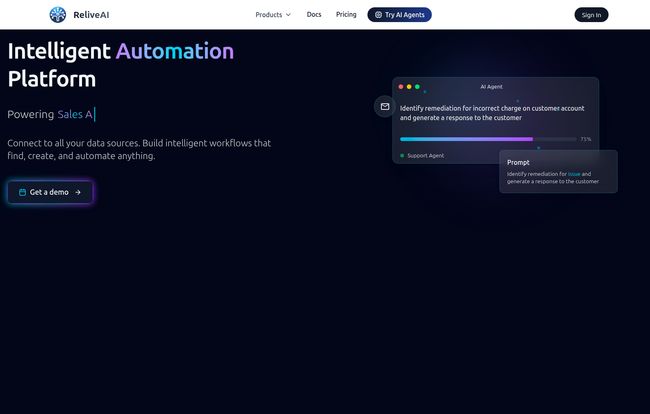
Visit ReliveAI
The Good, The Bad, and The AI-Powered
No tool is perfect, especially one that’s still fresh on the market. When I look at something new, I like to weigh the shiny promises against the real-world, rubber-meets-the-road realities. It’s about seeing the whole picture.
Where ReliveAI Shines (The Good Stuff)
The biggest win here is the democratization of powerful AI. For the longest time, building a custom AI solution for your business meant hiring expensive developers and data scientists. It was a massive undertaking. ReliveAI puts that power into the hands of the people actually doing the work—the marketing managers, the operations leads, the small business owners.
The efficiency gains are also pretty obvious. We’re not just talking about saving time on manual data entry. We’re talking about automating decision-making. Look at the example on their site: ‘Write a recommendation for a tiered-charge to a customer based on their recent usage.’ That’s not a simple ‘if-this-then-that’ task. That requires analysis, context, and a recommendation. Automating that kind of cognitive work is a huge leap forward.
I’m also a big fan of its multi-model approach. Being able to tap into OpenAI, Anthropic, and Google means you’re not locked into one ecosystem. If a new, better model comes out from a different provider tomorrow, you can theoretically switch over without rebuilding your entire system. That’s smart future-proofing.
Some Things to Keep in Mind
Now for a dose of reality. The platform is currently in public beta. If you’ve been in tech for any length of time, you know what that means. There might be some quirks, some features that aren’t fully fleshed out, and the occasional bug. That’s just the nature of new software. It’s for the early adopters who are willing to trade a bit of polish for a head start on new tech.
There’s also the dependency on external LLMs. While being multi-model is a plus, it also means your workflows are at the mercy of OpenAI’s or Google’s API uptime and pricing. If their service goes down, your smart agent suddenly isn’t so smart. It’s a calculated risk, but one you have to be aware of. Your automation is only as strong as its weakest API link.
Diving into the Features: Beyond the Hype
Let’s talk about what it’s actually like to use the thing. The experience is where a platform either proves its worth or falls flat.
Building Workflows in Plain English
This is the magic trick. The promise that you can just tell the platform what you want it to do. Instead of wrestling with dropdown menus and complex logic mapping, you’re writing a prompt. This lowers the technical barrier so dramatically. If you can write a clear email, you can probably build a workflow in ReliveAI. It turns a programming problem into a communication one, which is a space where way more people are comfortable.
The Power of AI Agents That Remember
Here’s a concept that I think is a real game changer. ReliveAI talks about agents that can ‘remember your business needs.’ This implies memory and context. A standard automation is stateless; it fires and forgets. An agent with memory, however, can handle a conversation, track a customer’s history through a process, or learn from previous outcomes to make better decisions next time. This is what separates simple automation from genuine AI assistance.
“It’s the difference between a tool and a teammate. A tool does what you tell it. A teammate understands what you need.”
Customization and Data Integration
An AI is only as good as the data it’s trained on. ReliveAI’s ability to connect to your specific data sources is crucial. It means the AI isn’t just pulling from a generic pool of internet knowledge; it’s learning from your customer data, your sales figures, your project updates. This makes its output and decisions directly relevant and infinitely more valuable. The more you can feed it about your own operations, the smarter it becomes within your world.
The Big Question: What About the Price?
Alright, the elephant in the room. You’re probably thinking, “This sounds great, but what’s it going to cost me?” And that’s a fair question.
As of right now, ReliveAI doesn’t have public pricing listed on its website. The main call-to-action is a “Get a demo” button. This is pretty standard for a B2B SaaS platform in its beta phase. They’re likely working with early customers to refine the product and figure out a pricing structure that makes sense. It might be based on the number of users, the volume of tasks, or the complexity of the agents you build.
My advice? If you’re genuinely interested, don’t let the lack of a pricing page stop you. Get the demo. This is your chance to talk to their team, explain your specific use case, and get a feel for whether it’s the right fit. It’s better to know if it can solve your problem first, then worry about the price.
Who is ReliveAI Really For?
I see a few key people getting really excited about this. There’s the scrappy small business owner who’s currently drowning in spreadsheets and manual follow-ups. There’s the innovative marketing manager who wants to build a truly intelligent lead scoring system that goes beyond simple demographics. I can also see the operations lead at a mid-sized company using it to build custom internal tools without having to beg for developer resources.
It’s for the problem-solvers. The people who can see a better way to do things but haven’t had the technical tools to build it. If you’re non-technical but have a deep understanding of your business processes, this could be your new best friend.
Final Thoughts: My Take on ReliveAI
So, is ReliveAI the future? I think it’s a very strong glimpse of it. The move from rigid, instruction-based automation to flexible, intelligent automation is the next logical step, and ReliveAI is planting its flag firmly in that new territory.
It’s still early days, and the ‘public beta’ tag is important to remember. But the foundation is incredibly solid. It reminds me of the early days of platforms like Webflow, which gave designers the power to build things that previously only coders could. ReliveAI is doing something similar for business process and AI. It’s an enabler. It’s a tool that could launch a thousand new efficiencies in businesses everywhere.
It’s definitely a platform I’ll be keeping a close eye on.
Frequently Asked Questions
- What is ReliveAI in simple terms?
- It’s a no-code platform that lets you build AI-powered workflows and ‘agents’ to automate complex business tasks using plain English, connecting to top AI models like GPT-4.
- Do I need to know how to code to use ReliveAI?
- Nope. That’s the main appeal. It’s designed for non-technical users who understand business processes but don’t write code.
- What AI models does ReliveAI integrate with?
- It integrates with major Large Language Models (LLMs) from leading providers, including OpenAI, Anthropic, and Google.
- Is ReliveAI free?
- Currently, there is no public pricing available as the platform is in beta. You need to schedule a demo to get details on access and potential costs for your specific needs.
- How is ReliveAI different from a tool like Zapier?
- Zapier is primarily for trigger-action automation (if this happens, do that). ReliveAI is designed for more complex, multi-step ‘agentic’ workflows where an AI can make decisions, analyze data, and learn from context, making it more intelligent than just a simple connector.
- Can I build completely custom AI agents for my business?
- Yes. The platform is built around the idea of connecting to your own data sources and using its no-code interface to build agents and workflows tailored to your specific business logic and needs.
Conclusion
The world of business automation is getting a much-needed intelligence upgrade. Platforms like ReliveAI are at the forefront, moving us from an era of simply connecting apps to one of creating intelligent agents that can truly work alongside us. While it’s still early for ReliveAI, the promise is undeniable and exciting. If you’ve ever wished you could just explain a repetitive, thought-intensive task to a computer and have it take over, you might want to give them a call. The future of work might be closer than we think.


