
Categories: AI API, AI Speech-to-Text, AI Transcriber, AI Transcription, Audio To Text AI
SaladCloud Review: Is This the End of High Cloud Costs?

Let’s have a little heart-to-heart. If you’ve ever spun up a GPU instance on AWS or Google Cloud for a serious project, you know that feeling. The one where you’re watching your AI model train, and with every percentage point of progress, you can practically hear a cash register cha-chinging in the background. For years, we’ve just accepted it. The ‘Big Three’ have a chokehold on high-performance computing, and their invoices are the stuff of nightmares for startups and indie devs alike.
It’s a tollbooth on the road to innovation. I’ve personally shelved passion projects because the projected cloud compute bill looked more like a down payment on a house. So when I first heard about SaladCloud, my default SEO-blogger cynicism kicked in. A “people-powered cloud” offering GPU time for a fraction of the cost? Yeah, right. I’ve seen these promises before.
But I kept digging. And the more I looked, the more intrigued I became. This isn’t just another Vultr or DigitalOcean competitor. This is a fundamentally different idea. And it might just be the shake-up our industry needs.
So, What Exactly is This SaladCloud Thing?
Okay, strip away the marketing jargon. At its heart, SaladCloud is a distributed computing network. Instead of owning massive, power-hungry data centers, they tap into a global network of consumer PCs. Think of it like Airbnb, but for your graphics card. There are hundreds of thousands of gamers and enthusiasts out there with powerful GPUs (the site says over 450K+) that sit idle most of the day. Salad lets them rent that unused power out to people like us who desperately need it.
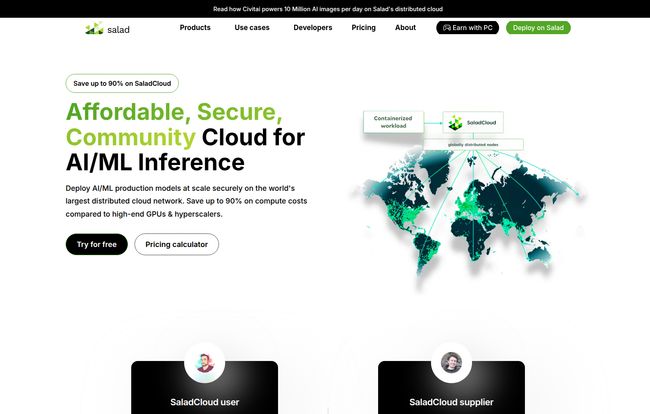
Visit SaladCloud
It’s a wild concept. It’s decentralized. It’s a bit rebellious. Your AI model isn’t running in a sterile, temperature-controlled facility in Virginia; its running in pieces across countless gaming rigs in Ohio, Berlin, and maybe even your neighbor’s basement. This distributed nature is how they completely sidestep the colossal overhead of traditional cloud providers. No billion-dollar data centers means… you guessed it… much, much lower prices.
The Features That Actually Matter to Developers
A cool idea is one thing, but can it actually do the work? I was skeptical about whether a patchwork of consumer machines could offer the kind of tools we rely on. Turns out, they’ve thought this through pretty well.
A GPU for Every Occasion
The core offering is, of course, the GPU compute. You can spin up instances with specific GPUs, from a humble RTX 3060 to an absolute beast like the RTX 4090. This is huge. You’re not just getting some generic “GPU Large” instance; you can pick hardware that fits your task, whether it’s running inference on a machine learning model, batch processing images, or even molecular dynamics simulations. They give you the keys to a whole garage of different engines, not just one.
The Surprisingly Good AI Transcription
This one caught me off guard. They have an AI Transcription API that they claim is highly accurate. In a world where transcription services can get pricey fast, having a cost-effective, high-quality API built right into the platform is a serious bonus. I can see this being a game-changer for anyone working with audio or video data on a budget, from podcasters to researchers analyzing interviews.
Developer-Friendly Deployments
This is where my techy side gets interested. They offer a Container Engine, which means if you’re already using Docker, you can deploy your applications onto their network without a massive headache. They also support Virtual Kubelets, which allows you to extend an existing Kubernetes cluster to run pods on Salad. In plain English? They make it relatively easy to move your existing work onto their platform without rebuilding everything from scratch. That shows they understand their audience isn’t just hobbyists but professionals who value their time.
Let’s Talk About the Price Tag (The Real Reason You’re Here)
Alright, this is the main event. Is it really that much cheaper? In a word: yes. The prices are, frankly, a bit ridiculous in the best way possible. You’re not looking at a 10-20% saving. In many cases, it’s more like 80-90% cheaper than what you’d pay for comparable power from a legacy provider.
Here’s a quick look at some of their GPU instance pricing. I’ve pulled a few examples, but you should check their full pricing page for the latest numbers. Note the term “Batch” – this is their lowest-cost tier, ideal for jobs that aren’t super time-sensitive.
| Instance / GPU | Specs | Batch Hourly Rate | Estimated Monthly Cost |
|---|---|---|---|
| RTX 4090 | 24GB VRAM, 8GB RAM, 4 vCPUs | $0.204 /hr | $148.90 |
| RTX 3080 | 10GB VRAM, 8GB RAM, 4 vCPUs | $0.114 /hr | $83.22 |
| RTX 3060 Ti | 8GB VRAM, 8GB RAM, 4 vCPUs | $0.064 /hr | $46.72 |
| General Purpose | 8GB RAM, 4 vCPU | $0.024 /hr | $17.52 |
Look at those numbers. Getting access to an RTX 4090 for under $150 a month is unheard of. No contracts, no pre-pay. It’s a pure pay-as-you-go model. This pricing structure alone is enough to make any CTO or project lead seriously reconsider their cloud strategy.
The Good, The Bad, and The GPU
No platform is perfect, and if I pretended SaladCloud was, you’d rightly click away. Being a professional means giving the full picture, not just the sunshine and rainbows. So lets get real about the pros and the cons.
What I Really Like About SaladCloud
The cost is the obvious one, so I won’t beat that drum again. What’s more impressive is the flexibility. The ability to customize your instance with the exact GPU, vCPU, and RAM you need is fantastic. Plus, the whole no-contract, no-prepay setup is a breath of fresh air. It feels genuinely user-first. I also have to say, I’m a sucker for the whole “people-powered” ethos. It feels like a small rebellion against the centralization of the web, and that’s a cause I can get behind.
A Few Things to Keep in Mind
Okay, here’s the reality check. The biggest ‘catch’, if you can call it that, is that you’re running on consumer hardware. This means performance can be more variable than on a standardized enterprise-grade server. An RTX 3080 is an RTX 3080, but the rest of the host system can differ. For most batch-processing tasks, this is a non-issue. But for ultra-low-latency applications, it’s a consideration.
Also, some of their most exciting services—like Distributed File Storage and Managed Databases—are still listed as “Coming Soon.” This shows they’re growing, but it also means the ecosystem isn’t as mature as, say, AWS’s endless list of services. You have to be okay with a platform that is still building out its full vision. For me, the trade-off for the cost is well worth it, but it’s not for everyone.
Who Should Be Using SaladCloud?
So, who is this for? I don’t think SaladCloud is going to convince a massive bank to move its entire infrastructure over tomorrow. But that’s not the point. This is for:
- AI Startups and Researchers: Anyone who needs to train or run inference on models without a FAANG-level budget.
- Indie Game Developers: Need to render assets or run builds? This is a phenomenally cheap way to do it.
- Digital Agencies & Freelancers: For tasks like large-scale data scraping, image processing, or video rendering, the cost savings could directly boost your profit margins.
- The Curious Coder: If you just want to experiment with powerful hardware without taking out a small loan, this is your playground.
If your workload is interruptible and can be broken into smaller chunks (think batch processing, not hosting a live-world MMORPG), you are the prime candidate for SaladCloud.
Is SaladCloud the Future of Cloud Computing?
Here’s my final thought. SaladCloud isn’t just a cheaper cloud; it’s a different kind of cloud. It’s a reminder that there’s more than one way to solve a problem. Will it replace AWS? No, not anytime soon. But it represents a powerful and necessary counter-current. It democratizes access to the kind of computing power that has been locked away in corporate data centers for too long.
For me, it’s one of the most exciting developments in the cloud space in years. It’s a bit scrappy, it’s community-driven, and it has the potential to save people a ton of money. And in this economy, that’s not just a nice feature—it’s everything. It’s a platform that’s not just built on silicon, but on a community. And that’s a foundation I’m excited to watch them build on.
Your Burning Questions Answered
- How does SaladCloud actually work?
- It creates a distributed network by allowing individuals to rent out their idle computer resources, primarily their GPUs. Salad packages this distributed power and makes it available to developers as a unified cloud service at a very low cost.
- Is it secure to run my applications on random peoples’ computers?
- This is a valid concern. Salad uses containerization (like Docker) to create isolated, secure environments for each job. This means your application is sandboxed and can’t access the host’s system, and the host can’t see what’s inside your container. They’ve put a lot of thought into a zero-trust security model.
- What’s the catch with the low prices? Is performance reliable?
- The main trade-off is the use of consumer-grade hardware, which can have more performance variability than enterprise servers. The ‘Batch’ pricing tier, their cheapest, is for workloads that can tolerate potential wait times. It’s a trade-off: you sacrifice some predictability for massive cost savings.
- What’s the difference between ‘Batch’ and other priority levels?
- Batch is the lowest-priority, lowest-cost queue. It’s perfect for tasks that can run overnight or don’t have a tight deadline. They will likely have higher-priority (and slightly more expensive) tiers for jobs that need to start immediately and run without interruption.
- Can I run a persistent web server or database on Salad?
- Right now, it’s best suited for containerized, interruptible workloads rather than always-on services like a traditional web server. However, with Managed Databases and other features on their roadmap, this could change in the future.
- How do I even get started with SaladCloud?
- You can head to their website, sign up, and check out their documentation. They provide guides on how to deploy container images to their network. Since it’s pay-as-you-go, there’s no major upfront commitment to just try it out.


