
Categories: AI Copilot, Large Language Models (LLMs)
Second Opinion Extension: My Take on This Grok Fact-Checker

You ask ChatGPT for a quick summary of a historical event or a technical concept, and it spits out something that sounds incredibly confident. Polished, even. But there’s a little voice in the back of your head, the one that’s been doing SEO and sifting through web content for years, that just says… ‘hmmm, that doesn’t feel quite right.’
This little dance with AI-generated content is the new normal. We’re swimming in it. And honestly, who hasnt been burned by a confident-sounding but totally wrong AI response? It’s the digital equivalent of asking for directions and being sent on a wild goose chase with a smile. That’s why when I stumbled upon the Second Opinion Extension, my curiosity was definitely piqued.
A tool that promises to fact-check AI and web content on the fly? Using Grok, of all things? Okay, you have my attention.
So, What is This Second Opinion Thing Anyway?
At its heart, the Second Opinion Extension is a simple browser tool. It’s designed to be a quick, almost reflexive check on any piece of text you’re reading. Whether it’s a paragraph from a news article, a blog post, or a response from your favorite chatbot, the idea is to give it a once-over for accuracy and bias.
It acts like a little AI-powered fact-checker that lives in your browser, ready to jump in and offer, well, a second opinion. It uses Grok AI—the model from Elon Musk’s xAI—to analyze text and flag potential inaccuracies, hidden biases, or important context that might be missing. It’s a bold claim in an era of rampant misinformation.
How It Actually Works (It’s Almost Too Simple)
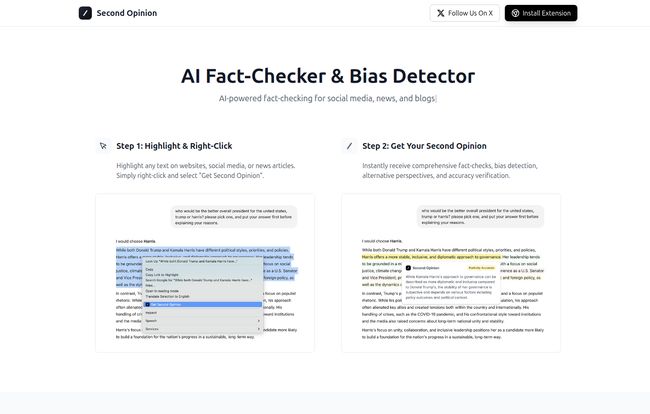
This is where the tool really shines for me. There’s no complicated dashboard or a steep learning curve. The process is dead simple:
- You find a piece of text you’re skeptical about.
- You highlight it with your mouse.
- You right-click and select “Get Second Opinion.”
That’s it. A moment later, a little window pops up with Grok’s analysis. It points out what might be off, what’s missing, or if the original text has a particular slant. It’s incredibly intuitive. No friction. This is the kind of usability that gets people to actually adopt a tool.
Visit Second Opinion Extension
A Quick Detour on Why Grok is an Interesting Choice
I find the choice of Grok fascinating. In the great AI wars of the 2020s, you have the giants like OpenAI’s GPT-4 and Google’s Gemini. Then you have Grok, which is branded as being more… rebellious? It’s been programmed to have a bit of wit and a “rebellious streak,” and it draws its real-time information from X (formerly Twitter). Using it as the engine for a truth-seeking tool is a bit ironic, but also clever. It’s positioned as an outsider, which for a “second opinion,” feels thematically right. It’s not just another echo in the chamber.
The Good, The Bad, and The API Key
No tool is perfect, right? After playing around with it, here’s my breakdown. I think it’s important to see both sides of the coin before you hit that install button.
The Upside: My First Impressions
The biggest pro is the sheer convenience. The ability to right-click anything and get an instant analysis is a game-changer for anyone who does a lot of online research. For content creators, journalists, and students, this could save a ton of time. It’s a fantastic first line of defense against the subtle ‘hallucinations’ that plague all large language models. The extension itself is also free to install and supports multiple browsers, which is always a plus.
Judging by the chatter on X, I’m not the only one who sees the potential. People seem genuinely excited about it:
“Incredible work. Love this!” – Jeff Guthrie
“Wonderful 🙏” – mehak ali
That kind of early buzz from the tech community is usually a good sign.
Let’s Talk About the Catch: The Grok API
Okay, here’s the fine print. While the extension is free to install, using it is not. To make it work, you need to plug in your own Grok API key. And using that API costs money based on token usage.
It’s the classic ‘razor and blades’ business model. They give you the razor for free, but you have to keep buying the blades to use it. Now, for a heavy user, this might be a worthwhile expense. But for the casual user, the friction of getting an API key and the unknown cost might be a barrier. It’s a crucial detail that changes the proposition from a ‘free tool’ to a ‘freemium-style service’.
The Lingering Accuracy Question
The other major point to consider is that the tool’s output is only as good as Grok itself. And no AI is infallible. Grok can make mistakes, have its own biases, or fail to understand the nuance of a complex topic. So, you’re essentially fact-checking one AI with another AI.
This means you can’t treat the ‘second opinion’ as the absolute gospel. It’s a fantastic guide, a great way to spot red flags you might have missed, but it shouldn’t replace your own critical thinking. Always cross-reference with primary sources if something seems important. Think of it as a highly-informed suggestion, not a final verdict.
Putting it to the Test: Second Opinion vs. Misinformation
Imagine you’re reading an article that makes a bold claim about a new health trend. It sounds plausible, but a little too good to be true. Instead of opening 15 new tabs to search for studies and counter-arguments, you could just highlight the paragraph, right-click, and get an instant analysis.
Second Opinion might come back and say: “This claim is an oversimplification. While there is some preliminary research, it doesn’t support the strong conclusions made in this article. It also fails to mention the potential side effects discussed in [source].” Suddenly, you’ve gone from being a passive reader to an informed critic in about five seconds. That’s powerful stuff.
Who Is This Tool Really For?
So, who should drop what they’re doing and install this? In my opinion, the ideal user is someone already deep in the tech and information ecosystem.
- Content Creators and SEOs: We consume and produce so much information, a rapid-fire fact-checker is a godsend for research and competitor analysis.
- Students and Researchers: Perfect for quickly vetting sources and getting a broader perspective on academic papers or articles.
- Heavy AI Users: If you’re constantly prompting ChatGPT, Claude, or Gemini, this is a must-have to keep them honest.
If you’re a casual internet browser who just checks email and watches cat videos, the whole API key setup is probably more trouble than its worth. But for the information warriors among us? It’s definitely worth a look.
Frequently Asked Questions
How does the Second Opinion extension work?
It’s a Chrome extension (and supports other browsers) that integrates with Grok AI. You simply highlight any text on a website, right-click, and the tool sends the text to Grok for analysis. It then shows you a report on potential inaccuracies, bias, or missing information.
Is the extension itself free to use?
Yes, the extension is free to install. However, it requires a Grok API key to function, and using the Grok API involves costs based on your usage (token consumption). So, the platform it runs on is not free.
What browsers does it support?
Based on the information available, it’s a Chrome extension but is designed to be compatible with multiple browsers that support Chrome extensions, like Edge and Brave.
How accurate is the AI fact-checking really?
Its accuracy is entirely dependent on Grok AI’s capabilities. While powerful, no AI is perfect. It’s best used as a tool to spot potential issues, not as an absolute source of truth. Always use your own judgment.
Do I need a paid subscription to use it?
You don’t need a subscription to “Second Opinion” itself, but you will incur costs from xAI for using their Grok API. You’ll need to set up billing with them to generate and use your API key.
Is it better than just Googling something myself?
It’s different. Googling is for finding sources. Second Opinion is for analyzing a specific piece of text in front of you. It’s faster for getting a quick critique or identifying bias, whereas Googling is for deeper, manual research. They complement each other well.
My Final Verdict
The Second Opinion Extension is a genuinely clever and useful tool that addresses a very modern problem. It’s a step in the right direction for holding AI and online content accountable. The ease of use is its killer feature.
The reliance on a paid API key is its biggest hurdle for mass adoption, but for professionals and power users, the cost might be a small price to pay for the convenience and power it offers. It’s not a magic bullet that solves misinformation, but it is a fantastic, sharp, and easy-to-wield tool in the fight for digital literacy. And in 2024, we need all the help we can get.


