
Categories: AI Dream Interpreter, AI Games, AI Mental Health, AI Therapist
Selfgazer Review: Psychological Tarot & Self-Exploration?

In the world of SEO and digital trends, we see things come and go faster than fashion trends. One minute it’s all about sourdough starters, the next it’s about AI-generated art. But one trend that has some serious staying power is the digital wellness and spirituality space. We’re all looking for a little more meaning, a bit of clarity in the chaos. And into this crowded arena steps a new platform: Selfgazer.
When I first stumbled upon it, my seasoned-blogger-skepticism-meter went off. The name itself is pretty on-the-nose, right? But the tagline—”Have You Met The Mystery That Lives Within You?”—got me. It’s not the usual ‘find your destiny’ fluff. It felt more like an invitation to a conversation with, well, yourself. So I put my cynical hat on the shelf and decided to see what this was all about.
So, What Exactly is Selfgazer?
At its core, Selfgazer isn’t just another horoscope app or a random tarot card generator. It presents itself as a more thoughtful experience, a tool for self-exploration that uses the ancient symbolic systems of Tarot, Astrology, and even the I Ching as a framework. The whole idea is to use these classic archetypes not for fortune-telling, but for generating psychological insights. Think of it less as a crystal ball and more as a beautifully crafted mirror for your own psyche.
It’s a blend of ancient wisdom and modern psychology, designed to help you connect the dots in your own life. The platform seems to be built on the premise that these symbols can unlock parts of our own understanding, helping us see patterns we might otherwise miss. It’s an approach that reminds me a lot of Jungian psychology, with its focus on archetypes and the collective unconscious. Pretty heady stuff for a website, I’ll admit.
Visit Selfgazer
First Impressions and Navigating the Mystery
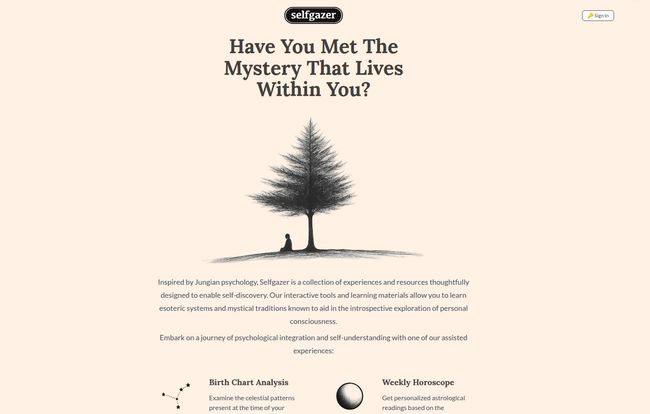
Landing on the Selfgazer homepage feels… calm. The design is clean, minimalist, with a sort of earthy, organic vibe. None of the flashing psychic hotline banners or cheesy purple nebulae you might expect. It immediately sets a tone of serious introspection rather than mystical fantasy. It’s inviting you to take a deep breath before you begin.
Everything is laid out pretty clearly. You’re not bombarded with pop-ups or confusing options. It’s all centered around their main offerings, which they call consultations and explorations. I appreciate a good user experience, and this one feels intentionally designed to be a gentle entry point into some potentially deep waters.
A Tour of the Oracle’s Digital Tools
Selfgazer isn’t a one-trick pony. It offers a suite of tools drawing from different traditions. This multi-pronged approach is one of its most interesting features.
More Than Just Your Newspaper Horoscope
The astrology section is surprisingly robust. They offer the standard Birth Chart Analysis, which is a must for any serious platform. But they also include Synastry Analysis (for comparing two people’s charts for relationship insights) and even a Bazi Chart, which is a sophisticated form of Chinese astrology. What really caught my eye, as someone who knows just enough to be dangerous, is that their calculations are powered by Swiss Ephemeris. For the uninitiated, that’s the gold standard for professional-grade astrological data. It’s like finding out your favorite burger joint uses a Michelin-star chef. It signals a commitment to accuracy that you just dont see in most mainstream apps.
The Psychological Tarot Readings
The Tarot offering is framed as a “Guided Tarot.” This suggests it’s more than just pulling a card and reading a generic meaning. The focus is on “psychological integration,” prompting you to think about how the card’s symbolism applies to your current situation. It’s about asking better questions, not just getting simple answers. I’ve always felt the real power of Tarot wasn’t in predicting the future, but in its ability to reframe the present. Selfgazer seems to lean heavily into that philosophy.
Consulting the Ancient I Ching
Including the I Ching, or Book of Changes, is another nod to a deeper, more philosophical approach. It’s one of the oldest divination texts in the world and is notoriously complex. Seeing it offered alongside Tarot and Astrology shows that Selfgazer is aiming for a user who is genuinely curious about different paths to wisdom.
The Big Question: Is It Really Psychological?
This is the million-dollar question, isn’t it? It’s easy to slap the word “psychological” onto something to make it sound more legitimate. In my experience, however, Selfgazer’s approach feels grounded. It’s not claiming to be a therapist. It’s positioning itself as a tool for introspection.
The real connection to psychology lies in the use of symbolism. Carl Jung built much of his work on the idea that archetypes—universal symbols like The Mother, The Hero, The Trickster—are fundamental to human experience. Tarot cards are basically a deck of these archetypes. When you see the Empress card, you’re not just seeing a picture of a queen; you’re tapping into a universal concept of nurturing, creativity, and abundance. Selfgazer encourages you to see these cards as prompts, as mirrors reflecting your own internal state. It’s a valid technique for self-reflection, as long as you hold it with the right perspective.
That “For Entertainment Purposes Only” Disclaimer
Ah yes, the fine print. On the site, Selfgazer is clear that it is “for entertainment purposes only” and cannot diagnose or treat mental health conditions. Some might see this as a cop-out, a way to avoid responsibility. But I see it as an act of profound honesty and ethical responsibility.
In an age where everyone seems to be an armchair therapist, it’s refreshing to see a platform set clear boundaries. This isn’t a replacement for professional help. It’s a supplement for personal growth. It’s a space to play, to wonder, to reflect. It’s entertainment, yes, but in the most meaningful sense of the word—something that engages and holds your attention for the purpose of insight and enjoyment. It’s a crucial distinction, and I respect them for making it so clearly.
What’s the Price for a Peek Behind the Veil?
Here’s where things get a bit mysterious. As of this writing, I couldn’t find a clear pricing page or subscription model on their website. The JSON data I looked at also showed an empty pricing field. This could mean a few things. It might be a completely free service, supported by ads or future premium features. It could be in a beta phase, where they are still figuring out the monetization strategy.
I even hit a 404 page when clicking around on one of the menus, which suggests the site might still be a work in progress. A little cosmic glitch, perhaps? For now, it seems you can explore its features without pulling out your credit card, which is a great way to see if its your cup of tea.
So, Who is Selfgazer Really For?
This platform isn’t for everyone. If you’re looking for a quick, yes/no answer about whether you’ll get that promotion, you might be disappointed. But if you fall into one of these camps, I think you’ll find a lot of value here:
- The Spiritually Curious: People who are drawn to these ancient systems but are turned off by dogma and fuzzy predictions.
- The Introspective Journaler: Anyone who loves prompts for self-reflection and wants to add a new dimension to their practice.
- The Amateur Psychologist: If you’re fascinated by archetypes, symbolism, and the workings of the human mind, this is a fantastic playground.
- The Astrology Buff: The use of the Swiss Ephemeris alone makes it worth a look for anyone who takes their charting seriously.
It’s decidedly not for someone in a mental health crisis or anyone looking for a substitute for professional medical or psychological advice.
Conclusion: A Mirror for the Modern Soul
So, what’s my final verdict on Selfgazer? I’m genuinely impressed. It manages to take ancient, often misunderstood systems and present them in a modern, intelligent, and psychologically-grounded way. It’s a sophisticated tool that respects both the traditions it draws from and the intelligence of its users.
It’s not about giving you the answers. It’s about helping you ask better questions. In a world full of noise, a tool that helps you listen to yourself is a rare find. If you’re open to it, Selfgazer could be a powerful and insightful companion on your journey of self-discovery. It’s a beautifully designed ‘Choose Your Own Adventure’ for the soul, and for now, it seems you can start that adventure for free.
Frequently Asked Questions about Selfgazer
- What is Selfgazer in simple terms?
- Selfgazer is a website and platform that offers tools for self-exploration using systems like Tarot, Astrology, and the I Ching. It frames these tools through a psychological lens to help users gain personal insights, rather than for predicting the future.
- Can Selfgazer replace therapy?
- Absolutely not. The platform is very clear that it is for entertainment and self-exploration purposes only. It is not designed to diagnose or treat any mental health conditions and should never be used as a substitute for professional psychological or medical help.
- Is the astrology on Selfgazer accurate?
- From a technical standpoint, yes. Selfgazer uses the Swiss Ephemeris for its astrological calculations, which is considered the industry standard for accuracy among professional astrologers. The interpretation of that data, of course, is subjective and meant for reflection.
- Is Selfgazer free to use?
- At the time of this review, there is no clear pricing information on the website, and it appears to be free to use. This may change in the future as the platform develops.
- What makes Selfgazer different from other tarot apps?
- Its main differentiators are its multi-system approach (including Astrology and I Ching), its explicit focus on psychological integration rather than fortune-telling, and its use of a professional-grade engine for its astrology calculations. The overall tone is more serious and introspective.


