
Categories: AI Chatbot, AI Language Learning, AI Translate
Speaks GPTs Review: Your AI Language Tutor?

You’re trying to string together a sentence in a foreign language, armed with nothing but a popular translation app. You type in, “I’m excited to try the local food,” and what you get back is… technically correct. But when you say it, you get that look. The polite but confused smile that says, “I understand the words you said, but no human has ever combined them in that order before.”
It’s the curse of literal translation. You get the vocabulary, but you lose the soul, the nuance, the stuff that makes a language feel alive. For years, I’ve been searching for a tool that bridges that gap. Not just a dictionary, but a guide. A mentor, even.
And I think I may have stumbled upon something pretty special in the ever-growing sea of custom GPTs. It’s called Speaks, and it’s less of a translator and more of a patient, incredibly knowledgeable language tutor that lives in your browser.
Visit Speaks GPTs
So, What in the World Are Speaks GPTs?
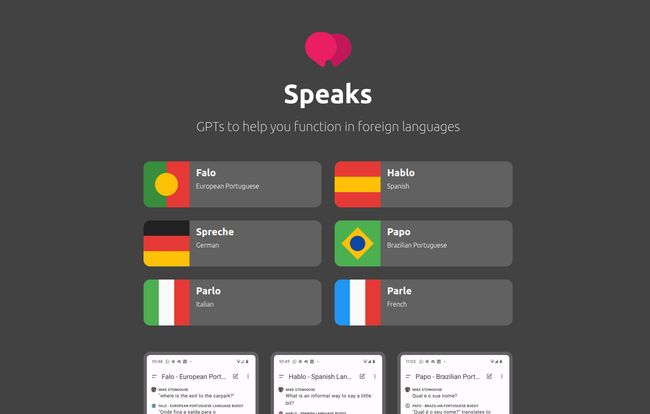
First off, Speaks isn’t a single app. It’s a whole suite of custom-built ChatGPT bots, each one fine-tuned for a specific language. The lineup currently includes:
- Falo for European Portuguese
- Hablo for Spanish
- Spreche for German
- Papo for Brazilian Portuguese
- Parlo for Italian
- Parle for French
These aren’t your run-of-the-mill translation bots. They were created by a developer who goes by mlaster, and they’re designed to do what other apps don’t: explain themselves. They don’t just give you the answer; they show you their work, breaking down grammar, syntax, and even cultural context. It’s like peeking under the hood of a language to see how the engine really runs.
The Real Magic Is in the ‘Why’
Anyone can build a bot that swaps words from one language to another. The traffic is in the details, and this is where Speaks really shines. It’s not just about getting from Point A to Point B; it’s about understanding the journey.
It Explains the Nuances of Word Choice
I was playing around with the European Portuguese GPT, Falo, and asked it a simple question: “Where is the exit to the carpark?” The translation it gave was “Onde fica a saída para o estacionamento?” But then, it did something brilliant. It added an explanation.
“- ‘Where is’ translates to ‘Onde fica’ in this context, not ‘Onde é’…
– ‘to the carpark’ becomes ‘para o estacionamento’; ‘do’ is not commonly used for ‘car park’…”
That right there is the gold. It’s the kind of correction you’d get from a native-speaking friend. It’s not just what to say, but why you say it that way. It anticipates your follow-up questions and helps you build a more intuitive feel for the language.
A Guide to Sounding Natural
The Spanish bot, Hablo, does a fantastic job with informalities and idioms. For instance, it explains that to say “a little bit,” you can use “un poquito.” It then breaks down how the “-ito” suffix is a diminutive that makes the word sound less formal and more endearing. This is how you go from sounding like a textbook to sounding like someone who actually gets the local vibe. It’s about a better user experience, not just for you, but for the person you’re talking to!
Who Is This Really For? (And Who Should Stick to Google Translate)
Look, if you’re in a rush at a train station in Rome and just need to know how to ask “Which platform for Florence?” then a standard, lightning-fast translation app is probably your best bet. Speaks isn’t built for speed. It’s built for depth.
This is for you if:
- You’re a dedicated language learner who wants to understand the structure and subtleties of a language.
- You’re an expat or long-term traveler trying to integrate and sound more natural in your daily conversations.
- You’re just plain curious and love seeing how different languages work.
This probably isn’t for you if:
- You need instant, on-the-go translations for quick interactions.
- You aren’t interested in the grammar or reasons behind a translation.
It’s a different tool for a different job. And in a world of one-size-fits-all solutions, I find that specificity really refreshing.
How to Get Started and What’s the Catch?
Getting set up is surprisingly simple. You just find the Speaks GPTs in the GPT Store and add them to your ChatGPT interface. From there, you just start chatting. The creator suggests putting specific tasks in quotes, like “Translate ‘I would like a coffee’ to French,” and it works like a charm.
Now, for the cost. Are the Speaks GPTs free? Yes and no. The creator isn’t charging for them directly, which is amazing. However, to use any custom GPTs, you need a ChatGPT Plus subscription. So, while the tool itself is a passion project, access to the playground it lives in comes with a monthly fee from OpenAI.
Honestly, if you’re already paying for ChatGPT Plus, adding this suite to your toolkit is a no-brainer. The value it provides for language learning easily justifies the (non-existent) extra cost.
My Final Verdict: A Game-Changer for the Serious Learner
After spending a good bit of time with the different Speaks bots, I’m genuinely impressed. In the gold rush of custom GPTs, where so many are just thin wrappers over a simple prompt, this feels different. It feels intentional. Purposeful.
It’s the difference between being handed a fish and learning how to fish. Translation apps give you the fish. Speaks teaches you to bait the hook, cast the line, and understand the currents. It might take a little longer, but you’ll be able to feed yourself for a lifetime. For anyone serious about moving beyond beginner-level fluency, this is an incredible resource.
Frequently Asked Questions about Speaks GPTs
- Do I need ChatGPT Plus to use the Speaks GPTs?
- Yes. Accessing custom GPTs like the Speaks suite is a feature of the ChatGPT Plus subscription. You cannot use them with the free version of ChatGPT.
- What languages are currently supported by Speaks?
- Currently, the suite includes European Portuguese, Spanish, German, Brazilian Portuguese, Italian, and French. Hopefully the creator will add more over time!
- Is this faster than using a normal translation app?
- No, it’s generally slower. The goal of Speaks isn’t speed; it’s depth and understanding. It takes a moment to generate the translation and the detailed explanation that comes with it.
- Can this really help me sound more like a native speaker?
- Absolutely. By explaining idioms, formalities, and the nuances behind word choices, it directly helps you avoid common, robotic-sounding mistakes and adopt more natural phrasing.
- Who is the creator behind this tool?
- The Speaks GPTs were created by a developer named ‘mlaster’. It appears to be a personal project, which is probably why it feels so thoughtfully designed.
- Is it actually free to use?
- The tool itself is free, but it requires a paid ChatGPT Plus account to access it. There are no additional fees from the creator to use the Speaks GPTs.
Conclusion
In the vast world of SEO and digital tools, it’s rare to find something that feels so… human. Speaks GPTs manage to do just that. They leverage powerful AI not to replace human understanding but to deepen it. If you’re on your own language learning path, give one of the bots a try. You might be surprised at how much you learn beyond just the words.
Reference and Sources
- OpenAI’s ChatGPT Official Page – For information on ChatGPT and the Plus subscription.
- mlaster on GitHub – The creator of the Speaks GPTs suite.


