
Categories: AI Lead Generation, AI Marketing, AI Research Tool, AI Sales, AI Search Engine
Stackpointer Review: Is This AI Tool a Game Changer?

If you’ve been in the SEO, marketing, or sales world for more than a week, you know the grind. The endless, soul-crushing task of building targeted lead lists. I’ve spent more hours than I care to admit trawling through LinkedIn, scraping websites, and piecing together data in spreadsheets that felt obsolete the second I saved them. It’s tedious work. It’s necessary work. But man, is it a drag.
We’re constantly being told that AI is here to save us from this kind of drudgery. Sometimes it feels like hype, but every now and then, a tool comes along that actually delivers on that promise. A few weeks ago, I stumbled upon Stackpointer, which was making some noise over on Product Hunt. It calls itself an “AI-powered business search engine.” My first thought? Sure, another one. But I decided to give it a whirl. And I’ve got to say, I’m pleasantly surprised.
What Exactly is Stackpointer? (And Why Should You Care?)
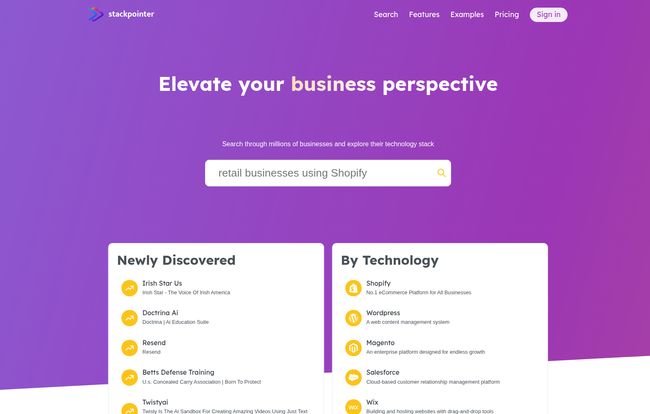
So, what is this thing? In the simplest terms, Stackpointer is like a super-powered Google specifically for finding and understanding businesses. But it’s got a killer trick up its sleeve. It doesn’t just find companies; it peeks under the hood to see what technology they’re using. Think of it as a digital private investigator for the B2B world. You can ask it plain-English questions like “show me SaaS companies in Austin that use Intercom,” and it just… does it.
This isn’t just about satisfying your curiosity. This is actionable intelligence. If you’re a marketing agency, a SaaS founder, or a sales rep, this kind of information is pure gold. It helps you find hyper-relevant prospects, understand your competitors’ strategies, and spot opportunities you would have otherwise missed completely.
Visit Stackpointer
My Experience Putting Stackpointer to the Test
Signing up was easy, so I jumped right into the free ‘Explorer’ plan to see what was what. I decided to start with a search similar to the one on their homepage: “retail businesses using Shopify.” The results populated almost instantly. No weird boolean operators or a million confusing filters to check. Just a simple, human question.
The AI Search That Actually Understands You
This is where Stackpointer first impressed me. The natural language search is… well, natural. It feels less like operating a database and more like asking a really smart research assistant for a favor. I tried a few more specific queries, like “pet supply stores in California that use Klaviyo” and “newly launched startups with a WordPress blog.” The quality of the results was pretty solid. It’s not just about keywords; the AI seems to grasp the intent behind the search, which is a big step up from many other tools I’ve wrestled with.
Peeking at the Tech Stack: The Real Goldmine
Okay, the search is cool, but the tech stack analysis is the main event. This is the feature that made me sit up and pay attention. For any given company in the search results, you can see a list of the known technologies they have on their website. We’re talking CRM software, e-commerce platforms, marketing automation tools, analytics scripts, you name it.
Why is this so powerful? Let me give you a concrete example. Let’s say you sell a chatbot service that integrates beautifully with Salesforce. With Stackpointer, you can generate a list of companies that use Salesforce but don’t seem to have a competing chatbot installed. That’s not a cold lead list; that’s a list of businesses with a pre-identified need for your exact product. It changes the entire conversation from “Do you need a chatbot?” to “I see you use Salesforce, and I have a tool that can make it even better.” Game changer.
The Good, The Bad, and The Nitty-Gritty
No tool is perfect, right? After playing around for a while, I’ve got a good handle on where Stackpointer shines and where it has room to grow.
What I Absolutely Loved
The sheer efficiency is the biggest win. What used to take me an afternoon of manual research can now be done in minutes. The ability to find companies based on their tech stack is, as I said, a massive advantage for targeted outreach. I also love that the higher-tier plans allow you to download your results. Getting a clean CSV file of hyper-targeted leads without teh copy-paste marathon is a beautiful thing. It just saves so. much. time.
Where It Could Be Better
Now for the reality check. The free plan is quite limited. With a cap of 10 results per search, it’s really just a demo. It gives you a taste of the power, like a free sample at a fancy cheese shop, but you can’t make a meal out of it. To get any real work done, you have to subscribe. Also, the accuracy is wholly dependent on the data Stackpointer can analyze from a business’s online presence. If a company is using some obscure or internally-built tool, it likely won’t show up. It’s not psychic, it’s a scraper—a very smart one, but a scraper nonetheless. So, you should always treat the data as a very strong starting point, not infallible gospel.
A Quick Look at Stackpointer’s Pricing
I appreciate a straightforward pricing model, and Stackpointer delivers that. No need to “contact sales” for basic access, which is always a relief. Here’s how it breaks down:
| Plan | Price | Key Features |
|---|---|---|
| Explorer | Free | AI search, 10 results per search limit, basic business info & stack analysis. |
| Launchpad | $5 / month | Everything in Explorer, 100 results per search limit. |
| Expansion | $25 / month | Everything in Launchpad, up to 5000 results per search, downloadable results. |
In my opinion, the Launchpad plan at $5/month is an incredible value for freelancers or small teams who just need to do regular, targeted research. The Expansion plan at $25/month is clearly aimed at power users—sales teams, marketing agencies, and anyone building large-scale outreach campaigns. Being able to download 5,000 results is a serious capability.
Who Really Benefits from a Tool Like This?
I can see a few groups getting a ton of value here. Sales professionals can ditch the cold calls and build lists of warm leads who actually need their services. Marketing agencies can find new clients by identifying businesses using outdated tech or lacking certain marketing tools. For SaaS companies, it’s a dual-threat: use it for lead gen and for keeping a close eye on what tech your competitors’ customers are using. Even entrepreneurs can use it to quickly size up a market and see what tools the major players are using to run their business.
Final Thoughts: Is Stackpointer Worth the Hype?
So, what’s the verdict? I’m genuinely impressed. Stackpointer isn’t some magical solution that will automate your entire sales process, but it is an incredibly sharp and efficient tool that solves a very real, very annoying problem. It takes the most painful part of B2B prospecting—the research and discovery—and makes it fast, intuitive and even a little bit fun.
If you’re still building lead lists by hand or struggling to find the right prospects, you should absolutely give Stackpointer’s free plan a spin. It might just be the smart research assistant you’ve been waiting for.
Frequently Asked Questions
- What is Stackpointer?
- Stackpointer is an AI-powered search engine designed to help you find and analyze businesses. It provides detailed company information, and most importantly, it identifies the specific software and technologies (the “tech stack”) a company uses on its website.
- How does Stackpointer help with lead generation?
- It allows you to create highly targeted lead lists by searching for companies that use specific technologies. For example, you can find all companies using HubSpot but not a particular competitor’s tool, giving you a list of businesses with a clear potential need for your product.
- Is Stackpointer free to use?
- Yes, there is a free ‘Explorer’ plan. It allows you to use the AI search and see tech stack data but limits you to 10 results per search. For more extensive use, there are paid plans that offer higher search limits and the ability to download your results.
- What kind of tech can Stackpointer identify?
- It can identify a wide range of web technologies, including e-commerce platforms (like Shopify, Magento), CRM systems (like Salesforce, HubSpot), content management systems (like WordPress), analytics tools, marketing automation software, and various plugins and scripts.
- Is the data from Stackpointer 100% accurate?
- Like any tool that analyzes public web data, its accuracy depends on what it can detect. It’s highly accurate for common and identifiable technologies, but may not catch every single tool a business uses. It’s best used as a powerful starting point for research and outreach.
- Who is the ideal user for Stackpointer?
- The ideal users are B2B sales professionals, marketing agencies, SaaS companies, and entrepreneurs who need to conduct competitor analysis or generate targeted lead lists based on technology usage.


