
Categories: AI Agent, AI API, AI Customer Service, AI Developer Tools, AI ERP, AI Workflow
StateSet Review: AI for E-Commerce Operations?

If you’re running a growing e-commerce brand, your backend probably looks like a bowl of spaghetti. You’ve got Shopify over here, Amazon FBA over there, a 3PL partner sending you cryptic spreadsheets, and your customer service team communicating through a series of frantic Slack messages. It’s a mess. We all know it.
For years, the solution has been a patchwork of Zapier automations, custom code held together with duct tape and prayers, and a whole lot of manual data entry. It works, kind of. Until it doesn’t. Until an order gets lost, inventory numbers are wrong, or a customer has a meltdown because their return hasn’t been processed. Sound familiar?
I’ve been in the trenches of SEO and traffic generation for years, and I’ve seen firsthand how operational friction can kill a brand’s momentum. That’s why when I stumble across a tool that claims to be the maestro for this chaotic orchestra, my curiosity piques. The latest one to cross my desk is called StateSet, an AI-driven platform that promises to orchestrate and automate commerce operations.
But does it actually work, or is it just another expensive subscription promising the moon? Let’s get into it.
What Exactly is StateSet? Breaking Down the Hype
So, what is this thing? At its heart, StateSet is a central nervous system for your entire commerce operation. Instead of having ten different tabs open for ten different platforms that refuse to speak to each other, StateSet acts as a universal translator and project manager. It unifies your disparate platforms—your storefront, your marketplaces, your shipping carriers, your inventory systems—into a single, coherent dashboard.
Think of it less like a single app and more like a hyper-efficient, AI-powered COO that never sleeps. Its job is to watch everything, connect the dots, and then automate the heck out of the repetitive tasks that suck up your team’s time. The big promise here is moving from a reactive state (putting out fires) to a proactive one (preventing them from starting). It’s an ambitious goal, for sure.
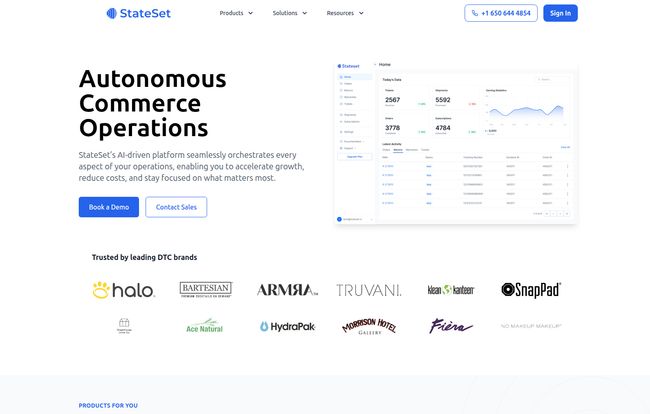
Visit StateSet
The Core Features That Actually Matter
A feature list is just a list. What I care about is what it does for a business. After looking through their offerings, a few things stood out to me as genuinely impactful for a scaling brand.
Taming the Platform Beast: Unified Integration
The number one headache for most e-commerce managers is siloed information. Your Shopify sales data doesn’t automatically update your standalone inventory system, which means your demand forecasting is a wild guess. StateSet’s biggest flex is its ability to integrate with, well, pretty much everything. We’re talking your e-comm platforms (Shopify, Amazon, etc.), shipping and logistics partners (FedEx), and even internal comms tools like Slack. This creates a single source of truth, which is the holy grail for anyone trying to make smart, data-driven decisions.
Your New AI Workforce: Automated Agents
This is where things get a little sci-fi, but in a good way. StateSet uses what it calls “AI agents” to handle workflows. This isn’t just a simple “if this, then that” automation. We’re talking about agents that can manage complex order routing, handle multi-step return processes (RMA), and even automate purchase order management. I’ve seen teams of people dedicated to just this kind of work. The idea here is to free up those brilliant human minds to focus on customer experience, marketing, and product development—the stuff that actually grows the business—instead of mind-numbing operational tasks.
From Data Chaos to a Crystal Ball: Centralized Intelligence
Once all your data is flowing into one place, you can do some pretty cool things with it. One of the standout features on their higher-tier plans is AI-Powered Demand Forecasting. For anyone who’s ever over-ordered stock and killed their cash flow, or under-ordered and missed out on sales, this is huge. By analyzing historical data and trends across all your channels, the platform aims to give you a much clearer picture of what’s coming. This is the kind of stuff that separates the seven-figure brands from the eight-figure ones.
Let’s Talk Money: The StateSet Pricing Breakdown
Okay, let’s address the elephant in the room. I’m not going to sugarcoat this: StateSet is a premium tool with a premium price tag. My first reaction to the pricing page was a bit of a spit-take, but then I remembered who this is for. This is not a tool for someone running a dropshipping store as a side hustle.
Here’s a rough look at the investment, according to their site:
- Starter Plan: Kicks off at $1,637 per month. This is geared towards smaller businesses getting serious about automation, handling up to 10,000 orders/month with up to 3 integrations.
- Scale Plan: Jumps to $2,735 per month. This is for growing brands, offering more workflow features, AI demand forecasting, and a capacity for 200,000 orders/month.
- Premier Plan: Now we’re getting into serious territory at $16,550 per month. This is for established businesses needing advanced analytics, more integrations (5-8 included), and dedicated support for up to 500,000 orders/month.
- Enterprise Plan: This is the classic “If you have to ask, you can’t afford it” tier. You’ll need to contact them for a custom quote, but it comes with unlimited everything.
The pricing is a clear signal. StateSet is positioning itself as an investment in infrastructure, not just another monthly SaaS subscription. You have to do the math on how much money you’re currently losing to inefficiency, errors, and wasted staff hours to see if it makes sense.
The Good, The Bad, and The AI-Powered
No tool is perfect. In my experience, it’s about finding the one whose strengths align with your needs and whose weaknesses you can live with.
The Upsides (What I Like)
The potential for massive efficiency gains is undeniable. By automating the backend grunt work, you can theoretically reduce operational costs and scale your order volume without needing to scale your headcount at the same rate. The single source of truth for data is another huge win. It eliminates the guesswork and empowers better, faster decision-making across the board. For a brand with ambitions to grow, this kind of foundation is incredibly valuable.
Potential Hurdles (What to Consider)
First off, the cost is a significant barrier for many. This is a serious financial commitment. Beyond the sticker price, there’s the initial setup and integration effort. This isn’t a plug-and-play app; it’s an enterprise-level system that will require time and resources to implement correctly. Also, while AI is fantastic, it’s not infallible. You can’t just set it and forget it. You still need smart humans to oversee the system, monitor for anomalies, and make strategic adjustments. Blind faith in any algorithm is a recipe for disaster.
Who is StateSet REALLY For?
So, who should be booking a demo? In my opinion, StateSet is for a very specific type of company. It’s for the established D2C brand that has found product-market fit and is now hitting a wall with operational complexity. It’s for the business owner who lies awake at night worrying about inventory, fulfillment errors, and whether their systems can handle the traffic spike from the next big sale.
If you’re managing multiple sales channels, a couple of warehouses, and a growing team, and you feel like you spend more time managing systems than growing your brand, you are their target customer. It’s for when the cost of your current chaos starts to outweigh the cost of the solution.
Frequently Asked Questions
- What is StateSet in simple terms?
- Think of it as a master control panel for all the different software and platforms you use to run your e-commerce business. It connects them all and uses AI to automate tasks like order processing and inventory management.
- Is StateSet suitable for small businesses?
- Given the pricing, it’s really geared towards established small businesses that are scaling rapidly or mid-to-large-sized companies. A brand new startup might find the cost prohibitive.
- How does the AI automation work?
- It uses pre-built and custom “AI agents” to execute workflows. For example, when a return is initiated on your website, an agent can automatically generate the shipping label, update inventory, and notify the customer, all without human intervention.
- What kind of platforms can StateSet integrate with?
- It’s designed to connect with a wide range of commerce platforms (like Shopify, BigCommerce, Amazon), ERPs, 3PLs, shipping carriers, and customer service tools. The goal is to unify your entire tech stack.
- Is StateSet just another order management system (OMS)?
- It includes OMS capabilities, but it’s much broader. An OMS typically just handles orders, whereas StateSet aims to orchestrate everything: orders, returns, inventory, purchasing, and the data intelligence behind it all.
- Does StateSet replace my entire e-commerce team?
- No, and that’s not the goal. The goal is to replace the repetitive, low-value tasks your team is doing, allowing them to focus on higher-value work like strategy, marketing, and improving the customer experience.
Final Thoughts: A Pricey but Powerful Conductor
StateSet is an impressive, ambitious platform. It’s tackling one of the biggest and most painful problems in the e-commerce world: operational chaos. It’s not a magic bullet, and it’s certainly not for everyone—the price tag alone ensures that.
However, for the right company at the right stage of growth, I can see it being transformative. It’s an investment in building a scalable, resilient, and efficient operational backbone. If your e-commerce orchestra is playing out of tune and costing you sales, maybe it’s time to consider hiring a new conductor. And this one happens to be powered by AI.


