
Categories: AI Art Generator, AI Background Generator, AI Background Remover, AI Character, AI Developer Tools, AI Game Generator, No-Code&Low-Code, Text to Image
Story Machine Review: AI Game Dev Without the Code?

I have a folder on my desktop that I’ve named ‘Game Dev Dreams.’ It’s filled with half-finished Unity tutorials, a few dozen pixel art sprites I’m weirdly proud of, and a C# script that does… well, I’m not entirely sure what it does anymore. The dream of making a game often crashes into the brutal reality of coding. It’s like wanting to write a novel but first having to build your own printing press.
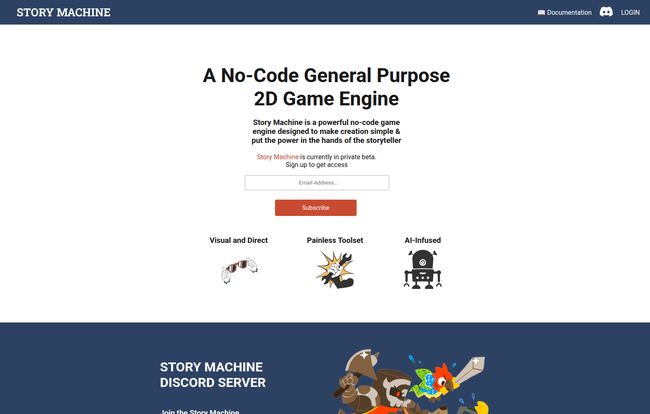
It’s a story I hear all the time from other creatives. The barrier to entry for game development has always been sky-high. But every now and then, a tool comes along that feels like it’s handing you a ladder. Or maybe even a jetpack. Recently, I stumbled upon one that really got my SEO-sense tingling and my inner storyteller excited: Story Machine. It bills itself as a “no-code general purpose 2D game engine,” but that’s a mouthful. What it really feels like is a promise.
So, What is Story Machine, Really?
Let’s break it down. Story Machine is a new game engine from the folks at Robot Invader, a legit indie studio that knows a thing or two about making fun games. The whole idea is to take the programming out of the equation. You’re not writing lines of code; you’re visually assembling your game, piece by piece. Think of it less like being an engineer and more like being a movie director. You’re focused on the scene, the characters, and the narrative, not the arcane syntax of a programming language.
It’s specifically built for 2D narrative games. We’re talking point-and-click adventures, visual novels, and interactive stories. If you’ve got a story to tell, this tool wants to be your microphone. The secret sauce? It’s infused with AI, which is more than just a buzzword here—it’s a core part of the creative process.
The Standout Features That Made Me Look Twice
When you’ve been in the digital marketing and tech space for a while, you get pretty good at cutting through the fluff. A lot of new platforms promise the world. But Story Machine’s feature set feels… different. It feels practical.
A Genuinely Visual and Direct Experience
Most game engines, even the “visual” ones, have a learning curve steeper than a mountain. You spend weeks just figuring out the UI. Story Machine seems to sidestep that entirely. Their whole philosophy is ‘visual and direct.’ You literally drag and drop elements to build scenes and sequence actions.
One of the coolest things I saw mentioned is their “snapshot” system for animating transitions between scenes. It sounds incredibly intuitive, letting you define the start and end state and letting the engine handle the smooth movement in between. No more manually tweaking animation curves for hours on end. Thank goodness.
Your AI Co-Creator for Art and Ideas
Okay, this is the big one. The AI-Infused part. We’ve all seen AI art generators, but Story Machine integrates this tech directly into the workflow. Need a spooky forest background for your prototype? Just type a prompt. Need a character asset? Describe them. This is an absolute game-changer for rapid prototyping.
Visit Story Machine
You can get your ideas from your brain onto the screen in minutes, not days. They even have a ‘Quick Mask’ tool that lets you select a part of an AI-generated image and re-roll it. Don’t like the character’s hat? Just mask it and ask the AI to generate a new one. This moves AI art from a novelty to a legitimately powerful and iterative design tool. It’s not about replacing artists, it’s about empowering creators who can’t draw to still bring their vision to life.
A “Painless Toolset” is a Bold Claim, But…
Anyone who has ever updated their game engine only to find half their project is suddenly broken knows the pain of ‘regression.’ It’s when new updates break old features. Story Machine makes a wild promise: a “no regression guarantee.” If they mean it, that alone is worth its weight in gold. It means you can trust the tool and focus on creating, not debugging the engine itself.
They talk about avoiding the “historical baggage” of other engines, and I feel that in my bones. So many tools are built on decades-old foundations, carrying along clunky, outdated ways of doing things because that’s just how it’s always been done. Starting fresh, like Story Machine has, allows for a much cleaner and more modern approach.
A Glimpse of the Magic: ‘Grandpa’s House’
Talk is cheap, right? But Robot Invader put their money where their mouth is by showcasing a game made entirely in the engine called Grandpa’s House. You can even play it right in your browser from their homepage. It has this wonderfully quirky, slightly eerie paper-craft art style that immediately shows off the engine’s 2D capabilities.
Playing through it, you can see the snapshot transitions at work and the kind of interactive, narrative-driven experience the engine is built for. It’s a fantastic proof-of-concept that makes the whole platform feel much more real and less like vaporware.
Who Should Be Signing Up Right Now?
So, who is this for? In my opinion, it’s for a massive, underserved group of people. It’s for the writers who want to create interactive fiction. It’s for the artists who want to build a world around their illustrations. It’s for the D&D Dungeon Master who wants to turn their campaign into a playable experience. It’s for anyone with a story burning inside them but without the time or desire to become a software engineer.
However, let’s be realistic. It’s not for everyone, at least not yet. The biggest thing to know is that Story Machine is currently in a private beta. You can’t just download it today; you have to sign up for a newsletter and wait for an invite. It’s also focused squarely on 2D games, so if you’re dreaming of a sprawling 3D open world, this ain’t it. And while the AI art generation is incredible for prototyping, you might still need to refine or create your own final assets if you have a very specific, polished look in mind.
What’s the Price of Entry?
This is the million-dollar question, isn’t it? As of writing this, the pricing is a complete mystery. The pricing page on their website leads to a ‘Not Found’ error, which makes sense for a product in private beta. They’re likely still figuring it out.
Will it be a monthly subscription like so many SaaS tools? A one-time purchase like some classic software? Or maybe a royalty model where they take a small cut of your game’s sales? We just dont know. For now, the only way to stay in the loop is to sign up for that newsletter on their homepage. Which I did. Immediately.
Frequently Asked Questions About Story Machine
- Is Story Machine free to use?
- Currently, Story Machine is in a private beta, and its final pricing model has not been announced. The best way to get access and information is by signing up for their official newsletter.
- Do I need to be a programmer to use Story Machine?
- Absolutely not. The entire platform is built around a no-code, visual interface. It’s designed for storytellers, artists, and designers, not just developers.
- Can I build a 3D game like Fortnite with this?
- No. Story Machine is specifically a 2D game engine. It’s optimized for narrative-heavy games like visual novels, point-and-click adventures, and interactive stories.
- How does the AI art generation work?
- It’s integrated directly into the editor. You can write a text prompt to generate images for backgrounds or assets. It’s a powerful tool for quickly prototyping ideas and creating content, especially if you’re not an artist yourself.
- Who is the company behind Story Machine?
- Story Machine is being developed by Robot Invader, an established independent game studio known for creating its own titles. This gives the project a lot of credibility, as it’s being built by people who actually make games.
Final Thoughts: A New Chapter for Storytellers?
It’s easy to be cynical about new tech, but I’m genuinely optimistic about Story Machine. For years, the tools have dictated the creator. You had to bend your ideas to fit the rigid logic of an engine. Story Machine feels like it’s trying to do the opposite—to build an engine that bends to the will of the storyteller.
By removing the code barrier and cleverly integrating AI as a creative partner, it has the potential to democratize game development in a way we haven’t quite seen before. It could unleash a wave of new voices and new kinds of stories. And I, for one, can’t wait to see what people build with it. Maybe it’s finally time to dust off that ‘Game Dev Dreams’ folder.


