
Categories: AI Agent, AI Code Review, AI Developer Tools
Sublayer: AI Agents for Ruby Devs? A First Look Review

If you’re not swimming in a sea of Python libraries like LangChain or tinkering with Jupyter notebooks, it can feel like you’re on the outside looking in. As someone who’s had a long-standing appreciation for the elegance and developer happiness of Ruby, I’ve been waiting for a serious contender to emerge from that corner of the world. And I think I might have just found it.
Enter Sublayer. I stumbled upon their site recently, and it immediately piqued my interest. It’s not just another API wrapper. It’s not a simple clone of a Python tool. Sublayer claims to be a ground-up rethinking of how we can build with AI, specifically for the Ruby ecosystem. It’s a bold claim, but after digging in, I’m starting to think they might be onto something.
So, What Exactly is Sublayer?
At its core, Sublayer is an AI agent framework built in and for Ruby. Think of it as the foundational toolkit you need to create your own AI-powered automations, devtools, or even complex systems of cooperating agents—sometimes called agent swarms. It’s a Rubygem, which for any Rubyist, is music to our ears. It means integration should be as simple as adding a line to your Gemfile. Ah, the simple pleasures.
One of the first things that jumped out at me is that it’s model-agnostic. This is a bigger deal than it sounds. It means you’re not handcuffed to OpenAI’s GPT-4, Google’s Gemini, or Anthropic’s Claude. You can pick and choose, or even switch between models, based on cost, performance, or whatever new hotness comes out next week. This flexibility is, in my opinion, non-negotiable for any serious AI tool today. It future-proofs your work.
“We are rethinking the product management app from the ground up to allow you to harness the full power of generative AI and LLMs.” – The Sublayer Team
But it’s the philosophy that really gets me. Sublayer seems focused on a process that involves human approval and interaction. This isn’t about creating some rogue AI that rewrites your entire codebase while you sleep (though that’s a fun/terrifying thought). It’s about building agents that augment your workflow, a smart assistant that handles the grunt work but keeps you firmly in the driver’s seat. It’s a collaborative approach, not a replacement one.
Visit Sublayer
The Core Features That Caught My Eye
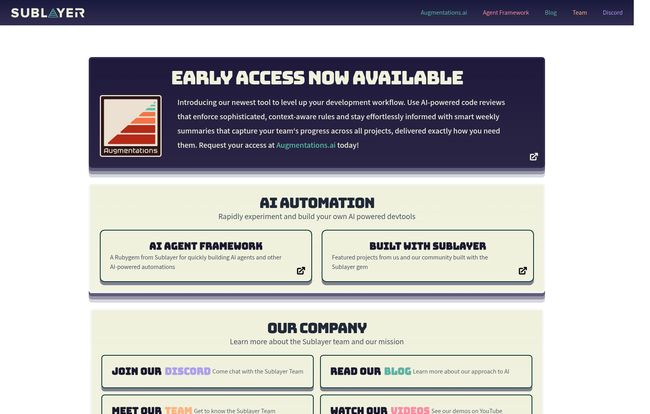
Okay, philosophy is great, but what can you actually do with it? Sublayer’s homepage splits its offerings into a few key areas, and they’re all pretty compelling.
The AI Agent Framework (The Heart of the Matter)
This is the main event. The framework provides the building blocks for creating AI agents. Imagine crafting an agent that can read through new support tickets, categorize them, and draft a preliminary response. Or an agent that monitors your application’s logs for anomalies and provides a plain-English summary of what went wrong. Because it’s a Ruby gem, you can integrate these agents directly into your existing Rails applications or other Ruby projects. This feels a lot like the early days of Rails, where gems like Devise or Active Admin came along and saved us from writing the same boilerplate code over and over again.
Augmentations.ai: A Practical Application
This is where things get really tangible. Sublayer is using their own framework to build a tool called Augmentations.ai, and it’s currently in early access. This tool focuses on two major pain points for any development team:
- AI-Powered Code Reviews: We’ve all been there. Staring at a pull request, trying to spot subtle logical flaws or context-specific bugs. Augmentations aims to automate a part of this by providing reviews that understand the context of your project. This is more than a simple linter; it’s like having a junior developer who has read your entire codebase checking your work.
- Smart Weekly Summaries: For team leads and project managers, this is gold. The tool can apparently capture your team’s progress across all projects and deliver a smart summary. No more chasing people for updates on a Friday afternoon. Sign me up.
Who is This Actually For? (And What’s the Catch?)
Let’s be clear: this is a tool for developers, specifically Ruby developers. If your team lives and breathes Ruby on Rails, this should be on your radar. The low barrier to entry (it’s a gem!) makes it incredibly appealing for existing Ruby shops looking to sprinkle some AI magic into their workflows without having to hire a team of Python data scientists.
Now, for the catch. The biggest one is right there on the homepage: “Early Access.” This tells us a few things. It’s new. It’s probably not feature-complete. There might be a bug or two. You’re not buying a finished, off-the-shelf product; you’re getting in on the ground floor. For some, that’s a dealbreaker. For others, it’s an exciting opportunity to help shape a new tool. I tend to fall into the latter camp.
The other “catch,” if you can call it that, is that you need to know Ruby. This tool isn’t trying to be everything to everyone. It’s a specialized tool for a specific, and dare I say, tasteful, community. And I respect that.
The Big Question: What About Sublayer’s Pricing?
Ah, the million-dollar question. Or, hopefully, a much more reasonable-dollar question. As of my writing this, there is no public pricing information available for Sublayer or Augmentations.ai. This is pretty typical for a product in an early access or beta phase.
If I were to guess, I’d imagine we might see a tiered model. Perhaps a free tier for individual developers or small open-source projects, and then paid tiers for teams based on usage, number of users, or features. The pricing for the Augmentations.ai code review tool will be particularly interesting to watch. For now, the only way to find out is to request access and start a conversation with the team.
My Take: Is Sublayer Worth Watching?
In a word: absolutely. The AI space needs more diversity in its tooling. Python has a commanding lead, for sure, but that doesn’t mean it’s the best tool for every single job. Ruby’s entire ethos is built around developer happiness and convention over configuration.
Some might argue that Python has already won the AI race, so why bother? I think that misses the point. It’s not about winning a race; it’s about building the best possible tools for a given context. Integrating AI directly into a massive, mature Rails application is a very different challenge than building a standalone model from scratch. A framework that understands the patterns and idioms of the Ruby world, like Active Record and Sidekiq, could be ridiculously powerful.
I see Sublayer as a massive opportunity for the Ruby community to not just participate in the AI revolution, but to do it in a uniquely ‘Ruby’ way: elegantly, pragmatically, and with a focus on making developers’ lives easier. It’s still early days, but I am very, very optimistic about this one.
Frequently Asked Questions about Sublayer
I’ve seen a few questions pop up, so let me try to answer some of them here.
- Do I need to be an AI expert to use Sublayer?
- It doesn’t seem so. The whole point of a framework like this is to abstract away a lot of the complexity. You’ll need to understand the concepts of what you want your agent to do, but you probably won’t be writing neural networks from scratch. You should, however, be comfortable working with Ruby.
- Is Sublayer just for Ruby on Rails?
- While it’s a natural fit for Rails apps, it’s a Rubygem at its heart. That means you should be able to use it in any Ruby project, whether it’s a simple script, a Sinatra app, or something else entirely.
- What does ‘model-agnostic’ really mean for me?
- It means freedom. If a new, cheaper, faster AI model is released tomorrow by a new company, you could theoretically switch your agents over to use it without rewriting your entire application’s logic. You’re not locked into a single vendor like OpenAI.
- Is Sublayer open source?
- The Rubygem part of the framework will likely be open source, as is common in the Ruby community. However, the supporting infrastructure, and specific products like Augmentations.ai, are likely to be commercial, proprietary software. This is a common and sustainable model.
- How is this different from just using an API client for OpenAI?
- Using an API client is like having a box of raw ingredients. You still have to figure out the recipe. A framework like Sublayer is the recipe book and some pre-made sauces. It gives you structure, handles state, manages complex interactions (like agent swarms), and provides a standard way of building things, which makes your code much easier to manage and scale.
Final Thoughts
Sublayer is one of the most exciting developments I’ve seen for the Ruby community in a while. It’s ambitious, well-timed, and seems to be built with a deep understanding of what makes the Ruby ecosystem special. While it’s still in its infancy with an early access label and no public pricing, the vision is clear: to make building sophisticated AI agents in Ruby not just possible, but delightful.
If you’re a Ruby developer who has been feeling a bit of AI FOMO, I strongly suggest you head over to their site, check out the blog, and request access. This could be the start of something big.
Reference and Sources
- Sublayer Official Website
- Augmentations.ai Early Access
- The Sublayer team also has an active Discord server and Blog which you can access from their homepage.


