
Categories: AI API, AI Developer Tools, AI Document Extraction, AI Files, AI Knowledge Base, AI Transcription, AI Web Scraping, Large Language Models (LLMs)
Supametas.AI Review: The RAG Data Tool You Need?

Alright, let’s have a real chat. If you’ve ever worked on an AI project, especially anything involving Large Language Models (LLMs), you know the dirty secret. The part nobody puts in the flashy demo. I’m talking about the data. The endless, soul-crushing, mind-numbing task of cleaning, structuring, and preparing data. It’s less “data science” and more “data janitor,” and honestly, it’s where most projects go to die a slow, painful death.
I’ve been there. I once spent the better part of three weeks trying to scrape, parse, and format data from a collection of a few thousand PDFs, forum posts, and internal wikis for a Retrieval-Augmented Generation (RAG) system. My scripts were a tangled mess of Regex and hope. My coffee consumption reached alarming levels. It worked… eventually. But it was awful.
So when I stumbled upon a platform called Supametas.AI, which claims to be the magic wand for this exact problem, my cynical veteran-blogger senses started tingling. Is it just another tool with a fancy landing page, or could this actually be the thing that gives us our time back? I decided to take a look.
So, What Exactly Is Supametas.AI?
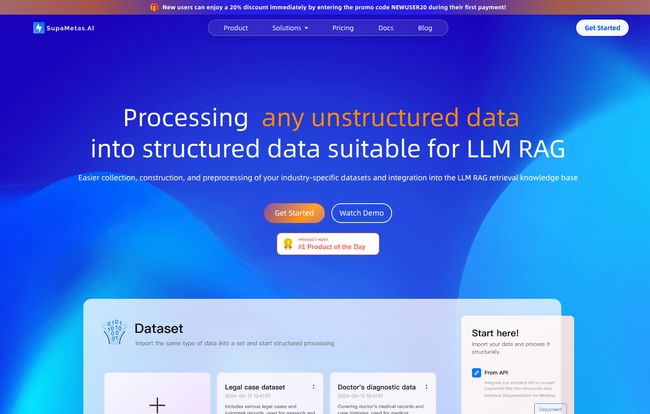
Let’s cut through the marketing-speak. At its core, Supametas.AI is an assembly line for your raw data. You throw in all your messy, unstructured stuff—think webpages, videos, audio files, images, PDFs, you name it—and it churns out clean, organized, structured data on the other side. Specifically, it’s designed to prepare data for LLM RAG knowledge bases.
For anyone new to the acronym, RAG (Retrieval-Augmented Generation) is the secret sauce that makes LLMs so much smarter and more reliable. Instead of just relying on its pre-trained knowledge, the model can ‘look up’ information from a specific, curated knowledge base you provide. This reduces hallucinations and lets you ground the AI in your company’s proprietary data. But for RAG to work, that knowledge base can’t be a dumpster fire. It needs to be pristine. And that’s the gap Supametas aims to fill.
It’s not just a scraper. It’s not just a file converter. It’s the whole pipeline, from data collection and extraction to preprocessing and getting it ready for integration. A pretty bold claim, right?
Visit Supametas.AI
My First Impressions: More Than Just a Data Scraper
Popping onto their site, the first thing I noticed was the clean, no-nonsense interface. It feels less like a clunky enterprise tool and more like something a modern developer would actually enjoy using. You create a ‘Dataset,’ point it at a source, and let it do its thing.
The real power seems to lie in its flexibility. You’re not just limited to one type of data input.
Taming the Wild West of Web Data
The webpage crawling feature is probably the most common use case. You can feed it a list of URLs and it will go out and pull down the content. But the cool part is the automated field extraction. Instead of writing complex CSS selectors or XPath queries, you can apparently just use natural language prompts to tell it what to grab. “Extract the product name,” “get the author and publication date,” etc. If that works as well as advertised, it could save an insane amount of time.
Beyond Text: Handling Multimedia Mayhem
This is where my interest really piqued. Most tools I’ve seen are pretty good with text, but fall apart when you show them a video or a folder of images. Supametas.AI explicitly supports text, audio, video, and image data. This opens up some fascinating possibilities. Imagine feeding it all your company’s training videos or product webinars and having it automatically create a searchable, queryable knowledge base. That’s powerful stuff.
The Good, The Bad, and The Nitty-Gritty
Okay, so it sounds great on paper. But no tool is perfect. After digging through the features and documentation, here’s my honest take.
The Good Stuff (Why I’m genuinely impressed)
The biggest win here is the sheer simplification of the RAG pipeline. It takes what is typically a multi-step, multi-tool process and puts it under one roof. The support for various data formats is a huge plus, moving beyond just text is a significant step forward for practical AI applications. The flexible data collection methods, from web crawling to direct file uploads and API calls, means it can fit into pretty much any existing workflow. This isn’t some rigid system; it’s more like a set of powerful Lego bricks you can assemble as needed.
A Few Caveats (Let’s Be Real)
Now, it’s not all sunshine and rainbows. For one, a platform this capable will likely have a bit of a learning curve. To really get the most out of it, you’ll need to move past the simple ‘point and click’ and understand how to best structure your datasets and prompts. Also, like many AI tools, it operates on a token system for its built-in models. If you’re processing massive amounts of data, you’ll need to keep an eye on that consumption. Finally, as it’s a SaaS platform, companies with extremely sensitive data might have some privacy concerns, although they do mention a ‘Private Deployment’ option for enterprise clients which is a smart move.
Let’s Talk Money: Supametas.AI Pricing Breakdown
Price is always the elephant in the room, isn’t it? I’ve seen some crazy pricing models for AI tools, so I was bracing myself. But honestly, the pricing structure for Supametas.AI seems pretty reasonable and scalable. They have a plan for basically everyone.
There’s a Free tier that is genuinely useful. You get one dataset up to 50MB and 50,000 tokens for teh built-in AI model. This is perfect for small projects, testing the waters, or for students who want to experiment. I love it when companies offer a free teir that isn’t just a glorified, time-bombed trial.
Here’s a quick breakdown of their main plans:
| Plan | Price/Month | Key Features |
|---|---|---|
| Free | $0 | 1 dataset, 50MB total size, 50,000 tokens. |
| Personal | $9 | 1 dataset, 100MB total size, 100,000 tokens. |
| Pro | $19 | 5 datasets, 1GB total size, 400,000 tokens. |
| Pro+ | $59 | 20 datasets, 5GB total size, 1,000,000 tokens. |
| Enterprise | Contact Us | Custom datasets, capacity, tokens, private deployment. |
The Personal and Pro plans look like the sweet spot for individual developers, researchers, and small teams. At $9 or $19 a month, the cost is easily justified if it saves you even a few hours of manual data work. The Pro+ and Enterprise tiers are clearly aimed at larger businesses with serious data processing needs. The pricing seems fair for the value proposed.
Who Is This Actually For?
After looking it over, I can see a few groups getting a ton of value from this.
- AI Developers & Data Scientists: This is the obvious one. Anyone building RAG-based applications will immediately see the appeal. It lets you focus on the model and the application logic, not the data plumbing.
- Startups: Small, agile teams can use this to quickly build powerful, data-driven features into their products without hiring a dedicated data engineering team.
- Content Creators & Researchers: Imagine being able to feed hundreds of articles, interviews, or academic papers into a system and then being able to ask it complex questions. It’s a research assistant on steroids.
- Large Enterprises: For companies with mountains of internal knowledge locked away in documents and videos, the enterprise version with private deployment could be a game-changer for internal knowledge management.
Frequently Asked Questions (The Stuff You’re Probably Googling)
How does token consumption work?
Tokens are used when you leverage the platform’s built-in AI models for tasks like intelligent content extraction or summarization. Basic processing and crawling may not consume tokens, but the advanced AI features will. You get a starter pack of tokens with each plan.
Can I use my own external AI models, like one from OpenAI?
Yes, the platform states it supports configurable use of your own external AI models. This is a fantastic feature for those who already have a preferred model or want more control over the AI part of the process.
Is it better than building my own data processing scripts?
For a one-off, very simple task, a custom script might be faster. But for anything complex, recurring, or involving multiple data types, a platform like this will almost certainly save you time, money, and sanity in the long run. It’s about trading a bit of cash for a lot of time and reliability.
What kind of support can I expect?
Based on their pricing page, support scales with the plan. The Free plan has no support, while higher tiers get email, chat, and eventually priority support. This is a pretty standard practice.
What are built-in AI models and external AI models?
Built-in AI models are the models provided by Supametas.AI, which you can use with the included tokens. External AI models are your own models, such as those from OpenAI or Anthropic, which you can connect to the platform. This allows for greater flexibility and lets you use models you’re already familiar with.
My Final Verdict on Supametas.AI
So, is Supametas.AI the magic wand I was hoping for? It’s pretty damn close.
No tool will ever completely eliminate the need to think critically about your data. You still need to understand your sources and what you want to achieve. But Supametas.AI looks like it can automate away the most tedious, repetitive, and error-prone parts of the process. It’s a powerful data processing engine that allows you, the human, to be the architect, not the janitor.
In a world where the quality of your AI is directly proportional to the quality of your data, a tool that makes data preparation this much easier isn’t just a convenience—it’s a competitive advantage. If you’re working in the LLM space, I’d say giving their free plan a spin is an absolute no-brainer. It might just be the thing that saves your next project, and your sanity.
References and Sources
- Supametas.AI Official Pricing Page
- What is Retrieval-Augmented Generation? – An excellent explainer from Pinecone.


