
Categories: AI Content Detector, AI Developer Tools, Large Language Models (LLMs)
Swift Security Review: Taming the Wild West of GenAI

It feels like just yesterday we were all trying to figure out what a ‘large language model’ even was. Now, it seems like half my team is using ChatGPT to draft emails, Gemini to brainstorm ideas, and who knows what else to debug code. It’s the new Wild West, a gold rush for productivity. And I’m all for it. Mostly.
But the security guy in me, the one who’s been dealing with traffic, trends, and C-suite panic attacks for years, has a nagging twitch in his eye. Every time an employee pastes a chunk of text into a public AI prompt, I have this vision of our company’s crown jewels being loaded onto a stagecoach with no driver, heading straight out of town. This isn’t just paranoia; it’s the reality of a new attack surface we’re all still getting our heads around. It’s called Shadow AI, and it’s the practice of employees using unapproved AI tools for work.
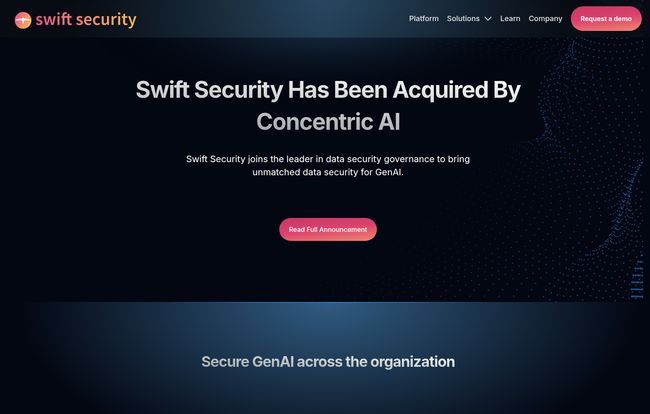
So, how do you let your team ride the incredible wave of generative AI without letting them accidentally give away the farm? I’ve been looking at a few platforms trying to solve this puzzle, and one that recently caught my attention is Swift Security. Especially since they were just acquired by Concentric AI, a name we all know in the data security space.
So What Is Swift Security, Really?
At its core, Swift Security positions itself as a unified AI Security Platform. Think of it less like a single gate and more like a network of smart, invisible security guards watching over every interaction your company has with AI. It’s designed to protect the three main fronts of the GenAI war: your Users, your Developers, and your Applications.
You’ve got users who might be innocently asking an LLM to rephrase a sensitive customer email. You’ve got developers—bless their hearts—who might be pasting proprietary code into an AI assistant to find a bug. And you have the custom applications your team is building that use these LLMs through APIs. Each one is a potential leak.
Visit Swift Security Platform
Swift’s whole pitch is to give you visibility and, more importantly, control over all of it. It works by sitting between your team and the big, wide world of public (and private) LLMs. When someone tries to send data out, Swift takes a peek in real-time. It asks: “Is this PII? Is this our secret sauce source code? Is this a sensitive financial projection?” Based on the policies you set, it can then block the data from ever leaving your network. Simple in concept, but incredibly powerful in practice.
The Real Problem: Leaky LLMs and the Shadow AI Menace
Let’s be honest. You can send out a dozen memos telling people not to put sensitive information into public AI tools. But they’ll forget. Or they’ll think, “oh, just this one little paragraph won’t hurt.” It’s human nature. I’ve seen it happen for years with cloud storage, with personal devices, you name it. If a tool makes someone’s job easier, they are gonna use it.
This is the crux of the problem Swift aims to solve. It’s not about stopping AI usage; it’s about making it safe. The risks are very real:
- Intellectual Property Loss: That brilliant new algorithm your team has been working on for six months? It could end up as training data for a public model if someone uses ChatGPT to optimize it.
- PII & Data Leakage: Customer lists, employee details, health information… the list of data that should never leave your walls is long and terrifying.
- Compliance Nightmares: A single slip-up can put you on the wrong side of GDPR, CCPA, and a whole alphabet soup of other regulations. The fines are no joke.
This is where that visibility Swift talks about becomes so critical. You can’t protect what you can’t see. Finding out which teams are using which AI tools is the first step to getting things under control.
A Look at the Features That Actually Matter
Any platform’s website is gonna be full of buzzwords. I try to cut through the noise and see what features solve actual, painful problems. Here’s my take on Swift’s offerings.
Real-time Data Classification is a Big Deal
This, for me, is the secret sauce. Old-school data loss prevention (DLP) tools often relied on clumsy keyword matching. Swift claims its classification is real-time and context-aware. It’s not just looking for a 9-digit number and screaming “Social Security Number!” It understands the context to reduce false positives. It’s the difference between a bouncer who just checks for a specific brand of shoe and one who can actually read the room and spot trouble before it starts. This is where the backing of Concentric AI, a leader in data classification, really makes me sit up and pay attention. They know this stuff inside and out.
It’s Not Just About Prompts and APIs
One feature I found particularly clever is the focus on blocking risky browser extensions. This is a sneaky vector. An employee installs a seemingly harmless “AI Summarizer” extension, and it ends up logging everything they type, including passwords and sensitive data, and sending it off to a server in a country you can’t even point to on a map. Being able to identify and block these extensions at the source is a huge, often overlooked, win.
The “Easy and Frictionless Deployment” Claim
Okay, I’m always a bit of a skeptic when I see this. I’ve seen too many “frictionless” deployments that ended up requiring a month of consulting fees and three new hires. Swift’s website says you can “get started in minutes.” That’s a bold claim. If true, it’s a massive advantage. Security tools that are a nightmare to implement often become shelf-ware. The easier it is to get up and running, the faster you can close those security gaps. My gut tells me the basic setup might be quick, but fine-tuning policies for a large enterprise will, naturally, take some thought. Which is as it should be.
The Good, The Bad, and The Vague
No tool is perfect. Let’s break it down with some honest perspective.
The Good Stuff: The biggest pro is that it’s a unified platform. I’m so tired of cobbling together five different point solutions that don’t talk to each other. Having one dashboard for users, developers, and apps is a huge relief. The promise of easy integration with existing enterprise architecture (your SIEM, etc.) is also a major plus. It needs to play nice with the expensive tools you already have.
The Reality Check: The website’s ‘cons’ section (if it had one) would mention that this isn’t a simple, fire-and-forget tool. It will likely require some security expertise to configure policies effectively. You need to know what data is sensitive to your organization to tell the tool what to protect. Also, its effectiveness hinges on the quality of its detection algorithms. This is true for any security tool, but it’s worth stating. You’re placing a bet on their tech being smarter than the lastest threat.
The Vague Part… Pricing: Ah, the classic B2B SaaS mystery. There’s no pricing page. No tiers to look at. This means you have to “Schedule a Demo” to talk to a sales rep. Don’t expect a $20/user/month plan. This is enterprise-grade software, and it will almost certainly have enterprise-grade pricing based on the size of your organization and the scope of the deployment. It’s not a flaw, just the way this market works.
My Final Take: Who Is This Really For?
After digging in, it’s clear who Swift Security is for. This isn’t for the solo blogger or the small 5-person agency. This is built for the mid-to-large enterprise. It’s for the CISO at a tech company, a financial institution, or a healthcare provider who just broke out in a cold sweat reading that paragraph about developers pasting code into an AI.
It’s for organizations where data isn’t just important; it’s the entire business. The testimonial from Reno Marioni of Wundr AI on their site says it all: it’s for those who want to use the “power of GenAI with confidence and security.”
Ultimately, the move to embrace GenAI is happening, with or without a CISO’s blessing. Tools like Swift Security, now with the powerhouse of Concentric AI behind them, represent a shift from trying to ban these tools to enabling them safely. I’ve been in SEO and digital security long enough to see these cycles repeat: a new technology explodes in popularity, a mad scramble to adopt it follows, and then comes the slow, painful realization that we forgot to lock the doors. It seems Swift is handing us the keys before we get robbed.
Frequently Asked Questions
- What is Swift Security?
- Swift Security, now part of Concentric AI, is an AI Security Platform. It’s designed to monitor and control how employees use generative AI tools like ChatGPT, ensuring sensitive company data like PII, source code, and intellectual property doesn’t get leaked.
- How does Swift Security protect against data leaks to LLMs?
- It acts as a control point between your users and the LLMs. Using real-time data classification, it inspects the data in prompts and API calls. If it detects sensitive information based on your company’s policies, it can block the data from being sent.
- Is Swift Security difficult to set up?
- They claim a very fast and easy deployment, letting you get started in minutes. While the initial setup might be quick, fully configuring the security policies for a large, complex organization will likely require some dedicated time and expertise.
- Why can’t I find pricing for Swift Security?
- Like many enterprise-focused B2B software platforms, they use a quote-based pricing model. You need to contact their sales team or schedule a demo to get pricing tailored to your organization’s size and needs.
- What is “Shadow AI” and why is it a risk?
- Shadow AI refers to employees using AI applications and tools that are not officially approved or managed by the company’s IT department. The primary risk is a lack of visibility and control, which can easily lead to accidental data breaches and compliance violations.
- How does the Concentric AI acquisition affect Swift Security?
- This is a significant positive. Concentric AI is a well-respected leader in Data Security Posture Management (DSPM), specializing in data classification. The acquisition brings deeper expertise and more robust technology to Swift’s platform, adding a lot of credibility and power to its data protection capabilities.


