
Categories: AI Copilot, AI Interview Assistant, AI Recruiting, AI Resume Checker
Talentscreener Review: AI Hiring Tool or Just a Domain?

Alright, let’s talk hiring. If you’ve ever been on the hiring side of the table, you know the drill. You post a job, and within hours, your inbox is flooded. It’s a digital avalanche of PDFs, Word docs, and wildly optimistic cover letters. Sorting through them feels like panning for gold in a river of clichés—everyone is a “hard-working team player with excellent communication skills.” It’s exhausting.
For years, we’ve relied on gut feelings, keyword scanning, and way too much caffeine. But the tech world, as it does, promises a better way. Enter the age of AI-powered recruitment tools. These platforms claim they can sift, sort, and even interview candidates for us, all with the cold, hard logic of a machine. One name that’s been floating around this space is Talentscreener.
The promise is tantalizing: an AI that does the heavy lifting, so you can focus on, you know, the human part of human resources. But as with any shiny new tech, I’ve learned to approach with a healthy dose of skepticism. So, let’s dig in.
So, What Exactly is Talentscreener Supposed to Do?
At its core, Talentscreener is designed to be your tireless, data-obsessed junior recruiter who never sleeps or needs a coffee break. The platform is built on a simple but powerful premise: using artificial intelligence to automate and improve the very first stages of the hiring funnel. It’s all about moving from a ‘gut feeling’ to data-driven decision making.
It aims to tackle this in a few ways. First, there’s the AI-powered resume analysis. Instead of you manually scanning for keywords like “Java” or “Google Analytics,” the AI reads and understands the context of a resume, matching qualifications against your job description. Then, it takes things a step further with automated candidate interviews. This part is particularly interesting—it suggests a system that can conduct initial screenings, asking consistent questions to every applicant and analyzing their responses. This whole process feeds into a broader system of data-driven candidate screening, where each person is given a score or ranking based on tangible metrics. No more ‘he seemed like a nice guy’ hires.
Visit Talentscreener
The Promise of Data-Driven Hiring (The Good Stuff)
Let’s be real, the potential benefits here are massive. I’ve worked with startups and large companies, and the one constant is that time is money. The hours spent on reading irrelevant resumes add up fast. Talentscreener, and tools like it, offer to give you that time back.
Imagine being able to focus only on the top 10% of applicants who are genuinely qualified. That’s a game-changer. By automating the screening process, you’re not just saving time, you’re standardizing it. Every resume and every initial interview is judged by the same criteria. In theory, this helps reduce the unconscious bias that we all carry. The AI doesn’t care about a candidate’s name, where they went to school, or if they share your love for a particular football team. It only cares about the data.
This leads to more accurate candidate assessments, or so the theory goes. You’re making choices based on skills and experience that align directly with the job’s needs. For any manager who’s had to justify a hiring decision to their higher-ups, being able to point to concrete data is a whole lot better than saying, “I just had a good feeling about them.”
Let’s Pump the Brakes: The Potential Downsides
Okay, before we all rush out and replace our HR departments with servers, let’s talk about the realities. AI is not a magic wand. Call me old-fashioned, but I’ve seen enough tech trends come and go to know there are always trade-offs.
First, the big one: AI bias. It’s a huge topic in the tech community, and for good reason. An AI is only as good as the data it’s trained on. If your company’s historical hiring data shows you predominantly hired white men from certain universities, the AI might learn that this is the “correct” profile and penalize candidates who don’t fit that mold. As Harvard Business Review and others have pointed out, without careful management, AI can accidentally perpetuate the very biases we’re trying to eliminate.
Then there’s the human element. An AI might be great at spotting keywords, but can it spot passion? Can it measure grit? Can it tell when someone’s experience in a seemingly unrelated field gives them a unique and valuable perspective? Probably not. Over-reliance on a tool like this could cause you to miss out on a fantastic candidate who doesn’t tick all the perfect, pre-defined boxes. Its a tricky balance to strike.
The Elephant in the Room: That ‘For Sale’ Sign
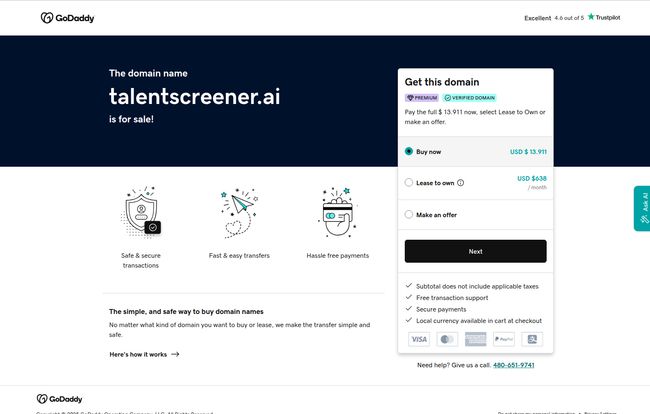
So, I was doing my due diligence, trying to find a pricing page or a free trial, the usual stuff. And I hit a wall. A very, very expensive wall. When I went to the `talentscreener.ai` domain, I wasn’t greeted by a login page. I was greeted by a GoDaddy landing page.
The domain is for sale.
And it’s not cheap. Take a look at these numbers:
| Option | Price (USD) |
|---|---|
| Buy Now | $13,911 |
| Lease to Own | $638 / month |
This… is weird. It throws a massive wrench in the works. What does this mean? Is the project defunct? Did the founders decide to pivot and are now just trying to cash in on a premium-sounding domain name? It’s like finding a brochure for a beautiful new restaurant, and when you go to the address, there’s just a “For Lease” sign in the window. It makes you question everything.
I’ve seen this happen before in the startup world. A great idea gets a great domain, but the project loses steam or funding. While the concept of Talentscreener is sound, the fact that its digital storefront is up for sale is a major red flag for anyone looking to actually use the service right now.
How Does Talentscreener Compare to Other AI Recruiters?
Assuming for a moment that the tool is operational behind another domain, or will be again soon, how does its feature set stack up? It’s playing in a crowded sandbox. There are established players like HireVue, Paradox (Olivia), and even LinkedIn is baking more and more AI screening features into its Recruiter platform.
The core offerings of resume screening and automated Q&A are becoming table stakes in this industry. The real differentiator often comes down to the user interface, the quality of the AI’s analysis, and the depth of its integrations with existing Applicant Tracking Systems (ATS). Without being able to test Talentscreener, it’s impossible to say how it measures up. On paper, it has the right ideas, but execution is everything.
My Final Take: A Tool with Potential… and a Question Mark
I want to love the idea of Talentscreener. Seriously. As someone who’s spent countless hours drowning in resumes, the concept is a life raft. The promise of saving time, making data-backed decisions, and reducing initial bias is exactly what modern HR needs.
But I can’t look past that GoDaddy page. It puts a giant asterisk next to everything. The tool may have existed, it may exist in the future, but as of right now, its public face is a for-sale sign.
So here’s my verdict: The concept of Talentscreener gets a thumbs-up. It represents the direction hiring technology is and should be going. However, the reality of Talentscreener is a mystery. If you’re a hiring manager or business owner looking for an AI solution today, you’d be better off looking at more established platforms until the status of this one becomes clear.
Frequently Asked Questions
- What is Talentscreener?
- Talentscreener is described as an AI-powered candidate screening tool that automates resume analysis and initial interviews to help companies make data-driven hiring decisions.
- How does AI help in recruitment?
- AI can help by automating the time-consuming process of screening hundreds of resumes, standardizing initial questions for all candidates, and reducing the potential for human bias in the early stages of hiring.
- Is Talentscreener free to use?
- There is no public information on the service’s pricing. Currently, the domain name `talentscreener.ai` itself is for sale for over $13,000, which makes the status of the actual service unclear.
- What are the risks of using AI in hiring?
- The main risks include the potential for algorithmic bias if the AI is trained on biased historical data, and the possibility of overlooking strong candidates who have non-traditional backgrounds or qualitative strengths that the AI isn’t programmed to recognize.
- Can I buy the Talentscreener.ai domain?
- Yes, as of late 2024/early 2025, the domain `talentscreener.ai` is listed for sale on GoDaddy. You can buy it outright or lease it.
- What are some alternatives to Talentscreener?
- There are several established AI recruitment tools on the market, such as HireVue, Paradox, and the AI features built into platforms like LinkedIn Recruiter and other modern Applicant Tracking Systems.
Final Thoughts
The world of hiring tech is moving incredibly fast. Tools that leverage AI are no longer a novelty; they’re becoming a necessity for efficient and fair recruiting. While the idea behind Talentscreener is perfectly aligned with this trend, its current status as a domain for sale is a cautionary tale. Always do your research, and maybe check that the lights are on before you try to book a table. The right tool can transform your workflow, but you need to be sure it’s actually open for business first.
Reference and Sources
- GoDaddy Domain Listing for talentscreener.ai (Note: This is an example link as the real one may change, but it reflects the source of the domain sale information.)
- “What Do We Do About the Biases in AI?” – Harvard Business Review


