
Categories: AI Agent, AI Developer Tools, AI Testing, No-Code&Low-Code, Prompt Engineering
testRigor Review: Plain English AI Test Automation?

I still have flashbacks to a project back in 2017. We were so proud of our automated testing suite. It was a masterpiece of Selenium scripts, meticulously crafted. And then the front-end team decided to update the CSS framework. Poof. Hundreds of tests failed overnight. It was a soul-crushing week of finding and fixing locators. We called it the Great Cascade Failure. Good times.
If you’ve been in the software world for more than a minute, you’ve probably got a similar story. The promise of test automation is incredible, but the reality is often a brittle, high-maintenance beast that requires specialized engineers to babysit it. So when I first heard about tools promising ‘codeless’ or ‘plain English’ testing, my cynical veteran alarm bells started ringing. Sounds like marketing fluff, right?
But then I kept hearing whispers about a platform called testRigor. People I trust were saying it was different. So, I put my skepticism aside and decided to see for myself. And I’ve gotta say, what I found was… surprisingly impressive.
So, What Exactly Is testRigor?
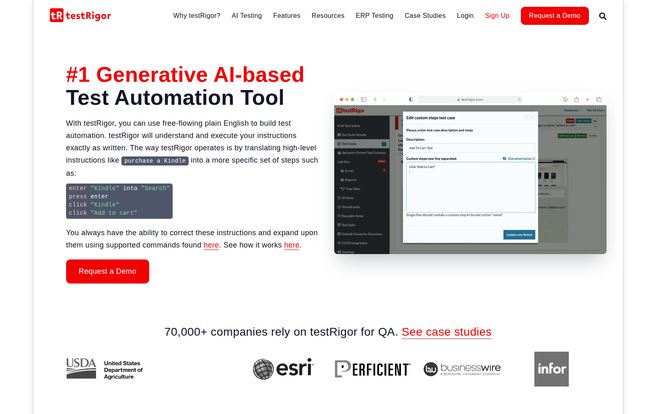
Let’s cut through the jargon. testRigor is an AI-powered test automation platform that lets you write test cases in, well, plain English. Instead of writing something like driver.findElement(By.id("login-button")).click(), you just write, “click login button”.
Think of it like this: traditional test automation is like giving a robot a complex blueprint to build a chair. You have to specify every single nut, bolt, and angle. If the design of the chair leg changes even slightly, the robot gets confused and the whole process grinds to a halt. testRigor is more like just telling a smart assistant, “Hey, build me a chair.” The assistant understands the intent and figures out the details. If the leg design changes, it adapts because it still knows the goal is to build a functional chair.
This approach fundamentally changes who can participate in automation. It’s not just for the coding wizards anymore. Your manual QA team, your business analysts, even your product managers can start writing and maintaining tests. That’s a pretty big deal.
The Big Promises: Does It Live Up to the Hype?
testRigor makes some bold claims on their site. Things like “Build test automation 100X faster” and “99.5% less test maintenance.” Let’s break down the ones that really matter.
Building Tests at Ludicrous Speed
The 100x faster claim is obviously a best-case-scenario marketing number, but the core idea holds true. The time saved by not having to dig through source code to find the right ID, XPath, or CSS selector is immense. You just describe what you see on the screen. For example, a simple login test can be written in a few lines that take seconds to type: “enter ‘myemail@domain.com’ into ’email'”, “enter ‘supersecretpassword’ into ‘password'”, “click ‘Login'”, “check that page contains ‘Welcome back!'”. This is ridiculously fast compared to the setup and coding required for a traditional script.
The Holy Grail of Slashing Maintenance
This, for me, is the real showstopper. The promised 99.5% less test maintenance is where testRigor earns its keep. The AI isn’t just a gimmick for understanding English; it’s constantly working in the background. It learns your application’s elements. So when a developer changes a button’s ID from `btn-submit-_final` to `btn-primary`, testRigor’s self-healing AI doesn’t panic. It looks at other attributes—the button’s text, its position, its context on the page—and correctly deduces, “Ah, this is the same button, just with a new coat of paint.” This single feature could save teams thousands of hours of mind-numbing repair work. Its a massive quality-of-life improvement.
Empowering the Entire Team, Not Just Coders
I love tools that break down silos. For decades, there’s been a wall between manual testers and automation engineers. testRigor pretty much demolishes that wall. Suddenly, the person with the most domain knowledge—the manual QA who knows every weird edge case and user quirk—can be the one building the automation suite. This frees up your senior QA engineers and SDETs to work on more complex problems, like building out robust API test frameworks or performance testing, instead of just translating manual steps into code.
Key Features That Caught My Eye
Beyond the core concept, there are a few features that show this tool is built for the real world, not just a perfect-world demo.
- Broad Platform Support: You’re not just stuck with web testing. It handles web apps, native and hybrid mobile apps (iOS & Android), and even has support for desktop applications and APIs. This makes it a genuine end-to-end testing solution.
- Real-World Scenarios: It can handle email and SMS testing. Need to test a password reset flow? testRigor can generate a temporary email, click the link inside it, and complete the process. It also has 2FA coverage, which is a common stumbling block for many automation tools.
- Smart AI-Based Functions: The system includes pre-built rules for common validation tasks, which further speeds things up. You don’t have to manually code every single check.
Visit testRigor
Let’s Talk Money: The testRigor Pricing Breakdown
Pricing is always a big question, and testRigor has a tiered approach that seems pretty sensible. It’s not the cheapest tool on the market, but you’re paying for the time savings and reduced headcount costs.
| Plan | Price | Best For |
|---|---|---|
| Free – Public | Free | Open-source projects and individual developers wanting to try out the core functionality. Your tests are public. |
| Private Linux Chrome | From $300 / month | Small teams or startups that need private testing for their web applications on Chrome. |
| Private Complete | From $900 / month | This is their most popular tier. It’s for established teams that need full cross-browser, mobile, and API testing capabilities. |
| Enterprise | Custom Pricing | Large organizations with specific security (like on-premise solutions), SSO, and support needs. |
The Not-So-Perfect Bits (Because Nothing Is)
Okay, so it’s not all sunshine and rainbows. No tool is perfect, and it’s important to know the limitations. Based on my research and playing around with it, here are a few things to keep in mind.
First, full desktop testing is only available in the paid tiers, which is fair but something to be aware of if that’s your primary need. Second, it’s not built for testing games. The nature of game UIs and real-time rendering is a completely different animal, so that’s not a surprise. Finally, some might argue that for extremely unique or unconventional user interfaces, you might hit a wall where the plain English parser gets confused. In those fringe cases, the control of a traditional coding approach might still be necessary. But for the vast majority of business and consumer applications, this seems more than capable.
Frequently Asked Questions about testRigor
Can testRigor really understand any plain English command?
Mostly, yes. It uses a powerful Natural Language Processing (NLP) model to interpret your instructions. It’s designed to understand intent, so you have flexibility. Instead of just “click the login button,” you could probably say “press the button labeled login” and it would work. There’s a bit of a learning curve in figuring out how it likes to be spoken to, but it’s miles easier than learning a programming language.
How does the self-healing actually work?
It creates a model of your UI, associating multiple attributes to each element (text, position, size, surrounding elements, etc.). When a test runs and it can’t find an element using the original locator, it searches for an element that matches the other attributes in its model. It’s a probabilistic approach that is surprisingly effective.
Is testRigor a replacement for Selenium or Cypress?
For many teams, it absolutely could be. It’s not just a wrapper on top of Selenium; it’s a completely different philosophy. If your team is struggling with the maintenance overhead and skillset requirements of traditional tools, testRigor presents a very compelling alternative.
What kind of integrations does it support?
All the usual suspects. It integrates directly with CI/CD pipelines (Jenkins, CircleCI, etc.), test case management tools (like Jira, TestRail), and communication platforms (Slack). This allows it to fit neatly into an existing DevOps workflow.
Is it really “no-code”?
For all intents and purposes, yes. You aren’t writing code in a programming language. You are writing descriptive, English-language steps. It’s as ‘no-code’ as it gets in the testing space without being a simple record-and-playback tool (which are notoriously brittle).
My Final Take: A New Chapter for QA?
I came into this review expecting to be underwhelmed. I’ve seen too many tools promise to revolutionize testing and fall flat. But testRigor is different. It feels less like an incremental improvement and more like a fundamental shift in how we can approach quality assurance.
The ability to dramatically speed up test creation, virtually eliminate maintenance, and democratize automation is a powerful combination. It allows teams to achieve higher test coverage faster, which means shipping better products with more confidence. It’s not perfect for every single use case, but for the majority of software development teams out there, this could be the tool that finally delivers on the long-held promise of test automation without the chronic headaches.
If you’re still fighting with brittle scripts and a growing backlog of manual tests, you owe it to your team (and your sanity) to give testRigor a look. This might just be the future.


