
Categories: AI Art Generator, AI Consulting, AI Design Generator, AI Models, AI Research Papers
The Asimov Institute: AI for Creativity & Constraint?

The last couple of years have been a whirlwind in the AI space. Every other day, there’s a new text-to-image model that can render a photorealistic squirrel eating a taco, or a large language model that can write a Shakespearean sonnet about my love for coffee. It’s exciting. It’s chaotic. And honestly, it feels like we’re all in a mad dash to build the fastest car possible, with very few people asking about the brakes.
That’s why I did a double-take when I stumbled upon The Asimov Institute. Their tagline isn’t about disruption or billion-parameter models. It’s quieter, more thoughtful: “For Artificial Creativity & Constraint.”
That second part. Constraint. That’s the word that hooked me. In a world screaming for more, more, more, here’s a group dedicated to the thoughtful application of less.
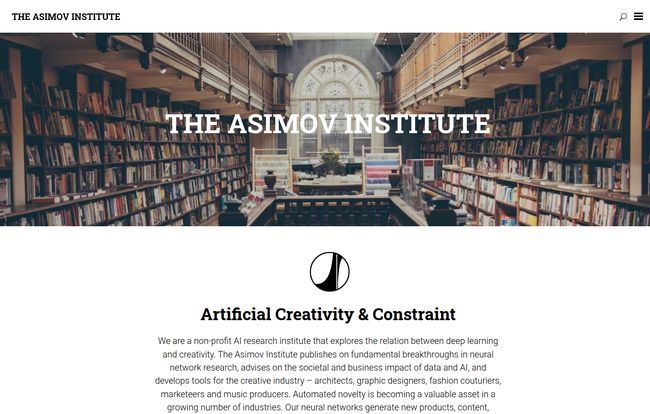
Visit The Asimov Institute
So, What Exactly is The Asimov Institute?
Based out of Utrecht in The Netherlands, The Asimov Institute isn’t your typical tech startup. They’re a non-profit AI research institute. This means they aren’t chasing venture capital or rushing a product to market to meet quarterly earnings. Instead, they’re focused on the foundational research at the fascinating intersection of deep learning and human creativity. They’re not just building another high-speed train; they’re down in the workshop redesigning the fundamental physics of the engine and the brakes at the same time.
Their mission is to develop deep learning tech for what they call “artificial creativity” while also figuring out how to properly constrain these powerful systems. It’s less about creating a tool and more about understanding the very nature of digital creation and control.
The Two Pillars: Artificial Creativity and AI Constraint
Let’s break down their two-pronged focus, because it’s where their unique value really shines.
Pushing the Boundaries of Artificial Creativity
When they talk about creativity, they don’t just mean teaching an AI to paint in the style of Van Gogh. They’re chasing something they call “automated novelty.” The goal is to create systems that can be a genuine asset for artists, marketers, and musicians by providing new project directions, content suggestions, styles, and ideas. It’s about building a collaborator, not just a content-churning machine. It’s a subtle but massive difference.
Why the ‘Constraint’ Part Is So Important
This is the part that, for me, is the most exciting. The entire AI industry is currently wrestling with the alignment problem—how do we ensure these incredibly powerful systems do what we want them to do, without unforeseen and dangerous side effects? Most companies are trying to bolt on safety features and content filters after the fact. It often feels like a patch job.
The Asimov Institute, however, is building the concept of constraint right into their core philosophy. It suggests a more responsible, deliberate approach to AI development. It’s about designing the guardrails at the same time you’re designing the engine. In an industry prone to moving fast and breaking things, this measured approach feels like a breath of fresh air. It’s a recognition that with great creative power must come great, well, constraint.
A Team That’s More ‘Art Collective’ Than ‘Tech Firm’
You can tell a lot about an organization by its people. When I looked at The Asimov Institute’s team, I didn’t just see a list of Deep Learning PhDs. Don’t get me wrong, they have those, but they’re listed alongside an Architect & Designer, a Producer & DJ, a Virtual Fashion Designer, and an Installation Artist.
This interdisciplinary roster is a huge tell. They understand that to truly get a handle on artificial creativity, you need… well, actual creatives in the room. This mix of talent from wildly different fields is how you avoid groupthink and get genuinely innovative ideas. You can’t solve the future of art with just engineers. I love that they seem to get that on a fundamental level.
Digging into Their Work (Or Trying To)
Okay, here’s where things get a bit mysterious. Their website is pretty sparse. It gives you the high-level mission and introduces the team, but if you’re looking for a suite of products to try, you won’t find it. I clicked around their blog links and even hit a classic “OOPS! THAT PAGE CAN’T BE FOUND” error, which is both frustrating and weirdly charming. It feels less like a polished marketing machine and more like, well, a research institute that’s more focused on the work than the website. A minor typo here or there on a site makes it feel more human too.
They do list a few projects, like the “Inverse Surveillance AI Hackathon 2021.” This is fascinating. The name alone suggests a focus on using AI to protect privacy rather than erode it—a complete reversal of how we typically see surveillance AI deployed. They also have links to their GitHub and Bitbucket, implying that some of their work might be open-source, which is a huge win for the community.
The Power of Being a Non-Profit in the AI Gold Rush
I think their non-profit status is maybe their most powerful feature. In the current AI gold rush, for-profit companies are under immense pressure to release models bigger, faster, and flashier than the competition. This can lead to cutting corners on safety and ethics.
Being a non-profit frees The Asimov Institute from that race. They can take their time. They can focus on foundational questions. They can prioritize societal benefit over shareholder value. In an ecosystem dominated by a few massive tech giants, independent, non-profit labs like this are absolutely critical for a healthy, diverse, and safer AI future.
Frequently Asked Questions about The Asimov Institute
- What is The Asimov Institute?
- The Asimov Institute is a non-profit research organization based in the Netherlands that focuses on the intersection of deep learning, artificial creativity, and AI safety/constraint.
- Is The Asimov Institute related to the author Isaac Asimov?
- The website doesn’t explicitly state a connection, but the name is almost certainly a nod to Isaac Asimov, the legendary science fiction author. His “Three Laws of Robotics” were one of the earliest and most famous attempts to outline ethical constraints for artificial intelligence, which aligns perfectly with the institute’s mission.
- Can I use tools or software from The Asimov Institute?
- Not in the traditional sense of a commercial product. They are a research institute, not a SaaS company. Their output is primarily research papers, insights, and potentially open-source code via their GitHub, rather than polished apps for public use.
- What makes them different from other AI companies?
- Their dual focus on creativity and constraint, their non-profit status, and their deeply interdisciplinary team of artists and scientists set them apart from most commercial AI labs.
- Is there a pricing plan?
- No. As a non-profit research institute, they don’t have commercial pricing or subscription plans. Their work is funded through other means, allowing them to focus on research for the public good.
My Final Thoughts on This Quietly Radical Group
So no, The Asimov Institute probably won’t be releasing the next viral AI profile picture generator. And that’s okay. Actually, it’s more than okay; it’s necessary.
They are not the flashy Formula 1 car grabbing all the headlines. They’re the brilliant engineering team working quietly in the garage, rethinking the very concept of safety and performance. In a field that can sometimes feel like it’s flying off the rails, The Asimov Institute is a reminder that the most important work isn’t always the loudest. They’re a group to watch, not for what they’ll release next week, but for the ideas that will shape a more creative and conscientious AI for decades to come.
References and Sources
- The Asimov Institute Official Website: https://asimov.institute/
- The Asimov Institute GitHub: https://github.com/AsimovInstitute


