
Categories: AI Assistant, AI Call Center, AI Voice Assistants
Toma AI: The Dealership Automation Tool You Need?

If you’re running a dealership, or even just working in one, you know the sound. The relentless, never-ending ringing of the phone. It’s the sound of money, sure, but it’s also the sound of chaos. A service customer trying to book an oil change, a sales lead with a question about inventory, a parts query, all at once. And every single missed call? That’s a potential customer walking away. It’s a service appointment that just went to the independent shop down the street.
For years, the answer has been to throw more people at the problem. Build out the BDC. Hire more receptionists. But we all know how that story goes. People get overwhelmed, they call in sick, and they can only be in one place at one time. I’ve been neck-deep in the world of traffic generation for a long time, and I can tell you that all the marketing, SEO, and CPC in the world doesn’t mean a thing if the phone call at the finish line gets dropped.
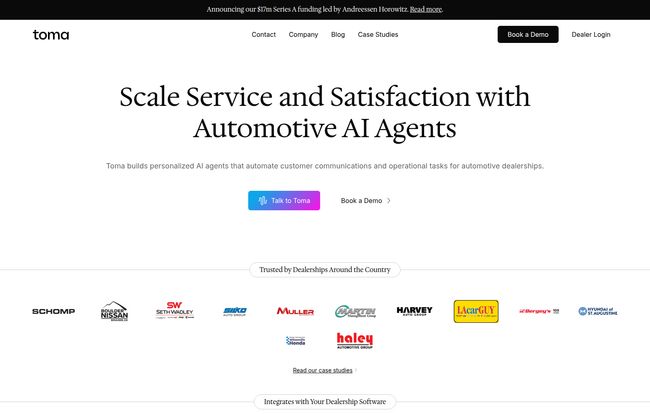
So, what if your best new employee wasn’t a person at all? Enter Toma, an AI automation platform that’s been making some serious waves in the automotive space. This isn’t some far-off, sci-fi concept. This is happening right now, and it’s changing how dealerships handle their most critical point of contact.
What Exactly is Toma? (And Why Should You Care?)
Think of Toma as a digital employee who works 24/7, never needs a coffee break, and can handle hundreds of conversations at once. At its core, it’s an AI-powered agent designed specifically for the unique grind of an automotive dealership. It automates all those crucial—but often repetitive—customer communications and operational tasks that bog down your team.
This isn’t just some chatbot pop-up on a website. We’re talking about an AI that answers your phones, talks to customers in a surprisingly natural way, and actually gets things done. Like scheduling service appointments directly into your system. It’s no wonder some of the biggest names in the business, groups like Lithia, Schomp, and Ken Garff, are already putting it to work. When dealership groups of that size get on board, you know something interesting is happening.
The Core Features That Actually Matter to Your Bottom Line
Fancy tech is great, but I’m interested in what moves the needle. Clicks, calls, and conversions. Here’s where Toma seems to connect the dots.
Never Miss a Call Again with an AI Receptionist
I once tried to book a test drive and was on hold for so long I gave up and called the competing dealer across town. I bought a car from them that same day. How much does a single missed sales call cost? Or a fumbled service booking? A study I read from CallRevu a while back put the value of a single inbound service call at over $300. Ouch. Toma’s whole reason for being is to stop that leakage. Its AI acts as a frontline receptionist, ensuring every single call, SMS, or web chat is answered instantly, day or night.
Supercharging Your BDC and Service Drive
Here’s where it gets really powerful. The platform isn’t just a glorified answering service. It’s an active participant in your business. It can book appointments for sales and service, send intelligent reminders to customers to reduce those infuriating no-shows, and even handle parts inquiries. Imagine freeing up your human BDC agents from the endless grind of appointment setting. They can then focus on what people do best: building rapport, handling complex customer issues, and closing sales. The AI handles the logistics; the humans handle the relationship. That’s a pretty smart division of labor if you ask me.
Visit Toma
Speaking a Language Your Dealership Understands: DMS Integration
Okay, this is the big one for any GM or Dealer Principal. Any new software that doesn’t talk to your existing systems is just creating more work. It’s a non-starter. Toma seems to get this. They have direct integrations with the heavy hitters of the Dealer Management System world: CDK, Reynolds & Reynolds, DealerTrack, and Tekion. This is absolutely critical. It means when the AI books a service appointment, it appears directly in your scheduler. There’s no manual data entry, no risk of transcription errors, no lag time. It makes the AI a true extension of your existing workflow, not just another window to have open.
The Real-World Impact: More Than Just Cool Tech
Talk is cheap, but data tells a story. One of the case studies that stood out to me was for Deacon-Martin Management Group. The numbers are frankly, a bit staggering:
- 9,000+ appointments scheduled by the AI.
- $25,000,000+ in revenue influenced.
- 321,000+ calls handled.
When you see numbers like that, you start to understand the scale. This isn’t a small-time efficiency gain. This is fundamentally changing a dealership’s capacity. There was a quote from a customer on their site that I loved: “…After turning Toma on and listening to the first few calls… there is no doubt we have another employee ready to go… delighting customers.” That hits the nail on the head. It’s not about replacing people, it’s about adding a ridiculously productive team member.
Okay, But What’s the Catch? A Realistic Look
No tool is perfect, and as an SEO and tech guy, I’m naturally skeptical. Let’s address the elephants in the room.
First, the “human touch” argument. Can an AI truly replicate a warm, empathetic conversation? Probably not entirely. But in my experience, for transactional interactions like booking a 30,000-mile service or confirming parts availability, most customers prefer speed and efficiency over small talk. Toma claims its conversations are natural and fast, and the goal here is to let the AI handle the straightforward stuff, freeing up your all-star service advisors for the more nuanced, relationship-building chats. I think that’s a fair trade.
Second, there’s always the potential for AI errors. What if it misunderstands a customer with a strong accent or a complex request? It’s a valid concern. Any dealership using a tool like this needs a clear protocol for escalating calls to a human when the AI reaches its limit. This isn’t a “set it and forget it” magic wand; it’s a powerful tool that still requires smart human oversight.
Finally, there’s the initial setup. Integrating with your DMS and tailoring the AI to your dealerships’s specific needs and language will take some upfront work. It’s an investment of time before it starts paying dividends.
What’s the Investment? A Look at Toma’s Pricing
So, how much does this new super-employee cost? Well, you won’t find a pricing page on their website. And honestly, that’s not surprising. For a B2B platform this specialized, with deep DMS integrations, pricing is almost always custom. The needs of a single-point Ford store in rural Nebraska are vastly different from a multi-rooftop luxury auto group in Los Angeles. The cost will likely depend on your call volume, the number of rooftops, and the specific automations you want to implement. The path forward is to book a demo and get a quote tailored for your operation.
So, Is An AI BDC Agent in Your Future?
AI in the auto industry is here to stay, and it’s moving way beyond just marketing analytics. Tools like Toma are tackling the very operational heart of the dealership: the phone call. It’s about stopping revenue leaks, creating massive operational efficiency, and letting your human team focus on what they do best.
It’s not about getting rid of your BDC. It’s about giving them a force multiplier. It’s about turning your dealership into an operation that truly never sleeps and never, ever misses an opportunity. The only question left is, how many calls did your dealership miss today?
Frequently Asked Questions
- What kind of dealerships is Toma best for?
- Toma appears to be designed for any automotive dealership that has a significant volume of inbound calls for sales, service, or parts. Given its powerful integrations and the scale of its case studies, it seems particularly well-suited for medium-to-large single stores and multi-rooftop dealer groups.
- Does Toma replace my BDC agents or receptionists?
- The goal isn’t necessarily replacement but augmentation. Toma handles the high-volume, repetitive tasks like answering every call and scheduling standard appointments. This frees up your human agents to handle more complex sales negotiations, difficult customer service issues, and high-value outbound campaigns.
- How difficult is it to integrate Toma with my DMS?
- While any integration requires an initial setup process, Toma is built to work directly with major systems like CDK, Reynolds & Reynolds, and DealerTrack. Their team would handle the technical side of the integration during onboarding. It’s a core feature, not an afterthought.
- Can I customize the AI’s responses?
- Yes, it seems so. The platform features a “Build Your Own” option, which suggests a high degree of customization is possible. You’d likely work with their team to tailor scripts and responses to match your dealership’s brand voice and specific processes.
- Is Toma’s service available 24/7?
- Absolutely. One of the primary benefits of an AI agent is its 24/7/365 availability. It can answer calls, book appointments, and respond to messages after hours, on weekends, and during holidays when your physical staff is unavailable.


