
Categories: AI Assistant, AI Knowledge Management, AI Research Tool
Tylo AI Review: The Research Tool You Haven’t Heard Of

My inbox, my feed, my entire digital existence is a constant waterfall of new AI tools. Every single day. “This AI will write your emails!” “This one will generate your groceries!” It’s a lot, and honestly, most of it is just noise. Shiny wrappers on the same old chocolate bar. But every now and then, something catches my eye. Something that isn’t trying to be everything to everyone, but is trying to do one, very difficult thing really, really well.
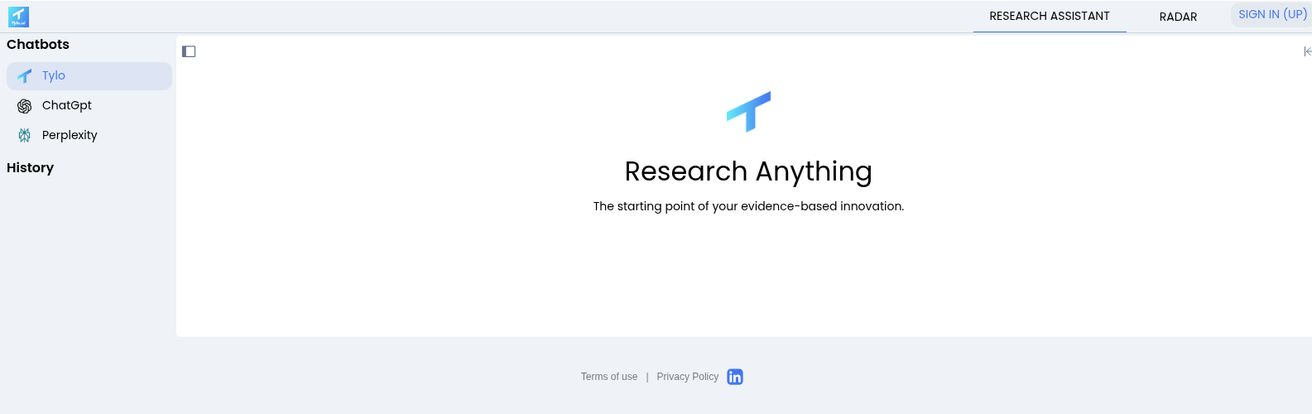
That’s the vibe I got when I stumbled upon Tylo AI. It wasn’t screaming at me from a flashy ad. It just… appeared. And the home screen, clean and simple, said, “Research Anything. The starting point of your evidence-based innovation.” That phrase, evidence-based innovation, just hit different. It’s not about making stuff up faster; it’s about finding the truth faster. I was intrigued.
What Exactly is Tylo AI? (And Why Should You Care?)
So what is this thing? Tylo AI isn’t your average chatbot. You’re not going to ask it for a poem about your cat in the style of Shakespeare. Instead, it’s a specialized research machine. Its whole purpose is to dive into the incredibly dense, jargon-filled worlds of academic publications and patents and pull out insights you can actually use.
It claims to do this using what’s called a “knowledge graph.” Forget a simple keyword search that just gives you a list of documents. A knowledge graph is more like a detective’s corkboard, with strings connecting people, concepts, data points and timelines. It doesn’t just find documents that mention “graphene batteries”; it understands the relationship between the researchers publishing papers, the companies filing patents, the chemical processes described, and the performance metrics cited. It connects the dots. For anyone who’s ever spent a week lost in a rabbit hole of research papers, you know how big of a deal that is.
Visit Tylo AI
My First Impressions: A Walkthrough of the Interface
Logging in, the interface is minimalist. Almost stark. I like that. It suggests a focus on function over fluff. The main screen is that simple “Research Anything” bar. But the really interesting part is the sidebar on the left. Under a “Chatbots” menu, you see three options: Tylo, ChatGPT, and Perplexity.
Now that got my attention. It’s a bold move, putting your own product right next to the 800-pound gorilla (ChatGPT) and the researcher’s darling (Perplexity). It tells me Tylo AI knows exactly who its competition is and isn’t afraid of the comparison. It suggests they believe they have a unique edge, which, in my opinion, is that specialized focus on patents and academic literature. It’s not a generalist; it’s a specialist. And in the world of R&D, specialists are worth their weight in gold.
There are also two main tabs up top: “RESEARCH ASSISTANT” and “RADAR”. The assistant is the core search, but that RADAR function… that sounds promising. More on that in a bit.
The Core Engine: From Dusty Papers to Actionable Plans
The real magic, the proposed value proposition here, is turning a mountain of text into a molehill of actionable business intelligence. Anyone in corporate strategy or R&D knows the pain. You want to know what the bleeding-edge of material science looks like. So you head to Google Scholar, the USPTO database, and other portals. Hours, or even days, later you emerge, blinking in the sunlight, with 50 browser tabs open and a vague sense of what’s happening. Maybe.
Tylo AI aims to be the cure for that. By structuring information from these sources into a knowledge graph, it can supposedly answer questions like:
- “Which companies are filing the most patents in solid-state battery technology?”
- “What are the emerging methods for carbon capture according to the last 18 months of academic literature?”
- “Show me the key researchers in this specific field and which institutions they are affiliated with.”
This is the kind of stuff that informs multi-million dollar decisions. It’s about de-risking innovation by standing on a mountain of verified evidence, not just a gut feeling. A subtle, but crucial, difference.
The Mysterious RADAR Feature
Okay, let’s talk about that “RADAR” tab. While I couldn’t get a full demo without a deeper sign-up, the name itself is pretty telling. I’ve seen similar features in high-end enterprise software. This is likely a technology tracking or monitoring system. You set your areas of interest—say, “mRNA delivery systems” or “perovskite solar cells”—and the RADAR keeps a constant watch.
Think of it as a periscope for your industry. It alerts you to new patents from competitors, groundbreaking papers from university labs, or shifts in research trends. It’s proactive, not reactive. You’re not searching for what happened last year; you’re getting a signal about what might happen next year. For competitive intelligence, this could be an absolute game-changer.
Let’s Talk Money: The Tylo AI Pricing Situation
Here’s my first little gripe. Like so many new SaaS tools, the pricing isn’t plastered on the homepage. You have to sign in to see it. It’s a personal pet peeve of mine, but I get the strategy. They want to get you in the door first.
After signing up, I was able to see the pricing structure. It seems to be a credit-based system, with an unlimited option. Here’s a quick breakdown of what I saw:
| Price | Plan Type | Details |
|---|---|---|
| £29 | Credits | Buy 1,000 credits, 1 year expiry |
| £199 | Credits | Buy 1,000 credits, 1 year expiry |
| £299 | Unlimited | 1 year Unlimited Pass |
Now, you probably noticed what I noticed. The £29 and £199 tiers both list “1,000 credits.” This is either a typo on their page, or there’s some other variable I’m not seeing (perhaps different access levels or types of credits?). This kind of confusion is a small sign of a product that’s still polishing its public-facing details. The £299 for a year of unlimited access, however, seems pretty straightforward and honestly, quite reasonable if the tool delivers on its promises.
The Good, The Bad, and The… Intriguing
After poking around, my feelings are pretty clear. The good is the mission. Focusing on deep, evidence-based research is a massive need. The use of knowledge graph technology is absolutely the right approach for this kind of complex data.
The bad? Well, it’s clearly a new platform. While clicking around, I even hit a 404 error page that had the default template text from Bubble, the no-code platform. That’s not a criticism, really, more of an observation. It tells me this is a tool that is actively being built and refined. You might encounter a few rough edges, which is par for the course with innovative tech. The lack of clear upfront info is also a minor drawback.
And the intriguing part is the sheer potential. That RADAR feature, the direct comparison to other AI giants, and the laser-focus on a tough problem. This isn’t just another AI toy. It’s an industrial-grade tool in the making.
Who Is Tylo AI Really For?
This is not a tool for the masses. My mom isn’t going to use this to find a recipe for lasagna. Tylo AI is built for a very specific type of professional. I’m talking about corporate R&D teams, venture capitalists doing due diligence, patent attorneys, product strategists, and academic researchers themselves. It’s for anyone whose job depends on knowing what’s next, based on real, verifiable data, not just trend reports.
Frequently Asked Questions about Tylo AI
- What is Tylo AI?
- Tylo AI is a specialized AI research assistant designed to extract actionable insights from dense sources like academic papers and patents using knowledge graph technology.
- How is Tylo AI different from ChatGPT?
- While ChatGPT is a general-purpose language model, Tylo AI is a specialist. It is specifically designed to analyze and connect information within the domains of scientific research and intellectual property, providing structured, evidence-based insights rather than just conversational answers.
- What is a knowledge graph?
- A knowledge graph is a way of organizing information that focuses on the relationships between data points. Instead of just a list of documents, it creates a web of connections, helping to uncover deeper patterns and insights that would otherwise be hidden.
- Who should use Tylo AI?
- Professionals in research and development (R&D), corporate strategy, venture capital, and intellectual property law would benefit most from Tylo AI’s capabilities.
- Is Tylo AI free to use?
- No, Tylo AI appears to be a paid service. It operates on a credit-based model and also offers an annual unlimited pass.
- What is the “RADAR” feature in Tylo AI?
- The RADAR feature is likely a proactive technology monitoring tool that tracks and alerts users to new developments, patents, and research papers within their specific areas of interest.
So, Is Tylo AI Worth a Shot?
My final take? I’m optimistic. In a sea of AI generalists, Tylo AI is a refreshing specialist. It’s tackling a genuinely hard and valuable problem: making sense of the world’s technical knowledge. Yes, it looks like it’s still a young platform with a few kinks to iron out, but the foundation is incredibly solid. The focus, the technology choice, and the stated mission are all spot-on.
For the right person—the innovator, the strategist, the researcher—this isn’t just another tool. It could be a powerful new way to see the future. I, for one, will be keeping it on my own personal radar.
Reference and Sources
- United States Patent and Trademark Office (USPTO): https://www.uspto.gov/
- What is a Knowledge Graph? by TechTarget: https://www.techtarget.com/searchbusinessanalytics/definition/knowledge-graph
- Tylo AI on LinkedIn (based on footer icon): You can likely find their official page by searching on LinkedIn.


