
Categories: AI Agent, AI API, AI App Builder, AI Chatbot, AI Developer Tools
Unbody Review: The AI Dev Stack That Saves You Time?

The AI gold rush is on, and every developer I know is either tinkering with a new AI feature or being asked by their boss to “sprinkle some AI on it.” It’s exciting, no doubt. But beneath the shiny surface of amazing demos is a whole lot of… well, plumbing. A whole lot of messy, complicated, and frustrating plumbing.
You start with an idea. A simple AI-powered search for your blog. Easy, right? Next thing you know, you’re trying to stitch together a vector database like Pinecone, manage embeddings with an OpenAI API key, wrangle a data pipeline with something like LangChain, and then serve your media from a separate CDN. Each piece has its own API, its own quirks, and its own bill. Before you know it, your ‘simple’ project feels like building a Frankenstein’s monster of services. I’ve been there. It’s a grind.
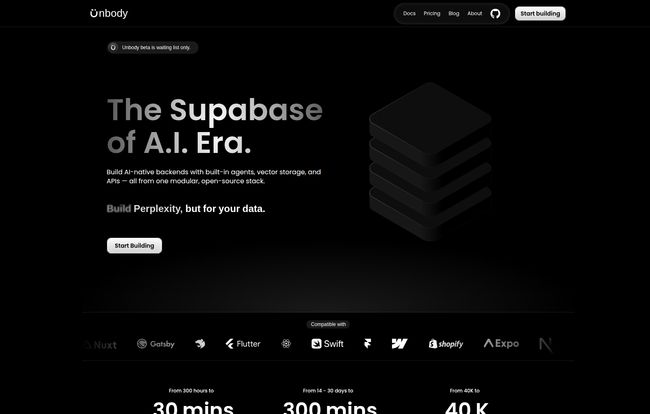
Then, I stumbled across a tool making a pretty bold claim: “The Supabase of AI. Era.” That tool is Unbody.io. For anyone who’s used Supabase to spin up a backend in minutes instead of weeks, that comparison hits hard. It promises to do for AI development what Supabase did for traditional web apps. A single, unified stack to handle all that messy plumbing. So, does it live up to the hype? Let’s get into it.
What Exactly is Unbody? Let’s Break It Down.
Think of it like this. If you wanted to build a custom kitchen, you could buy the lumber, cut the cabinets, pour the countertops, and install all the pipes yourself. Or, you could buy a high-quality, pre-fabricated kitchen where all the hard parts are already designed to work together perfectly. You just install it and start cooking.
Unbody is the pre-fab kitchen for AI applications. It’s an AI-native development stack with a headless architecture. That’s a lot of buzzwords, I know. In plain English, it’s an all-in-one backend that gives you everything you need to build an AI-powered app or website, all accessible through a single API touchpoint. It bundles things like vector storage, data transformation (ETL), Retrieval-Augmented Generation (RAG), and even media processing into one cohesive package. No more juggling five different services.
Visit Unbody
The Core Problem Unbody Solves: AI’s Plumbing Nightmare
The biggest headache in building AI products today isn’t the AI model itself; it’s the data. Your content might be scattered across a CMS, a Google Drive, local Markdown files, and a Notion workspace. Getting all that data into a consistent format that an AI can understand is a massive challenge. This is the “plumbing nightmare” I was talking about.
Unbody’s core mission seems to be solving this exact problem. It’s designed to ingest content from all these disparate sources and unify it into a single “knowledge foundation.” From there, you can perform powerful semantic searches, generate text, or build a custom chatbot that actually knows about your data. It’s like giving your AI a library card to its own perfectly organized library, instead of just letting it wander the chaotic mess of the open internet.
My Favorite Features (The Stuff That Actually Matters)
Okay, the concept is cool. But what about the actual features? After poking around, a few things really stood out to me as game-changers for developers.
A Single GraphQL API to Rule Them All
If you’ve ever had to manage credentials, error handling, and documentation for half a dozen different REST APIs, you’ll understand why this is such a big deal. Unbody channels everything—content queries, AI generation, media requests—through a single, clean GraphQL API. This dramatically simplifies the front-end code. You learn one API, and you can access the full power of the stack. It’s elegant, and honestly, it’s how modern development should feel.
Model Agnostic Means Future-Proof
The AI space is moving at a breakneck pace. Today, OpenAI’s GPT-4 might be the king. Tomorrow, it could be a model from Cohere, Google, or some open-source contender we haven’t even heard of yet. Getting locked into one provider’s ecosystem is a risky move. Unbody is model-agnostic. The platform is built to work with various AI models, which means you can switch or experiment with different providers without rebuilding your entire backend. That’s not just a feature; it’s a strategic advantage.
Out-of-the-Box Media Handling
This is one of those things that sounds minor but saves so much time. Unbody comes with a built-in CDN, image processing, and even video streaming. Need to serve a thumbnail version of an image? Just add a parameter to your API call. No need for a separate Cloudinary or Imgix account. It processes and optimizes your media on the fly. This tight integration of content and media is something I haven’t seen done this smoothly in an AI-centric platform before.
Who is This Really For?
From what I’ve seen, Unbody is tailored for two distinct groups, and their pricing reflects this perfectly.
First, you have the Hobbyist & Indie Hacker. For this crowd, Unbody offers a ridiculously generous free tier. You get to build a project, connect a data source, and make a decent number of API calls per month without ever pulling out your wallet. This is perfect for building a proof-of-concept, a personal project, or an MVP for your startup idea. It lowers the barrier to entry for experimenting with serious AI tech to practically zero.
Then you have the SMBs & Enterprise clients. This is where the paid plan, starting from $2000/month, comes in. Now, that price tag might make you spit out your coffee, but think about the alternative. How much would it cost to hire one or two skilled engineers to build and maintain this kind of complex infrastructure? A lot more than $2k a month, that’s for sure. For a serious business, this is about ROI. They’re not paying for a tool; they’re paying to outsource their entire AI backend infrastructure, reduce their time-to-market from months to weeks, and let their team focus on building the product itself.
Let’s Talk Pricing: Is It Worth It?
So let’s put the plans side-by-side. It’s pretty straightforward.
- Hobbyist Plan (Free): This plan is your entry ticket. It gives you 1 project with 1 data source, 5 minutes of build time per month, and a solid set of monthly API limits: 500 search requests, 50 generative text requests, and 50 Q&A searches. The image and audio/video APIs are quite generous too. For building a small app or testing the waters, this is more than enough.
- SMB/Enterprise Plan ($2000+/mo): This is the “talk to us” plan. Everything is custom – the number of projects, the build time, the API limits. You get access to all AI models, multimodal enhancement, and a custom pipeline. This is for companies that see AI as a core part of their business and understand the value of a managed, high-performance platform.
In my opinion, the pricing makes perfect sense. They’re giving it away for free to the people who will become its biggest advocates (developers), while charging a premium to the businesses who stand to gain the most financial value from it.
The Not-So-Perfect Parts (A Reality Check)
No tool is perfect, especially not a new one. Unbody is still in its early stages—the website mentions it’s an open-source alpha. This means it’s still got that new-car smell, and maybe a few squeaks. You might run into bugs, the documentation could have a few gaps, or you might need some specific development know-how to get everything running perfectly.
This isn’t a deal-breaker, but it’s a reality. You’re adopting an innovative, cutting-edge tool, and that sometimes means you’re on the front lines of development. For some, thats a thrill. For others looking for a decade of battle-tested stability, it might be a bit too early. But honestly, in the fast-moving world of AI, waiting for ‘perfect’ means you’ll always be late.
Final Thoughts: A Glimpse into the Future of Dev Stacks
So, is Unbody the “Supabase of AI”? From where I’m standing, the comparison is spot on. It takes a collection of complex, powerful technologies and abstracts them into a simple, elegant package that just works.
It solves a very real, very painful problem for developers and businesses. It drastically cuts down on the time, cost, and complexity of building meaningful AI products. While it’s still young, the vision is clear and the execution so far is mighty impressive. Tools like Unbody are a sign of where the industry is heading: away from DIY infrastructure and towards powerful, integrated platforms that let us focus on what we do best—building amazing things.
If you’re a developer who’s been curious about building with AI but scared off by the complexity, you owe it to yourself to check out their free plan. You have literally nothing to lose, and a whole world of new possibilities to gain.
Frequently Asked Questions
- In simple terms, what is Unbody?
- Unbody is an all-in-one backend for building AI applications. It combines a database, AI tools, and content delivery into a single platform, so you don’t have to connect multiple different services yourself. Think of it as a complete toolkit for your AI project’s backend.
- Can I use AI models other than OpenAI with Unbody?
- Yes. Unbody is designed to be model-agnostic. It supports models from major providers like OpenAI, Cohere, and Google, allowing you to choose the best one for your needs or switch models without a major overhaul.
- Is Unbody an open-source platform?
- Yes, the Unbody stack is open-source, currently in its alpha stage. This means developers can inspect the code, contribute to its development, and have more transparency into how it works.
- What kinds of applications can I build with Unbody?
- You can build a wide range of AI-native products. Some examples include intelligent chatbots that know your documentation, semantic search engines for your website, automated content generation tools, or any app that needs to understand and interact with a large body of text and media.
- How does the Unbody pricing work?
- Unbody has two main tiers. There is a free ‘Hobbyist’ plan with generous limits for small projects and testing. For larger businesses, there is a custom ‘SMB/Enterprise’ plan starting at $2000/month that offers expanded capabilities and dedicated support.


