
Categories: AI Agent, AI API, AI Cold Calling, AI Customer Service, AI Lead Generation, AI Meeting Assistant, AI Sales, AI Sales Assistant, AI Transcription, AI Voice Assistants, AI Voice Generator
VoiceGenie Review: An SEO’s Take on AI Voice Bots

If you’ve been in the marketing or sales game for more than a few years, you’ve seen a lot of ‘game-changers’ come and go. I’ve seen platforms promise the world and deliver a pamphlet. I’ve managed CPC campaigns that bled money faster than a leaky bucket. So when I hear about a tool that claims it can automate 80% of sales and support conversations with a generative AI voice bot, my inner skeptic raises a very prominent eyebrow.
The tool in question is VoiceGenie. And I’ve been watching the conversational AI space for a while now, not just with morbid curiosity, but because the grind of lead qualification is a universal pain point. It’s tedious. It’s repetitive. And frankly, it’s often the biggest bottleneck for a growing business.
So, is VoiceGenie another flash in the pan, or is it the real deal—a bionic arm for your over-stretched sales team? I spent some time digging into it, and my findings… well, they’re interesting.
So, What Exactly is VoiceGenie Trying to Be?
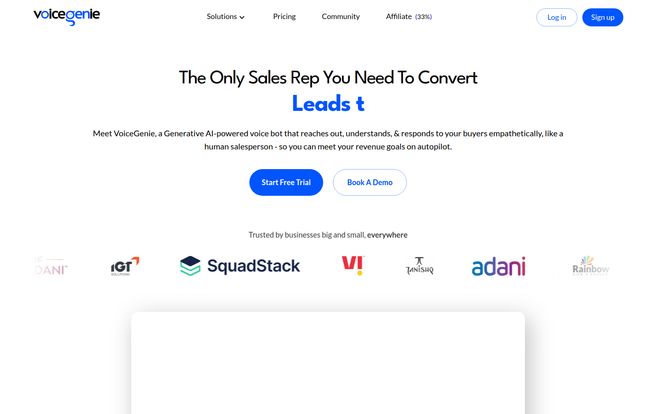
At its heart, VoiceGenie is a Generative Voice AI platform. Forget those old-school, ‘Press 1 for sales’ robocallers that make you want to throw your phone across the room. The idea here is to create an AI assistant that can have a genuinely fluid, human-like conversation. It’s designed to tackle that messy top-of-funnel stuff: generating awareness, educating potential customers, and qualifying leads before they ever reach a human agent.
Visit VoiceGenie
Think about it. A potential lead clicks on an ad, requests info, and almost instantly, they get a call. Not from a tired sales rep on their 50th call of the day, but from an AI that’s always on, always polite, and always following the script. It can answer their basic questions, figure out if they’re a good fit, and even book a meeting directly into your calendar. That’s the dream, anyway.
The Features That Actually Caught My Eye
A feature list is just a list until you see how it applies to the daily grind. Some of VoiceGenie’s capabilities are standard fare for automation platforms, but a few things stood out to me as a performance marketer.
That “Sentient” Conversation Engine
VoiceGenie uses words like ‘Sentient’ and ‘Brilliant’ on their site, which is bold marketing, to say the least. While I wouldn’t go that far (yet!), the core of their offering is a generative AI. This means it’s not just playing pre-recorded clips. It’s generating responses in real-time, allowing for a more natural back-and-forth. This is the difference between an IVR system and something that can actually handle unexpected questions. It can understand intent, handle interruptions, and adapt its conversation path. This is crucial for not immediately tipping off the user that they’re talking to a machine.
Your Tireless 24/7 Sales Assistant
This is probably the most obvious, but most powerful, benefit. Your human team needs to sleep. They take vacations. They have off days. An AI doesn’t. VoiceGenie can make and take calls around the clock, engaging leads the moment they show interest—whether that’s at 2 PM on a Tuesday or 2 AM on a Sunday. Speed to lead is everything in this business, and you can’t get much faster than instant.
Playing Nice with Your Existing Stack
Any new tool that doesn’t integrate with your CRM is just creating more work. VoiceGenie claims to integrate with major platforms, which is a non-negotiable for me. The ability to automatically log calls, update contact records, and trigger workflows in your existing system is what separates a neat toy from a serious business tool. The call recordings, transcriptions, and AI-powered summaries are absolute gold for understanding customer pain points at scale, without a human having to listen back to hours of tape.
Breaking Down The Cost: VoiceGenie Pricing
Alright, let’s talk money. I appreciate that VoiceGenie has transparent pricing on their website—it’s a pet peeve of mine when companies hide this behind a “Contact Us for a Demo” wall. The structure is based on a monthly subscription that gives you a set number of calling minutes.
Here’s a quick look at their plans:
| Plan | Price per Month | Included Minutes | Best For |
|---|---|---|---|
| Trial | $50 | 250 | Dipping your toes in the water. |
| Starter | $200 | 1,000 | Small businesses getting serious. |
| Growth | $500 | 2,500 | Growing companies ready to scale. |
| Elite | $1,000 | 5,000 | Larger businesses with high call volume. |
They also have an Add-On for $50 which gets you an extra 250 minutes, which is a nice, flexible option if you have a big campaign one month. The trial plan at $50 is pretty accessible, it’s low enough to run a meaningful test without having to get a ton of corporate approvals. The Starter and Growth plans seem like the sweet spot for most small-to-medium businesses.
The Good, The Bad, and The Potentially Awkward
No tool is perfect. Let’s get into the nitty-gritty.
Where VoiceGenie Could Be a Lifesaver
The biggest win here is efficiency. Plain and simple. It frees up your skilled (and expensive) sales and support staff from the soul-crushing, repetitive task of initial qualification. It allows them to focus on what they do best: closing deals and solving complex problems with already-warmed-up leads. The data you get—the call summaries, the common questions, the objections—is a goldmine for refining your marketing messaging and product.
Some Stumbling Blocks and Reality Checks
First, this isn’t a plug-and-play magic wand. It requires initial setup. You need to design the conversation flow, write the scripts, and hook it into your systems. While it’s probably not rocket science, if you want to do anything complex with the API, you might need someone with a bit of technical skill.
But the biggest hurdle is a philosophical one. There’s a real risk of your leads feeling duped or frustrated if they realize they’re talking to a bot. Some people will just hang up. I’ve always believed that automation should support the human connection, not try to replace it entirely. The key is transparency. Some studies, like one I saw on Gartner’s hype cycle for customer service, show a growing acceptance of AI, but its not universal. The trick is to use the AI for the right job—the initial, data-gathering part of the conversation—before handing off to a human for the real relationship-building.
My Final, Unfiltered Thoughts
So, is VoiceGenie worth it? My answer is a firm… it depends.
If you’re a B2C company with a high volume of inbound leads, or a B2B business that needs to sift through a huge list of potential prospects, then yes. I think this kind of technology is not just the future; it’s rapidly becoming the present. The amount of time and money it can save by automating top-of-funnel drudgery is immense.
However, if your business is built on high-touch, white-glove service from the very first interaction, you might want to be more strategic. Perhaps use it for after-hours support or for following up on webinar attendees, rather than as your primary first point of contact.
My advice? Don’t be scared of it, but be smart about it. The $50 trial is your friend. Sign up, define a very specific, measurable goal—like qualifying leads from a single Facebook campaign—and see how it performs. See how the conversations flow. Listen to the recordings. The worst that can happen is you’re out 50 bucks and you’ve learned a valuable lesson. The best that can happen? You’ve just found your company’s new favorite employee.
Frequently Asked Questions About VoiceGenie
- What’s the real difference between its ‘agent’ and ‘assistant’?
- Based on their site, it seems to be about the complexity of the task. An ‘assistant’ might handle straightforward tasks like booking appointments or answering simple FAQs. An ‘agent’ implies a more complex, multi-turn conversational ability to qualify leads or handle more detailed support issues. It’s all part of the same generative system, just applied to different goals.
- Can I use this for customer support, not just sales?
- Absolutely. It’s well-suited for handling common support questions, checking order statuses, or providing technical troubleshooting for simple issues. This can free up your human support team to handle the really frustrated or complex customer problems.
- How hard is it to actually set up a campaign?
- From what I can tell, the basic setup is designed to be user-friendly. You’ll likely use a visual interface to design the conversation flow and write the script. The real work is in the strategy: defining your goals, writing a script that sounds natural, and anticipating customer questions. The technical part seems secondary to the conversational design.
- Does the AI learn and get better over time?
- Yes, that’s a key part of generative AI. The system learns from thousands of conversations, identifying what works, what doesn’t, and how to better handle certain objections or questions. The AI you have on day 90 will likely be smarter and more effective than the one you started with on day 1.
- What happens if a caller gets angry or wants a human?
- This is a critical part of the setup. A well-designed AI flow should have an ‘escape hatch’. It should be programmed to recognize signs of frustration, or direct commands like “I want to speak to a person,” and immediately route the call to a live agent. Trying to trap a frustrated caller in an AI loop is a recipe for disaster.
The Last Word
The rise of AI in marketing isn’t about replacing humans. It’s about augmenting them. Tools like VoiceGenie represent a powerful shift toward automating the tasks that machines do well (repetition, data processing, 24/7 availability) so that humans can focus on the things we do well (empathy, complex problem-solving, building genuine rapport). It’s a brave new world for lead gen, and frankly, I’m here for it.


