
Categories: AI For Data Analytics, AI For Finance, AI Productivity Tools
Webb Fontaine: AI for Smarter Government Trade & Customs

International trade is chaos. A beautiful, chaotic, globe-spanning mess that somehow, miraculously, gets a t-shirt from a factory in Vietnam to a store in Ohio. As someone who lives and breathes data, traffic, and systems, the sheer scale of the logistics involved both fascinates and terrifies me. For every sleek container ship you see gliding into port, there’s a mountain of paperwork, a tangle of regulations, and an army of people trying to make sense of it all.
For decades, this system has run on a mixture of legacy tech, paper trails, and good old-fashioned human intuition. But that’s changing. Fast. And that’s where companies like Webb Fontaine come into the picture. I stumbled upon them while looking into how AI is worming its way into industries far beyond my usual marketing and CPC world. What I found was pretty interesting.
They’re not selling another social media scheduler or a keyword research tool. They’re tackling the colossal task of modernizing how entire countries manage trade. It’s a B2G (Business-to-Government) play, which is a whole different ball game, with higher stakes and, frankly, much bigger problems to solve.
So, What Exactly is Webb Fontaine?
At its heart, Webb Fontaine is a technology partner for governments. Imagine all the moving parts of a country’s trade: customs declarations, port manifests, inspection reports, tariff calculations, transit documents. It’s a symphony of data, and historically, every musician has been playing from a different sheet of music. Webb Fontaine steps in as the conductor, handing everyone an iPad with the same score, all updated in real-time.
They provide AI-powered platforms to streamline this entire process. Their goal is to help governments increase their revenue (by catching under-declared goods, for instance), beef up security, and make the whole process of importing and exporting less of a headache for businesses. Think of them as building the digital plumbing for a country’s economy. It’s not glamorous, but without it, everything grinds to a halt.
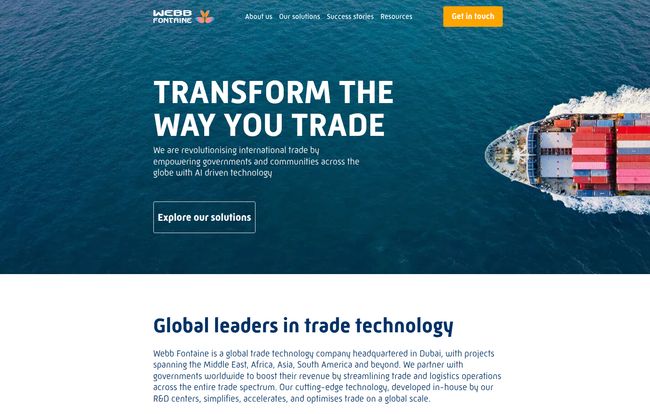
Visit Webb Fontaine
Their services cover the whole nine yards of trade facilitation: from sophisticated Customs Management Systems and unified Single Window platforms (more on that in a sec) to Port Community Systems and high-tech Risk Intelligence. They’re essentially offering a full-stack upgrade for a nation’s trade infrastructure.
The “AI-Powered” Promise: Hype or a Real Game Changer?
Okay, I’ll admit it. My eyes glaze over a little bit whenever I see “AI-Powered” slapped onto something. It’s the marketing buzzword of the decade. But in this context, it actually makes a ton of sense. The core of AI, especially machine learning, is pattern recognition in massive datasets. And what is international trade if not one of the biggest, messiest datasets on the planet?
Webb Fontaine seems to be focusing its AI on two critical areas: Smart Valuation and Risk Intelligence.
Smart Valuation is about ensuring a product’s declared value is accurate. Let’s say someone tries to import a thousand high-end graphics cards but declares them as cheap calculators to avoid paying higher tariffs. An AI system, trained on millions of past shipments, can instantly flag that declaration as suspicious. For a goverment, that’s not just a statistic; that’s real, tangible revenue that was about to walk out the door.
Risk Intelligence is the security side of the coin. The system analyzes countless data points—origin country, shipping route, type of goods, parties involved—to assign a risk score to each shipment. A low-risk container might get a digital green light for immediate release, while a high-risk one is automatically flagged for physical inspection. This is a huge leap from random checks, making the entire process faster for legitimate traders and more secure for the country.
A Look at Their Core Solutions
The Single Window Concept
This is a term you hear a lot in the trade world, and it’s a big part of Webb Fontaine’s offering. The “Single Window” is basically a one-stop-shop digital portal. Instead of a shipping agent having to submit paperwork to the port authority, then to customs, then to the ministry of agriculture, and so on, they submit everything once, through one single platform. The platform then intelligently routes the information to all the necessary agencies. It’s a simple concept with a profound impact on cutting down bureaucracy and speeding up clearance times. A real game changer for efficiency.
Modernizing Customs and Ports
Their `Webb Customs` and `Webb Ports` solutions are the nuts and bolts. They replace aging, often paper-based, systems with an integrated digital platform. This connects all the players—customs officers, port operators, shipping lines, and agents—so everyone is working with the same information. It reduces errors, minimizes delays, and creates a transparent audit trail for every single thing that happens.
Tracking and Intelligence on the Move
Finally, there’s `Webb Transit Tracking` and the aforementioned `Risk Intelligence`. This isn’t just about knowing where a container is. It’s about securing the entire supply chain. GPS tracking on trucks combined with digital seals can ensure a high-value or sensitive cargo isn’t tampered with on its way from the port to an inland depot. It’s about building trust into the physical movement of goods.
The Real-World Impact (With a Dose of Reality)
This all sounds great on a PowerPoint slide, but what about the real world? Webb Fontaine prominently features their work with governments in places like Benin, Egypt, and Nepal. These aren’t just names on a map; they represent complex, unique trade environments. Having successful implementations in diverse economies lends them a massive amount of credibility. It shows they can adapt their tech to different legal frameworks and infrastructure levels.
But let’s not get carried away. A project of this scale comes with some serious hurdles. In my experience with large-scale tech rollouts (though admittedly, never for an entire country!), the dream and the reality can be two very different things.
- The Investment is Huge: This is not a simple SaaS subscription. Implementing a nationwide trade platform is a major infrastructure project. It requires significant financial and political commitment from the government.
- The Integration Headache: You can’t just airdrop a new system into a government’s IT environment. It has to talk to ancient legacy systems, databases that haven’t been updated since the dial-up era, and processes that are deeply entrenched. I’ve seen simpler website migrations go completely off the rails; this is that, times a thousand.
- The Human Element: An AI can flag risks, but you still need well-trained, well-paid customs officers to act on that intelligence. Technology is a tool, not a silver bullet. Ongoing monitoring and adjustments, both to the tech and the human processes around it, are absolutely critical.
What About the Price Tag?
If you go looking for a pricing page on the Webb Fontaine site, you won’t find one (I checked, it’s a 404 page). And that’s no surprise. You don’t sell national infrastructure with a three-tiered pricing table.
The cost of a Webb Fontaine solution is entirely bespoke. It would depend on the size of the country’s economy, the volume of its trade, the number of government agencies involved, and the state of its existing digital infrastructure. The conversation isn’t about cost; it’s about investment and return. The business case they’re making is that the system will pay for itself through increased customs revenue, reduced fraud, and the economic boost that comes from more efficient trade. To get a number, you have to do what their site says: Speak to an expert.
My Final Take: Is It Worth It for Governments?
From my perspective as a tech and systems guy, the move to a fully digital, intelligent trade platform isn’t just a good idea—it’s inevitable. Any country that wants to be a serious player in the 21st-century global economy simply can’t afford to be stuck in the 20th century, administratively speaking. The friction of old-school bureaucracy is a direct tax on growth.
Webb Fontaine seems to be one of the few big, experienced players in this very niche, very high-stakes field. They have the case studies and the comprehensive tech stack to back up their claims. The biggest challenge isn’t whether the tech works, but whether a government can muster the political will and operational discipline to implement it properly.
It’s a massive undertaking, but the alternative—falling further behind in an increasingly fast and interconnected world—is far scarier.
Frequently Asked Questions
- Who is Webb Fontaine’s typical customer?
- Their primary customers are national governments and their associated bodies, such as customs authorities, port authorities, and ministries of trade or finance. They work on a national scale to overhaul trade infrastructure.
- Is Webb Fontaine just a software company?
- Not really. It’s better to think of them as a technology and implementation partner. They provide the software platforms but also consult and work with governments to deploy, integrate, and manage these massive systems, which often includes training and change management.
- How does the AI in Webb Fontaine’s system actually work?
- The AI primarily works by analyzing vast amounts of historical and real-time trade data. It learns what’s “normal” for shipments of certain goods from certain places, allowing it to automatically flag anomalies, like suspicious valuations or high-risk cargo combinations, much faster and more accurately than a human could.
- Why is there no public pricing for Webb Fontaine?
- Because every implementation is a unique, country-wide project. The price depends on countless variables like the country’s size, trade volume, and existing technology. Pricing is determined through direct consultation and a detailed assessment of the government’s needs.
- What is a “Trade Single Window”?
- It’s a digital platform that allows traders and shipping agents to submit all their import, export, and transit information to the government through a single online portal. It dramatically simplifies paperwork and speeds up the entire customs and clearance process.
- Can small businesses use Webb Fontaine?
- Not directly. Small businesses would interact with the system indirectly. If their country’s government implements a Webb Fontaine platform, that business would then use the new, streamlined government portal (the Single Window, for example) to clear their goods, benefiting from the increased speed and efficiency.
Conclusion
So there you have it. Webb Fontaine is playing in a league that most of us in the digital marketing world rarely see. They are not just optimizing a website; they are optimizing a country’s entire economic border. The blend of AI, big data, and public policy is a fascinating space to watch. While the implementation challenges are real, the promise of a smarter, faster, and more secure global trade network is a powerful one. It’s a bold vision, and it’ll be interesting to see which nations take the leap.


