
Categories: AI Quizzes, AI Report Generator
What Do My Friends Think of Me Quiz: An Honest Review

You’re laughing with your friends, having a great time, and then later that night, a tiny, nagging thought pops into your head: “Do they really like me? Do they think I’m funny, or just… loud?
It’s a universal human anxiety. We spend so much of our lives inside our own heads, curating our own self-image, that it’s nearly impossible to know how we truly come across to others.
For years, the best tool we had for this was, well, blunt-force bravery. You could ask a friend directly and hope they were both honest and articulate. Or you could study up on psychological models like the Johari Window—a fascinating concept that divides your personality into four quadrants: what you know and others know, what only you know, what only others know (your blind spots!), and what no one knows.
That second quadrant, the blind spots, is where the juicy stuff is. It’s the ‘food stuck in your teeth’ of your personality. And recently, I stumbled upon a tool that acts like a digital mirror held up by your friends to help you see it: an AI-powered quiz aptly named What Do My Friends Think of Me.
So, What is This Thing, Really?
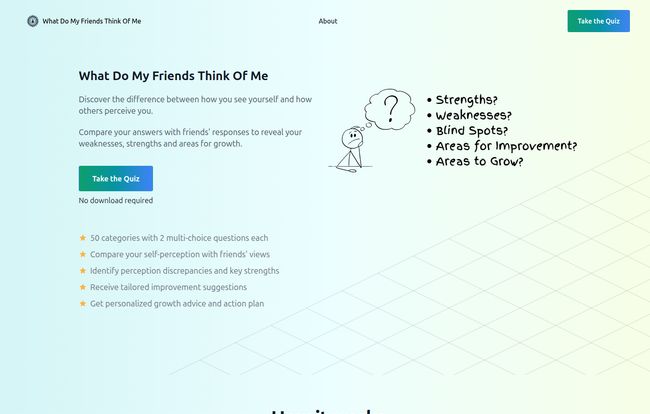
At first glance, it looks like another fun online quiz. But it’s got a bit more going on under the hood. This isn’t about finding out which type of bread you are. The platform uses a pretty detailed 50-category quiz to build a profile of your personality, based on your own answers. It covers everything from your social habits to your emotional tendencies.
But here’s the twist. The real magic happens when you turn it over to your friends. They take the exact same quiz, but they answer it about you. The AI then takes your self-assessment, compares it with the (hopefully honest) feedback from your pals, and generates a personalized report. The goal is to highlight the gaps—the places where you see yourself one way, and the world sees you another. Its a fascinating idea, right?
Visit What Do My Friends Think Of Me
The Step-by-Step Breakdown of How It Works
The process is refreshingly simple, which I appreciate. No clunky software to download or confusing interfaces. The charmingly basic stick-figure diagrams on their site pretty much sum it up:
- You Take the Quiz: First, you go through the 50-category quiz yourself. Be honest! There’s no point in doing this if you’re just going to paint the rosiest picture of yourself. This is your baseline.
- You Get Your Secret Link: Once you’re done, the platform generates a unique, shareable link. This is your golden ticket.
- You Start Friend-Wrangling: Now comes the fun/awkward part. You send that link to a few trusted friends. My advice? Don’t just blast it out. Pick people who know you well and who you think will give it to you straight.
- They Spill the Beans: Your friends then take the same quiz, answering the questions from their perspective of you.
- The Big Reveal: After a certain number of your friends have submitted their responses (the site says a minimum number is required), you’ll get an email with a link to your personalized report. This is where you get to see the data and discover your potential blind spots.
But Why Should You Even Bother? The Real Payoff
Okay, so it sounds like a neat party trick. But as someone who’s spent years optimizing everything from websites to ad campaigns based on data, I see some genuine value here for personal development. It’s about turning vague social anxieties into actionable insights.
Uncovering Your Hidden Strengths and Blind Spots
This is the main draw. Maybe you think of yourself as a bit shy and reserved, but your friends all categorize you as a “thoughtful listener.” Boom, that’s a newfound strength you can lean into. On the flip side, you might pride yourself on being “efficient,” while your friends are gently trying to tell you that you come off as a bit… “impatient.” That’s a classic blind spot. It’s like driving a car; you can’t get rid of blind spots entirely, but knowing where they are makes you a much safer, more effective driver. This is just that, but for your social life.
A Turbo-Boost for Your Self-Awareness
Self-awareness is one of those buzzwords that gets thrown around a lot in the personal growth space. But what does it even mean? In my book, it means having a clear, unbiased understanding of your own character. Tools like this, while not scientific gospel, give you data points outside your own echo chamber. Seeing your self-perception chart next to your friends’ perception chart is a powerful, immediate dose of perspective.
Building Better and Stronger Relationships
Let’s go back to that “efficient” vs. “impatient” example. Knowing that perception gap exists is a game-changer. It doesn’t mean you have to fundamentally change who you are. But it might mean you soften your approach in certain situations. It opens the door for better communication, because you’re suddenly aware of the subtext you might be sending out. The result? Less misunderstanding and stronger connections.
My Honest Take: The Good, The Bad, and The Awkward
So, I’ve walked you through the what and the why. But is it actually any good? Here’s my no-fluff opinion.
The Good Stuff is genuinely good. The personalized report isn’t just a raw data dump. It offers tailored suggestions and an action plan. It’s one thing to be told you have a blind spot; it’s another to be given a constructive idea of what to do about it. And I have to admit, seeing your strengths validated by your friends is a major confidence booster. Those little things you do that you think go unnoticed? They probably don’t. That feels pretty great.
Now for the potential downsides. The biggest one is obvious: the entire system hinges on your friends’ participation and honesty. If you send it to five people and only one responds, your data is going to be skewed. And if that one person is your mom… well, you’ll get a lovely report, but maybe not the most objective one. The results are inherently subjective. This isn’t a CAT scan of your soul; it’s a collection of opinions. You have to go into it with that mindset.
Also, to get your report, you need to provide a valid email address. This is a pretty standard lead-generation tactic, but it’s something to be aware of. You’re trading your email (and your friends’ time) for these insights.
What’s the Damage? Let’s Talk Pricing
This is often the million-dollar question. So how much does it cost to get this deep psychological profile? Well, from what I can see on the site, it seems to be free to get started. You can take the quiz, send the link, and presumably get your report without pulling out a credit card. The FAQ on their site even has a question about pricing, but it doesn’t give a direct answer on the homepage.
My educated guess? The basic report is likely free, but there might be an option to purchase a more in-depth analysis or an expanded action plan. This is a common model for tools like this, and it’s a fair one. It lets you try before you buy. For now, it looks like you can get some real value without any financial investment, which is a big plus in my book.
Frequently Asked Questions
What exactly is ‘What Do My Friends Think of Me’?
It’s an online, AI-powered quiz designed to increase your self-awareness. You take a quiz about yourself, your friends take the same quiz about you, and the tool analyzes the differences between your self-perception and their perceptions to reveal your strengths and blind spots.
How does the AI analysis work?
The AI compares the data from your quiz answers against the aggregated data from your friends’ answers across 50 different personality categories. It then identifies significant patterns and discrepancies to generate a personalized report with insights and growth suggestions.
Is my data safe and anonymous?
While the website requires an email to send you the final report, the feedback from your friends is typically aggregated and anonymized. This encourages them to be more honest. As with any online platform, it’s always a good idea to review their privacy policy for specifics.
How many of my friends need to respond?
The site states that a minimum number of responses is required to generate an accurate report. This is to ensure the data is balanced and not overly influenced by a single person’s opinion. The exact number might vary, but plan on needing at least 3-5 friends to participate.
So, is it really free?
It appears to be free to take the quiz, share the link, and receive a personalized report. There may be optional, paid upgrades for more detailed reports or features, but the core functionality seems to be available at no cost.
Can I completely trust the results?
Think of the results as a guide, not gospel. They are based on the perceptions of the friends you choose. It’s a powerful tool for reflection and a great conversation starter, but it’s still a snapshot of opinions, not an absolute scientific truth.
So, Should You Do It?
If you’re the kind of person who is genuinely interested in personal growth and not afraid of a little constructive criticism, then my answer is a resounding yes. It’s a low-stakes, high-potential tool for gaining a new perspective. Will it be a bit awkward asking your friends to do it? Maybe. Could some of the feedback be a little tough to swallow? Possibly.
But the potential to better understand yourself, improve your relationships, and get a nice little confidence boost from your confirmed strengths makes it worth the risk. At the end of the day, self-awareness isn’t about achieving perfection. It’s about being brave enough to look in the mirror—even when your friends are the ones holding it. Give it a shot. You might be surprised by what you see.
References and Sources
- What Do My Friends Think of Me – Official Website
- Wikipedia – Johari Window


