
Categories: AI Chatbot, AI Developer Tools, AI Workflow, Large Language Models (LLMs)
Zeabur Review: The Future of Cloud Deployment is Here?

Let’s have a frank conversation. How many of your brilliant project ideas have been left to gather digital dust in a private GitHub repo? You build something cool, something you’re genuinely excited about. And then you hit The Wall. The wall of deployment. The soul-sucking vortex of configuring servers, setting up environments, wrestling with CI/CD pipelines, and deciphering cryptic error messages at 2 AM. I’ve been there. We’ve all been there.
It’s the part of development nobody really loves, the necessary evil that stands between your code and the world. For years, platforms like Heroku were a godsend, but things have changed. The landscape has shifted. That’s why when I first heard about Zeabur, a platform calling itself an “AI Deployment Agent for Vibey Coders,” I was skeptical but intrigued. “Vibey coders?” Okay, marketing is marketing. But the promise of simplifying deployment to a few clicks? That got my attention.
So, What Exactly is Zeabur, Anyway?
Strip away the buzzwords, and Zeabur is a cloud deployment platform built for the modern developer. Think of it as a super-smart assistant whose only job is to take your code from your Git repository and get it running on the internet. Fast. It’s designed to automatically figure out what kind of project you have—whether it’s a Node.js backend, a React frontend, a Python script, or a database—and just… handle it. No fuss.
It’s not just for simple stuff either. It’s built to support a whole ecosystem of services and make them play nice together. This isn’t just another PaaS (Platform as a Service); it feels more like a deployment control center. You can push code, LLM-generated code, databases, and all the bits and pieces of a modern application and watch them come to life in minutes, not days.
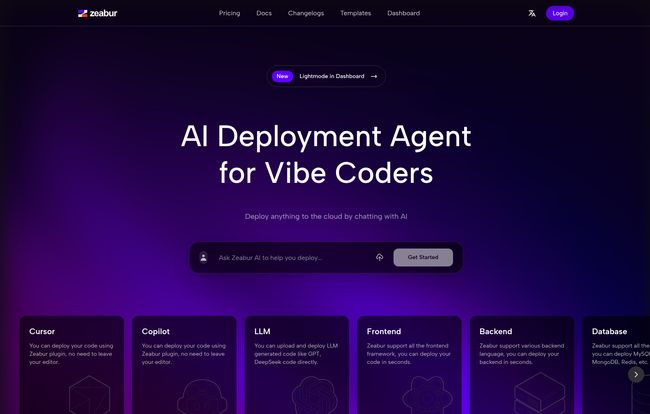
Visit Zeabur
My First Run: The “It Just Works” Magic
I decided to put it to the test with a small side project—a Node.js/Express API with a Postgres database. Normally, this would involve me setting up a VPS, installing Node, installing Postgres, configuring user roles, setting up PM2 to keep the app alive, and then wiring up a GitHub Action for auto-deployment. A solid afternoon of work, at least.
With Zeabur, the process was… anticlimactic, in the best way possible. I connected my GitHub account, pointed it to my repo, and it immediately identified the `package.json` file. It asked if I wanted to launch a Postgres database. I said yes. A minute or two later, both my API and the database were live, connected, and accessible via a temporary URL. The database connection string was even automatically injected as an environment variable. I was floored. It just got out of my way and let me focus on the code.
The Standout Features That Genuinely Matter
Every platform boasts a long list of features, but only a few ever make a real difference in your day-to-day workflow. Here’s what stood out to me with Zeabur.
One-Click Deployment is Not an Exaggeration
This is the core promise, and they deliver. You can deploy directly from a Git repository (GitHub for now), or even just drag and drop a folder. It’s incredibly slick. Zeabur analyzes the code and automatically builds and deploys it. For a developer, this is pure gold. It shortens the feedback loop from “I wrote a new feature” to “the new feature is live” dramatically.
A Marketplace of Ready-to-Go Service Templates
This was a pleasant surprise. Beyond your own code, Zeabur has a marketplace of pre-configured services you can deploy with a single click. Need a WordPress site? Done. Want to set up a Loki instance for log aggregation? Click. An Uptime-Kuma monitor? Easy. This transforms Zeabur from just a code host into a full-blown infrastructure toolkit. It’s perfect for quickly spinning up the supporting services every real-world application needs.
CI/CD Without The YAML Hell
If you’ve ever spent hours fighting with the syntax of a `.github/workflows` file, you’ll appreciate this. Continuous Integration and Continuous Deployment (CI/CD) are built-in and automatic. Push a new commit to your main branch, and Zeabur automatically rebuilds and redeploys your service. No configuration needed. It also creates preview deployments for pull requests, which is fantastic for team collaboration and testing changes before they hit production.
Bring Your Own Server (Or Just Use Theirs)
Zeabur offers a flexible hosting model. By default, your services run on their shared cluster, which is perfect for getting started. But here’s the cool part: you can also bind your own server. If you have a powerful VPS from providers like DigitalOcean, Vultr, or Hetzner that you want to use, you can connect it to Zeabur. Zeabur then acts as the management and deployment layer on top of your own hardware. This gives you the simplicity of Zeabur’s interface with the power and cost-effectiveness of your own server. A very smart move.
Let’s Talk Money: The Zeabur Pricing Model
Ah, pricing. The section everyone scrolls to. Zeabur’s approach is a refreshing change from the complex calculators of big cloud providers. It’s primarily a pay-as-you-go model based on actual resource usage, which I am a huge fan of. Why pay a flat $20/month for a server that’s idle 95% of the time?
Here’s a simple breakdown of their plans:
| Plan | Monthly Cost | Best For |
|---|---|---|
| Free Trial | $0 | Trying out the platform, hobby projects. No credit card required. |
| Developer | $5/month + usage | Individual developers and containerized services needing priority support. |
| Team | $80/month + usage | Teams and growing businesses focused on performance and scalability. |
The usage costs are billed by the minute for CPU, memory, and network egress. This granularity is great for cost-conscious projects. Even better, they have a Budget feature that automatically puts your services to sleep if you hit a self-defined monthly spending limit. No more surprise bills. This is a massive win for indy hackers and startups.
Who is Zeabur Really For?
After playing around with it for a while, a clear picture of the ideal Zeabur user emerges.
- Indie Hackers & Solopreneurs: If you’re a one-person shop, your time is your most valuable asset. Zeabur eliminates the DevOps tax, letting you ship faster.
- Frontend Developers: Often, frontend devs need a simple backend or database but don’t want to become full-time sysadmins. Zeabur is a perfect fit.
- AI Developers: The platform is marketed towards them for a reason. Spinning up a Python backend for an AI model, connecting it to a vector database, and deploying a web interface can be done with incredible speed.
- Startups and Small Teams: The Team plan and the focus on scalability make it a strong contender for businesses that are growing quickly but don’t have a dedicated DevOps team yet.
The Not-So-Perfect Parts
No platform is perfect, and it’s important to be realistic. My experience was overwhelmingly positive, but there are a few things to keep in mind. The pay-as-you-go model, while great, can also be unpredictable if your app suddenly gets a huge traffic spike. The budget feature helps, but it’s something to monitor. Also, while connecting your own VPS is a powerful feature, it does require a bit more initial setup and assumes some comfort with the command line. Lastly, you are reliant on their platform, a classic trade-off for convenience. If Zeabur goes down, so does your deployment pipeline.
The Final Verdict: Should You Give Zeabur a Shot?
Absolutely. Yes. One hundred percent.
In a world of increasing complexity, Zeabur is a breath of fresh, simplified air. It’s a tool that respects your time and lets you get back to what you love: building things. It successfully bridges the gap between the simplicity of older platforms like Heroku and the power of modern cloud infrastructure, without the punishing learning curve. The free trial is generous and doesn’t even ask for a credit card, so there’s literally no reason not to try it on your next project.
It feels like a tool built by developers, for developers. It solves a real, persistent pain point in our industry. And for that, it gets a huge thumbs up from me. It might just be the thing that gets your next great idea out of that dusty repo and into the world.
Frequently Asked Questions about Zeabur
- Is Zeabur free to use?
- Yes, Zeabur has a Free Trial plan that lets you deploy services without a credit card. It’s perfect for hobby projects and testing the platform. For more resources and features, they have paid plans that operate on a pay-as-you-go basis.
- What happens if my services are attacked or get a huge traffic spike?
- Zeabur’s paid plans include billing alerts. You can also set a monthly budget limit. If your usage costs exceed this budget, Zeabur will automatically put your services to sleep to prevent a surprise bill, which is a great safety net.
- Can I use my own domain name?
- Yes, Zeabur has full domain management. You can easily connect your custom domains to any of your deployed services and it handles the SSL certificate generation for you automatically.
- What technologies does Zeabur support?
- It supports a wide range of languages and frameworks, including Node.js, Python, Go, Java, Rust, Ruby, PHP, as well as frontend frameworks like React, Vue, and Svelte. It also supports Dockerfiles for containerized applications and offers various databases like PostgreSQL, MySQL, Redis, and MongoDB.
- Is Zeabur a good alternative to Heroku or Vercel?
- I’d say so. For backend and database hosting, it’s a very strong Heroku alternative, especially with its more flexible pay-as-you-go pricing. For full-stack applications, it competes well with Vercel or Netlify, with the added advantage of being able to easily host non-JavaScript backends and other services in the same place.


