
Categories: AI Assistant, AI Predictions, AI Search Engine
FindAMeal Review: AI Food Finder or Just More Hype?

Ah, the eternal question. The one that has torpedoed more date nights and stalled more group chats than any other. Where should we eat? It hangs in the air, heavy with the ghosts of a thousand mediocre meals and the pressure of finding that one perfect spot. For years, my process has been a chaotic ballet of browser tabs. I’ll have Google Maps open for location, Yelp for the crowd-sourced rage-reviews, a couple of high-brow food blogs for the real scoop, and maybe Foursquare for… well, I’m not sure why I still check Foursquare, but old habits die hard.
It’s exhausting. And more often than not, I just end up succumbing to decision fatigue and going to the same old pizza place down the street. It’s fine. The pizza is fine. But my foodie soul weeps.
So when I heard about FindAMeal, another app promising to solve this very specific, very modern problem, my inner cynic just sighed. Another one? But this one had a little something different in its pitch: AI. Not just search filters, but a genuine AI that supposedly understands what you actually want. Okay, you have my attention. Let’s see if this is the real deal or just another app destined for my “Used Once” folder.
What Exactly is FindAMeal? (And Why Should You Care?)
At its core, FindAMeal isn’t trying to reinvent the wheel—it’s trying to build a better car around it. It’s an AI-powered search engine that acts as your personal food scout. Instead of you having to manually piece together information from a half-dozen different sources, FindAMeal does the heavy lifting for you. It pulls data from the big players—we’re talking Google, Yelp, Foursquare and others—and synthesizes it all into one, easy-to-digest recommendation.
Think of it less like a search engine and more like a digital food concierge. You don’t just tell it “Italian food.” You can, in theory, ask it for “a cozy, romantic Italian spot that’s not too loud and has great handmade pasta for under $30 a plate.” The platform is designed to parse that request and deliver a curated list, complete with explanations for why each place fits your vibe. That last part is a pretty big deal.
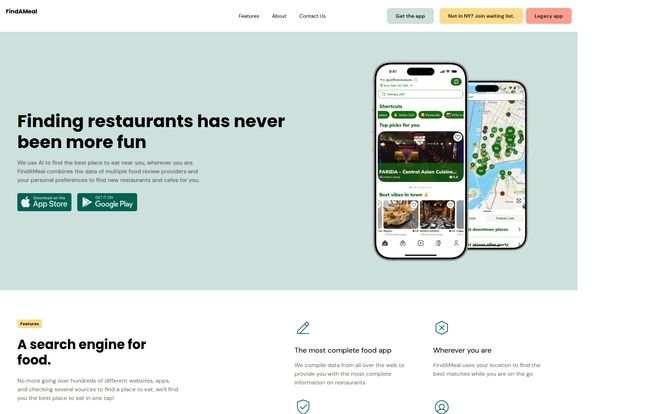
Visit FindAMeal
The Magic Ingredient: How the AI Actually Works
This is where things get interesting for a tech and traffic nerd like me. Most restaurant apps rely on simple keyword matching and filters. You check a box for “$$” and “Italian,” and it shows you all the places tagged with both. Simple, but not very smart.
FindAMeal uses natural language processing (NLP), a fancy term for teaching a computer to understand human language, with all its quirks and nuances. This is the difference between searching for “sushi” and asking, “Where can I get amazing, authentic omakase that won’t totally destroy my wallet?”
The AI looks beyond simple tags. It scans reviews for sentiment, keywords, and context. It learns what “cozy” means by analyzing thousands of descriptions of places people call cozy. It figures out what constitutes a “hidden gem” by finding highly-rated places with fewer, but more passionate, reviews. Over time, it also learns from your own preferences. If you keep saving and rating spicy noodle joints, you can bet it’s going to start prioritizing those in your future searches. It’s the kind of personalization that algorithms have promised for years, but rarely deliver in a way that feels genuinely helpful.
More Than Just a Search Bar: The Social Side of FindAMeal
Here’s the part that I think could really make FindAMeal stick. It’s not just a utility; it’s a community. The platform has built-in social features that, frankly, make a lot of sense for food discovery. You can create a profile, follow your friends, and see where they’re eating and what they’re loving. You can curate and share lists—’Best Brunch Spots in Brooklyn’, ‘Killer Late-Night Tacos’, ‘Date Night Winners’.
This taps into a simple truth: we trust our friends’ recommendations more than a stranger’s on the internet. Seeing that my friend with impeccable taste in cocktails just raved about a new speakeasy carries a lot more weight than a 4.2-star rating from 1,300 anonymous people. It’s like turning your city’s food scene into a collaborative map, drawn by the people you know and trust. I’ve always felt that platforms like Letterboxd for movies nailed this social-curation model, and it feels like a natural fit for dining.
Let’s Be Real: The Good and The Could-Be-Better
No tool is a silver bullet. After playing around with it, I’ve got some thoughts. My experience in SEO has taught me to look at both the shiny front-end and the creaky back-end of any platform.
What I’m Loving So Far
The biggest win, hands down, is the data aggregation. The sheer relief of not having to toggle between three different apps to vet one restaurant is… profound. It’s a simple concept, but they execute it well. I’m also incredibly impressed with the “why” feature. Seeing a little summary like, “Recommended for its lively atmosphere and authentic Neapolitan pizza, mentioned in 32 reviews” is infinitely more useful than just a star rating. It gives you the flavor of the place before you even walk in the door. Finally, its potential for finding true hidden gems is real. By looking at qualitative data, not just quantitative, it can surface that amazing hole-in-the-wall that gets overlooked by mainstream discovery algorithms.
Where It Could Improve (Because Nothing’s Perfect)
Let’s be honest. The system’s intelligence is entirely dependent on the quality of its source data. If a restaurant has a bunch of fake reviews on Google, FindAMeal is going to inherit that problem. It’s the classic ‘garbage in, garbage out’ scenario. Some might also find that the AI’s interpretation isn’t always spot on. You might ask for a “quiet” spot and get a place that reviewers describe as “intimate” but is actually blasting loud music. There’s a learning curve, both for the user and the AI. And for the personalization to truly kick in, you have to be willing to put in the work—rating places, saving favorites, and giving the AI data to learn from. It’s not a mind reader on day one.
The Million-Dollar Question: What’s the Price?
This is usually the part of the review where I brace for impact, but there’s good news. Based on all available information on their site and the app stores, FindAMeal appears to be free to use. This makes sense; the established model for these kinds of consumer apps is to build a user base first and figure out monetization later. I’d speculate they might eventually introduce premium features or sponsored listings for restaurants, similar to Yelp’s business model. But for now, you can get all this AI-powered goodness without dropping a dime. Hard to argue with that.
A Quick Note for My Fellow Non-New Yorkers
As I was scrolling through their website, I noticed a little section that asks, “Are you not in New York?” This is a huge clue. It strongly suggests that FindAMeal is currently in a limited launch phase, likely focusing on perfecting the model in a dense, competitive market like NYC before rolling out everywhere else. Don’t be discouraged! This is standard operating procedure for a startup. It’s smarter to dominate one city than to be mediocre in fifty. They have a waitlist you can join, and I’d suggest doing it. That way, you’ll be the first to know when it lands in your town.
My Final Verdict: Is FindAMeal Worth the Download?
So, is FindAMeal the cure for restaurant indecision? It just might be. In a sea of same-y search apps, it offers a genuinely fresh approach. The combination of multi-source data aggregation, legitimately smart AI search, and integrated social features is a powerful one. It’s not just another list of restaurants; it’s a tool that tries to understand the context and feeling you’re searching for.
It’s not perfect, and its ultimate success will depend on how well the AI learns and how quickly it expands to new cities. But is it promising? Absolutely. For me, anything that saves me from the agony of endless scrolling and helps me find a truly memorable meal is a massive win. I’m keeping this one on my home screen, and I’m genuinely excited to see where it goes. It’s earned its spot.
Frequently Asked Questions
- 1. What is FindAMeal?
- FindAMeal is a mobile app and search engine that uses artificial intelligence to help you find restaurants and cafes. It pulls reviews and data from multiple sources like Google and Yelp to give you personalized recommendations based on natural language queries.
- 2. How is FindAMeal different from Google Maps or Yelp?
- The main differences are its AI-powered search and data aggregation. Instead of just filtering, you can ask complex questions like “a fun place for a group birthday dinner with good cocktails.” It also combines information from both Google and Yelp (and others), so you don’t have to check multiple apps.
- 3. Is FindAMeal free to use?
- Yes, based on all current information, the FindAMeal app is free to download and use. There are no subscription fees mentioned.
- 4. Do I need an account to use FindAMeal?
- While you can likely perform basic searches without an account, to use the personalization and social features—like saving favorites, creating lists, and following friends—you will need to create a free profile.
- 5. Where is FindAMeal currently available?
- The service appears to be launching first in New York City. They offer a waitlist for users in other locations who want to be notified when FindAMeal expands to their area.
- 6. How does the AI personalization work?
- The AI learns from your behavior on the app. Every time you search, save a restaurant, rate a meal, or create a list, the algorithm gets a better understanding of your specific tastes, allowing it to provide more accurate and tailored recommendations in the future.
Reference and Sources
- FindAMeal Official Website: Link to their site would go here.
- Yelp: A primary source of crowd-sourced review data.
- Google Maps: A source for location data and user reviews.
- Forbes Tech Council: Article on the broader role of AI in the food and beverage industry.


