
Categories: AI Chatbot, AI Data Mining, AI Interview Assistant, AI Marketing, AI Report Generator, AI Research Tool, AI Response Generator, AI Summarizer, AI Transcription, AI Translate
Listen Labs Review: AI Customer Interviews, Faster?

Okay, let’s have a real chat. If you’ve ever been in the trenches of marketing, product development, or UX, you know the grind of customer research. The endless back-and-forth emails to schedule a simple 30-minute call. The awkward silences. The hours spent transcribing recordings until your ears bleed. And then, the monumental task of sifting through pages of notes, trying to find that one golden nugget of insight. It’s a process. A long, often painful, process.
I’ve been there more times than I can count. So when a tool like Listen Labs pops up on my radar, claiming to do it all for you with AI—and in under 24 hours—my professional curiosity (and a healthy dose of skepticism) goes into overdrive. An AI that finds people, interviews them, and writes the report? Sounds a bit like magic. But is it the real deal, or just another shiny object in the ever-expanding MarTech universe?
So, What Exactly is Listen Labs?
Forget what you know about survey platforms. Listen Labs isn’t about multiple-choice questions and star ratings. It’s an AI-first research platform. The core idea is to automate the entire qualitative interview process. Instead of you personally conducting interviews one by one, an AI moderator steps in to do the heavy lifting. It finds the right people from its massive pool of participants, engages them in a conversation based on a script you provide, and then analyzes all the responses to deliver a neat, actionable report.
Think of it less as a tool and more as a research assistant on steroids. One that never needs a coffee break and can talk to dozens of people simultaneously.
How The Magic Happens: The Listen Labs Process
The whole workflow, from what I’ve gathered on their site, seems deceptively simple. It breaks down into three main stages:
- Set Your Stage: You start by either picking from one of their pre-built templates or uploading your own interview guide. This is your script, your set of questions that the AI will use to guide the conversation. Crucially, this is also where you can add stimuli for testing—we’re talking images, videos, and even interactive Figma prototypes. For any product manager or UX designer, the ability to get real feedback on a prototype without having to set up a dozen moderated sessions is, frankly, a massive deal.
- Recruit Your Audience: Next, you define who you want to talk to. Listen Labs boasts access to a pool of over 30 million participants. You set the demographics, the criteria, and the platform goes out and finds your people. No more begging friends on LinkedIn or paying exorbitant fees to a traditional recruiting agency.
- Get Your Insights: This is the part that feels like science fiction. You basically hit ‘go’ and wait. The AI conducts the interviews, gathers all the qualitative data (the ‘whys’ and ‘hows’), analyzes it for themes and patterns, and then bundles it all up into a report. They claim this whole cycle can take less than 24 hours. That’s a turnaround time that’s almost unheard of in traditional research.
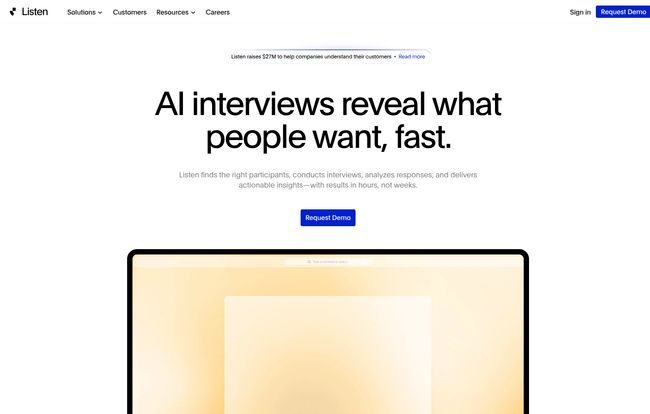
Visit Listen Labs
Who Is This Actually For?
While anyone could probably find a use for it, Listen Labs seems purpose-built for a few key roles:
- Product Managers: Need to validate a new feature idea before sinking development resources into it? This seems like a no-brainer. Getting quick feedback on a Figma prototype at scale is a dream.
- Marketers: Trying to understand your customer’s pain points to craft better messaging? You can test ad copy, concepts, or just get a deeper understanding of your target audience’s vocabulary. It’s like a focus group on demand.
- UX Researchers: This one’s interesting. While it might not replace deep, empathetic, one-on-one ethnographic studies, it could be an incredible tool for handling the more repetitive, top-of-funnel research, freeing up time for more strategic work. It scales the unscalable.
The Good, The Bad, and The AI
No tool is perfect, right? I’ve learned that the hard way. It’s always a trade-off. Here’s my breakdown of where Listen Labs likely shines and where you might want to be a bit cautious.
The Upside of AI-Powered Research
The biggest win here is speed. The claim of getting insights in under 24 hours is a genuine paradigm shift. What normally takes weeks of planning, scheduling, conducting, and analyzing can be done before your weekly team meeting. Microsoft’s testimonial on their site, mentioning they got user stories “within a day,” adds some serious weight to this claim.
Then there’s the scalability. You’re not limited by your own calendar. You can ‘run’ 50 interviews as easily as you can run 5. This allows for a level of qualitative data collection that was previously only possible for companies with massive research budgets. It helps remove the “we only talked to five people” bias that often plagues qualitative work.
Let’s Be Real: The Potential Downsides
Now for the other side of the coin. My biggest question mark hangs over the AI itself. An AI moderator is working from a script. It can’t truly improvise or pick up on the subtle, non-verbal cues a human interviewer can. That slight hesitation before an answer, the flicker of confusion in someone’s eyes—that’s data. And an AI might miss it. This reliance on AI could miss some of teh more nuanced, emotional insights that come from genuine human connection.
There’s also the ever-present ghost in the machine: AI bias. The algorithms are only as good as the data they’re trained on. Is the analysis truly objective? It’s something to be mindful of. Finally, the success of the entire operation hinges on how well you craft your initial interview questions. Garbage in, garbage out. You can’t just wing it; you need a well-thought-out guide to get meaningful results.
The All-Important Question: What’s the Price Tag?
I went looking for the pricing page. It’s the first thing I do with any new tool. And… I hit a 404 error. A “Page could not be found” message. In my experience, when a B2B SaaS company doesn’t list its pricing publicly, it usually means one thing: it’s not cheap. This is typically a “Contact Sales for a Demo” model, which points towards an enterprise-level solution rather than a self-serve tool for freelancers or small startups. The cost could definitely be a barrier for some folks, which is one of the potential cons.
Listen Labs vs. Traditional Methods
Comparing Listen Labs to traditional research is like comparing a self-driving car to driving stick. The traditional way gives you total control, you feel every bump in the road, and you’re intimately connected to the process. It’s rewarding, but it’s also manual and requires your full attention.
Listen Labs is the self-driving option. You tell it the destination (your research goals), and it handles most of the driving. It’s efficient, fast, and frees you up to look at the scenery (i.e., think strategically about the insights). But you’re trusting the machine to navigate. The best approach? Probably a hybrid. Use the self-driving car for the long, boring highway stretches (scaling research) and take the wheel yourself for the tricky, scenic mountain roads (deep, empathetic interviews).
So, Is This The Future of Customer Research?
Look, I don’t think human researchers are going to be out of a job tomorrow. There’s an art to a good interview that, for now, still requires a human touch. But do I think tools like Listen Labs are the future? Absolutely.
They solve a very real, very expensive problem: time. They democratize access to qualitative insights at scale. I see this not as a replacement for human researchers, but as an incredibly powerful supplement. It’s the sou chef that does all the chopping and prep work, allowing the head chef (you) to focus on creating the masterpiece. It’s a way to bring more customer voices into the product development process, more often. And that’s always a good thing.
Frequently Asked Questions (FAQ)
- How does Listen Labs find interview participants?
- Listen Labs recruits participants from a large, global pool of over 30 million people. You define your target audience based on demographics and other criteria, and the platform sources qualified individuals for your study.
- Can I use my own customer list for interviews?
- This is a common question for platforms like this. While their main value proposition is their massive participant pool, enterprise plans for platforms like this often include options for uploading and interviewing your own customer lists. You’d likely need to contact their sales team to confirm the specifics.
- What languages does Listen Labs support?
- The platform features multi-language support, allowing you to conduct research in various global markets. This is a significant advantage over manual methods which would require hiring local moderators.
- Is the AI analysis really reliable?
- Reliability depends on the complexity of the topic and the quality of your interview script. The AI is designed to identify themes, sentiment, and key quotes. For high-level trend analysis, it’s likely very effective. For deep, psychological analysis, you’d still want a human researcher to review the raw data.
- How is this different from a tool like SurveyMonkey?
- SurveyMonkey and similar tools are primarily for quantitative data (the ‘what’). They collect structured answers through polls and multiple-choice questions. Listen Labs is for qualitative data (the ‘why’). It conducts open-ended interviews to understand motivations, feelings, and context.
- Is there a free trial for Listen Labs?
- Given the absence of a public pricing page and the enterprise focus, a traditional free trial is unlikely. They more likely offer a custom demo where their team walks you through the platform and may set up a small pilot project.
Reference and Sources
- Listen Labs Official Website
- Nielsen Norman Group: AI and Bias in UX (A relevant article on the topic of AI bias in user research)


