
Categories: AI Course, AI Developer Tools, AI Tutorial, Large Language Models (LLMs)
Machine Learning at Scale Review: A 10x Engineer’s Secret?

Alright, let’s have a real chat. If you’re in the machine learning space, you know the feeling. It’s like trying to drink from a firehose that’s spewing out ArXiv papers, GitHub repos, and a new ‘revolutionary’ framework every other Tuesday. It’s a lot. Keeping up isn’t just a full-time job; it’s an extreme sport.
For years, I’ve seen countless blogs, courses, and talking heads promise to make you a better engineer. Some are great. Many are… well, let’s just say they’re more academic than applicable. So when I stumbled upon a Substack called Machine Learning at Scale, my internal skeptic-o-meter started twitching. But then I saw who was behind it, and what it was offering. And I have to admit, I’m intrigued. Very intrigued.
So, Who is Ludo and Why Should We Listen?
This isn’t some rando repackaging docs. The newsletter is written by Ludovico Bessi. And who is Ludo? Just a Machine Learning engineer over at Google. You know, that little search engine company. The image on his site mentions he’s worked on fighting abuse with large scale ML systems and built end-to-end user-to-ads systems from scratch. That’s not entry-level stuff. That’s big-league, messy, real-world engineering.
Before Google, he was working on computer vision for his thesis at Volvo. This isn’t just theory; this is a resume built in the trenches of production-level ML. For me, that’s a massive green flag. I’m always more interested in learning from the person who has the scars from deploying a model at scale than the person who only has the pristine theory. It’s the difference between reading a travel guide and getting advice from someone who actually lives in the city.
What Exactly Is ‘Machine Learning at Scale’?
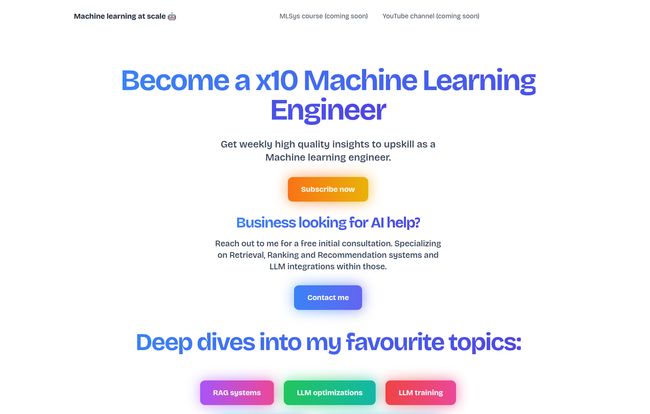
At its heart, Machine Learning at Scale is a Substack publication. Simple as that. Once a week, an email from Ludo lands in your inbox. But it’s what’s in that email that matters. He’s not just summarizing news. He’s offering deep dives and curated insights into the topics that actually matter for engineers building things today.
We’re talking about the nitty-gritty of:
- RAG systems: The backbone of so many modern GenAI apps.
- LLM optimizations: Because running these behemoth models isn’t cheap.
- LLM training: Moving beyond just using an API and understanding the core.
- ML System design: The architectural glue that holds everything together.
- Recommendation systems: The engines that power so much of the modern web.
It’s basically a curated brain dump from a senior engineer at one of the world’s top tech companies. The goal, as stated on the homepage, is to help you become a “x10 Machine Learning Engineer.” A bold claim, for sure. But the focus is on practical, high-quality insights that you can, presumably, take to your stand-up meeting the next day.
Visit Machine Learning at Scale
The Good, The Not-So-Bad, and The Practical
No tool is perfect, so let’s get into the weeds. I’ve seen enough marketing fluff to last a lifetime, so I appreciate a straight-up look at what you’re getting into.
What I Genuinely Like
The biggest pro here is the source. It’s content from a practicing Google ML engineer. This means the insights are likely battle-tested and relevant to the problems big tech is solving right now. It’s a direct line to the kind of thinking that builds products used by millions. He also provides lists of tools used by ML engineers, which is pure gold. It’s one thing to learn a concept, it’s another to know what hammer to use for which nail.
The focus is intensely practical. It’s not about abstract mathematics; it’s about system design and optimization. This is the stuff that gets you promoted. It’s the knowledge that separates a junior from a senior enginere. The social proof is there too—the “Wall of love” on the site has testimonials from folks at places like The Knot and other tech companies, which tells me it’s hitting the mark for its intended audience.
A Few Things to Keep in Mind
Let’s be fair. The platform is still growing. Right now, the content is primarily text-based in the newsletter. If you’re a visual learner who needs videos to soak things in, you might have to wait a bit. Ludo is upfront about an ML System design course and a YouTube channel being “coming soon.” So, the potential is huge, but you’d be subscribing to the current text-based offering with the promise of more to come. Also, it’s a Substack subscription. This isn’t a free-for-all blog, it’s a premium product, and you have to decide if that model works for you.
Is This Substack Worth Your Investment?
Here’s the million-dollar question. Or, well, the few-dollars-a-month question. Substack has both free and paid tiers, and premium publications like this typically ask for a subscription fee. The pricing isn’t explicitly listed on the landing page, which is standard for Substack—you see it when you go to subscribe.
But think about the cost-benefit here. A single good insight that helps you solve a major problem at work or ace a system design interview is worth far more than a few lattes a month. Compare the potential cost of a subscription to a single tech conference ticket ($1000+) or a multi-week online course ($500+). Suddenly, a newsletter providing consistent, high-signal information looks like a pretty smart investment in your career growth. You’re paying for curation and expertise, saving your most valuable asset: your time.
Over 3500 engineers have already subscribed. That’s not a trivial number. It signals that there’s a real hunger for this kind of focused, high-quality content, and people are willing to open their wallets for it.
The Future Looks Bright for ML at Scale
I’m genuinely excited about the planned ML aystem design course and the YouTube channel. If the quality of the written content is any indication, these could become go-to resources for the entire ML community. Turning these complex, text-based deep dives into a more interactive and visual format could be a game-changer for many engineers. It shows a commitment to building a comprehensive learning platform, not just a newsletter.
My Final Take on This Whole Thing
So, what’s the verdict? I think Machine Learning at Scale is a fantastic resource for any mid-to-senior level ML engineer who feels like they’re treading water in the information deluge. It’s for the engineer who wants to move from just using tools to truly understanding systems. It’s a direct peek into the mind of someone building at the highest level.
Is it a magic pill to make you a 10x engineer overnight? Of course not. Nothing is. But it looks like a damn good tool to add to your belt. It’s a compass that helps you navigate the chaotic landscape of modern machine learning, pointing you towards what’s truly important and practical. And in this field, a good compass is priceless.
Frequently Asked Questions
- 1. Who is the ideal reader for Machine Learning at Scale?
- It seems best suited for machine learning engineers who already have some experience and are looking to level up. If you’re grappling with system design, scalability, and optimization in your day job, this is likely for you.
- 2. Is this newsletter suitable for absolute beginners?
- While a motivated beginner could certainly learn a lot, the topics (LLM optimization, RAG, system design) suggest it’s targeted more towards those with a foundational understanding of ML concepts. It’s about scaling and building robust systems, not just ‘Hello World’ in TensorFlow.
- 3. How much does it cost?
- It’s a Substack publication, which means it likely operates on a paid subscription model. You’ll need to visit the publication’s page and click ‘subscribe’ to see the specific monthly or annual pricing tiers Ludo offers.
- 4. What makes this different from other ML blogs or resources?
- The key differentiator is the source: a current Google ML engineer sharing practical insights from the field. It’s less about general news and more about curated, deep knowledge on specific, high-impact engineering problems.
- 5. Can I read a sample before I subscribe?
- Most Substack writers offer some free posts or a free preview so potential subscribers can get a feel for the content. Your best bet is to visit the Machine Learning at Scale homepage and check for any publicly available articles in the archive.
- 6. How practical is the information presented?
- Based on the topics and the author’s background, the content is designed to be highly practical. The focus is on real-world application, system design, and optimization—skills directly applicable to an ML engineering role.
Reference and Sources
- Machine Learning at Scale Official Substack (Note: This is a presumed URL)
- Google AI Blog for industry context


