
Categories: AI Description Generator, AI Floor Plan Generator, AI Marketing, AI Resume Builder, AI Voice Assistants, AI Writing Assistants
Mirr.art Review: AI Curation for Artists & Galleries?

If you’re an artist, you’ve been there. Staring at a finished piece, a canvas you’ve poured your soul into, and then… the other blank page appears. The one where you have to write the description. The artist statement. The social media post. Suddenly, you’re a writer, a marketer, a publicist, and all you really want to do is get back to the studio.
And if you run a gallery? It’s that feeling multiplied by ten, or twenty. Juggling artists, curating shows, writing press releases, and trying to keep the lights on. It’s a grind.
For years, we’ve seen tech try to ‘solve’ the art world, with mixed results. But the recent explosion in AI has brought a new wave of tools to the table. One that caught my eye is mirr.art. It bills itself as a kind of AI-powered copilot for the art ecosystem. But is it a genuine helper, or just more tech noise? I decided to take a closer look.
What Exactly is Mirr.art Supposed to Do?
So, what’s the big idea? At its core, mirr.art is trying to be the connective tissue between artists, the galleries that represent them, and the collectors who support them. Think of it as a smart platform that uses artificial intelligence to handle some of the most tedious, time-sucking tasks in the art business.
For artists, it’s about finding the right words and the right audience. For galleries, it’s about streamlining curation and promotion. And for collectors, it offers a more personalized way to discover art, with the added security of modern tech like blockchain for verifying authenticity. It’s an ambitious pitch, trying to be a lot of things to a lot of people. Sometimes that works, sometimes it falls flat. Let’s see which way this one leans.
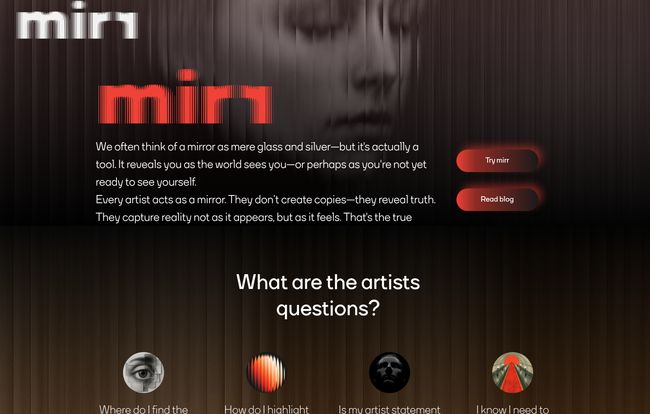
Visit mirr.art
The Artist’s Toolkit: Beyond a Digital Paintbrush
I think the most immediate appeal of mirr.art is for the individual creator. The platform seems to directly address some of the biggest non-art-making headaches that artists face.
Banishing the Blank Canvas of Words
This is the killer feature for me. The AI-powered art description and tagging. You give it your art, and it helps you articulate what makes it special. It’s like having a tiny, well-read art historian on your shoulder, whispering suggestions. It can generate multiple descriptions, help you highlight stylistic details, and even whip up an artist statement or a CV. I’ve spent hours agonizing over a single paragraph for a show submission, so the thought of automating that first draft is… well, it’s pretty darn appealing.
Finding Your Stage in a Crowded World
Visibility is everything. Mirr.art has a feature for discovering open calls and projects, aiming to match an artist’s portfolio with relevant opportunities. This is a huge step up from endlessly scrolling through generic listing sites. It also has a ‘promotion assistant’ that supposedly uses local data to help you target your promotional efforts. That’s a smart touch, moving beyond just generic social media blasts.
For the Galleries: An AI Curator in Your Pocket
Okay, let’s switch hats and look at this from a gallery owner’s perspective. The challenges are different, but no less daunting.
Mirr.art offers tools to manage multiple artist accounts within a single dashboard, which is a basic but necessary feature for any gallery software. But it gets more interesting with its ‘exhibition concept generation’. The AI can apparently help you test out thematic ideas and even generate photorealistic images of how a show might look in your space. I’m a little skeptical, but also intrigued. If it can help break a creative block on a new show concept, that’s a win.
“The idea of automatically placing artworks within a virtual space to test curation… that could save days of physical labor and back-and-forth. It’s the kind of practical application of AI I like to see.
The promise of an ‘endless stream of content’ for your online presence is also a big one. Automating the creation of social posts, newsletter snippets, and website updates based on your current roster and exhibitions could free up a massive amount of time for a small gallery team.
The Good, The Bad, and The AI
No tool is perfect, right? After digging through what mirr.art offers, here’s my honest take on the highs and lows. The biggest pro is obvious: it saves time. It automates the administrative busywork that artists and gallerists despise, letting them focus on their actual jobs: creating and curating. It also seems genuinely focused on making the art market more accessible, which is a noble goal.
However, I do have reservations. The biggest one is the potential for creative over-reliance on the AI. If every artist starts using a similar tool to write their statements, will everything start to sound… the same? It’s a valid concern. You have to treat it as a starting point, not a final product. I also suspect there might be a bit of a learning curve to get the most out of all these features. And, I’ve got to admit, the copy on their own website is a bit repetitive—a small irony for a tool that helps with writing. Hopefully the tool itself is more varied!
What’s the Price of Admission?
Here’s the million-dollar question. Or, hopefully, a much-less-than-a-million-dollar question. As of my review, mirr.art does not list public pricing on its website. This is pretty common for B2B or specialized SaaS platforms. They likely have different tiers for individual artists, small galleries, and larger institutions.
My guess is it’s a subscription model. To find out for sure, you’ll have to use the ‘Contact Us’ form on their site. While I always prefer transparent pricing, this approach does allow them to tailor a package to your specific needs. They do have a ‘Try mirr’ button, which suggests some kind of trial or demo is available, which is always a good sign.
My Two Cents: Is Mirr.art a Revolution or a Robot?
So, what’s the final verdict? I’ve seen a lot of tech tools come and go, and my gut feeling about mirr.art is cautiously optimistic. I dont think it’s a robot coming to take creative jobs. I see it as a powerful assistant.
Think about how Photoshop changed photography. It didn’t replace the photographer; it gave them a darkroom with superpowers. That’s how I see mirr.art. It’s not going to create the art for you, and it’s not going to close the sale for you. But it can be a powerful ally in the fight against administrative burnout. It can handle the first draft, organize your opportunities and give you back your most precious resource: time. And for any creative professional, that’s gold.
Frequently Asked Questions about Mirr.art
- Is mirr.art only for digital artists?
- Not at all. The tools for description, promotion, and curation seem designed for all mediums. Whether you’re a painter, sculptor, or photographer, the challenge of writing about your work and managing your career is universal.
- How does the AI generate art descriptions?
- While they don’t specify the exact model, it likely uses a combination of visual analysis (reading the pixels of your uploaded image) and natural language processing. It probably analyzes your art for style, subject, color palette, and composition and then cross-references that with a massive database of art history and descriptions to generate relevant text.
- Is the blockchain component really necessary for collectors?
- For some, it might feel like a buzzword, but it serves a practical purpose: provenance and security. Using a blockchain ledger to track ownership and authenticity of a piece provides a secure, unchangeable record. For high-value art, this can provide significant peace of mind for an investor or serious collector.
- Can I try mirr.art for free?
- The website features a prominent “Try mirr” call-to-action. This typically means there is a free trial, a demo, or a freemium version available so you can get a feel for the platform before committing.
- Will using an AI for my artist statement make me sound generic?
- That’s the key risk. My advice is to use it as a brainstorming partner. Let it generate a few drafts, pick out the phrases or ideas that resonate, and then rewrite it entirely in your own voice. It can help you get past the initial writer’s block, but the final piece must be yours.
The Final Brushstroke
Mirr.art is an ambitious platform entering a space that’s ripe for innovation. It’s trying to solve real, nagging problems for the people who make and sell art. While the fear of AI in creative fields is understandable, I believe the smart approach is to see these things as tools, not replacements. If a platform like mirr.art can handle the drudgery of admin and promotion, it leaves more space for the messy, unpredictable, and wonderful human act of creation. And that’s a future I can get behind.


