
Categories: AI API, AI Code Generator, AI Developer Tools, AI For Data Analytics
Next Boilerplate Review: A Shortcut for Your AI Startup?

Every developer, founder, and indie hacker has been there. You get that spark. That brilliant, world-changing idea for a new SaaS app. It’s going to have some cool AI feature, a slick UI, and it’s going to solve a real problem. You’re flying high… for about ten minutes. Then reality hits you like a ton of unconfigured webpack files.
Suddenly, you’re not building your amazing app. You’re spending a week setting up user authentication. Again. You’re wrestling with database schemas, figuring out a deployment pipeline, and trying to remember how to properly structure a Next.js project for SEO. The initial excitement drains away, replaced by the tedious grind of building the plumbing. Your brilliant idea is still just an idea, buried under a mountain of boilerplate code.
I’ve seen this movie a dozen times. It’s the primary killer of side projects and early-stage startups. So, when a tool comes along that claims to just… handle all of it, my ears perk up. I’m talking about Next Boilerplate, a tool that’s been making some noise in the dev community lately. It promises to be the ultimate AI startup kit. But is it just another shiny object, or is it the real deal? Let’s find out.
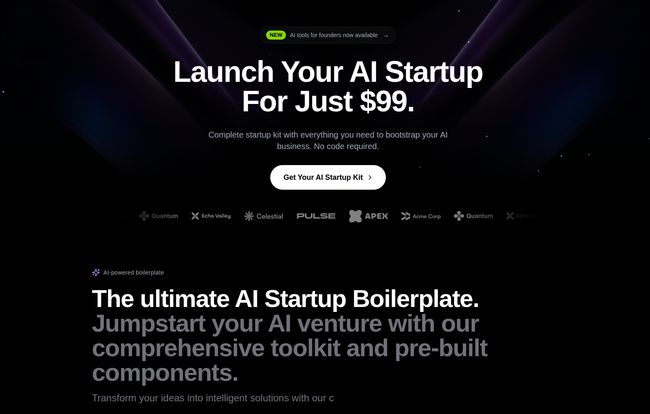
Visit Next Boiler Plate
What Exactly is Next Boilerplate? (And Who Is It For?)
Okay, so what are we even talking about here? In simple terms, Next Boilerplate is like a professional-grade starter kit for building an AI-powered application. Think of it like buying a high-end, pre-fabricated house frame instead of milling the lumber yourself. You still get to design the rooms, pick the paint, and furnish it, but the foundation, walls, and roof are already solid and up to code.
It’s built on a very modern and, frankly, smart tech stack: Next.js, React, and TypeScript. For anyone in the web development world, you know this is a powerful combination for building fast, scalable, and SEO-friendly applications. It’s not a no-code platform where you just drag and drop boxes; you need to know how to code. This is for developers who want to skip the repetitive setup and get straight to building their unique features.
So who’s the ideal customer? I’d say it’s for:
- Indie Hackers: Solo developers trying to launch a product fast without a team.
- Early-Stage Startups: Small teams that need to build an MVP and validate an idea before their funding runs out.
- Freelancers: Devs who want to quickly spin up new projects for clients without reinventing the wheel every single time.
The Core Features That Actually Matter
A features list can be boring. What matters is what those features do for you. I’ve sifted through their offerings, and here’s the stuff that genuinely stands out to me as a massive time-saver.
The Foundation: A Solid Modern Stack
The choice of Next.js is a big green flag. It gives you server-side rendering and static site generation right out of the box, which is fantastic for performance and, as an SEO guy, a godsend for getting your new app indexed and ranked. Combining it with TypeScript adds that layer of safety and predictability to your code that prevents so many dumb runtime errors. This isn’t some cobbled-together stack; it’s what many top-tier companies are using today.
The “AI” in the AI Startup Boilerplate
This is its main differentiator. Next Boilerplate isn’t just a generic starter kit; it’s geared specifically for AI products. It comes with pre-configured APIs and hooks for things like AI code generation, natural language processing (NLP), and even AI model training. This means you don’t have to spend days figuring out how to connect to OpenAI’s API or manage your data for fine-tuning. It also includes AI-powered analytics to track things like model accuracy and user satisfaction, which is a surprisingly thoughtful touch.
All The Boring (But Crucial) Stuff, Done For You
This is the real gold, in my opinion. Setting up all the necessary SaaS components is what kills momentum. Next Boilerplate comes with:
- Secure Authentication: User sign-up, login, password resets, support for multiple providers. Done.
- Scalable Database Setup: Comes with ORM integration, so you’re ready to manage data from day one.
- UI Component Library: A set of ready-made React components to build your interface quickly.
- Deployment Pipeline: CI/CD integration to make pushing updates and rolling back changes a smooth process.
- Payment Integration: Ready to accept payments. This alone can be a huge headache to set up securely.
Honestly, just those five things can represent weeks of development work. Having them ready to go is a massive advantage.
My Honest Take: The Good, The Bad, and The Code
Alright, no tool is perfect. After digging in, here’s my unfiltered perspective on where Next Boilerplate shines and where you might want to pause for thought.
What I Genuinely Like
First off, the pricing model. Pay once, receive updates forever. In a world where every single dev tool wants a piece of your soul via a monthly subscription, this is incredibly refreshing. It feels like a throwback to the old days of buying software, and I’m here for it. The value proposition of saving potentially 80% of your initial development time for a one-time fee of less than a hundred bucks is, frankly, a no-brainer for the right project.
The focus is spot on. They correctly identified the biggest pain point in launching a new software product—the infrastructure—and built a solution squarely aimed at solving it. It frees up your most valuable resource: your brainpower to focus on your product’s unique value.
A Few Things to Keep in Mind
This isn’t a tool for a complete beginner. The website makes that clear, but it’s worth repeating. You need to be comfortable with React and have at least a working knowledge of Next.js and TypeScript to really make the most of it. This is a shortcut for coders, not a substitute for them.
Also, whenever you buy a kit like this, you’re buying into someone else’s opinions about how code should be structured. For 95% of projects, this is fine and probably better than what you’d come up with on the fly. But if you have very specific, esoteric architectural needs, you might find yourself fighting the framework rather than working with it. Customization is possible, but it’s built on their foundation.
Let’s Talk Money: The Next Boilerplate Pricing
The pricing is straightforward, which I appreciate. There are two main tiers, and both are a one-time purchase. It’s important to note they use a bit of urgency marketing, stating the price will increase after a certain number of sales.
| Plan | Price | Key Features |
|---|---|---|
| Starter Kit | $69 (one-time) | All standard features, basic AI capabilities, community support. |
| Pro Kit | $99 (one-time) | Everything in Starter, plus advanced AI features and priority support. |
For most people starting out, the Pro Kit at $99 seems like the sweet spot. The jump in price is minimal for access to advanced AI features and, more importantly, priority support. When you’re stuck on a problem, getting a faster answer can be worth its weight in gold.
So, Is Next Boilerplate Right for Your Project?
This is the bottom line, isn’t it? It all comes down to a simple calculation: is the cost of this tool less than the value of your time? For most developers, the answer is a resounding yes. If you bill your time at, say, $80/hour, this tool pays for itself in about an hour and a half of avoided work. That’s a pretty compelling ROI.
You should seriously consider buying it if:
- You are a developer who wants to launch an AI or SaaS product quickly.
- You value speed and momentum over building every single line of code from scratch.
- Your idea fits within a fairly standard web app architecture.
- You hate, and I mean hate, setting up authentication and payment systems.
You might want to pass if:
- You are not a developer or are very new to the React/Next.js ecosystem.
- Your project requires a completely unique, non-standard backend architecture.
- You genuinely enjoy the process of building infrastructure from the ground up (we all know a few of these folks!).
Final Thoughts
Tools like Next Boilerplate represent a fantastic shift in the creator economy. They lower the barrier to entry, not by removing the need for skill, but by eliminating the tedious, repetitive work that doesn’t add unique value. It lets creators focus on creating.
It’s not a magic wand that will build your startup for you. You still need a good idea, the skills to code your features, and the hustle to find customers. But what it does, and does well, is clear the runway for you. It hands you the keys to a finely tuned vehicle and says, “Okay, the engine is running. Now, where do you want to go?” For any founder staring at a blank code editor, that’s an incredibly powerful head start.
Frequently Asked Questions
What do I actually get when I buy it?
You get access to the entire source code for the boilerplate. It’s a complete Next.js project with all the features mentioned—authentication, database setup, AI integrations, UI components, and deployment scripts. You can then build on top of it as you see fit.
How does the licensing work?
While the site doesn’t specify the exact license in the screenshots, these types of products typically offer a license that allows you to build unlimited commercial projects. The main restriction is usually that you can’t just resell the boilerplate itself. Always check the terms on their site for the final word!
Is it easy to customize?
If you’re a React developer, yes. Since you get the full source code, you can change anything you want. The pre-built components are there for speed, but you’re not locked into using them. You can modify them or build your own from scratch.
Can I upgrade from the Starter to the Pro Kit later?
The FAQ on their site indicates this is possible. You’d likely just pay the difference in price to get access to the advanced features and priority support.
What kind of AI capabilities are included?
It comes with ready-to-use integrations for common AI tasks like generating text or code, natural language processing, and provides a framework for you to train your own models on your specific data. It’s designed to connect to major AI providers’ APIs easily.
What kind of support is offered?
The Starter Kit comes with community support (likely a Discord or forum), while the Pro Kit gets you priority support, which usually means faster, direct access to the creators for help.


