
Categories: AI Models, AI Tutorial, AI Workflow, Graph AI, No-Code&Low-Code
SelfMachines Review: The No-Code AI Builder I’m Watching

Building, training, and deploying AI can be an absolute bear. I’ve spent more late nights than I care to admit wrestling with tangled dependencies, debugging cryptic error messages, and trying to explain to stakeholders why my “learning” model isn’t, well, learning. It often feels like you need a Ph.D. in theoretical computer science and a minor in black magic just to get a simple agent off the ground.
So, whenever a platform pops up screaming “no-code AI,” my inner skeptic raises a well-practiced eyebrow. We’ve seen it before, right? Oversimplified tools that promise the world but deliver a toy. But then I stumbled upon SelfMachines, and I have to say… this one feels different. It’s got a certain gravity to it, a seriousness that made me sit up and pay attention.
Instead of just being another black-box API wrapper, SelfMachines presents itself as a development platform for what it calls “hyper-productivity.” Big words. But the core idea is genuinely intriguing: building complex AI systems visually, using a graph-based approach. Think of it less like a magic wand and more like a high-tech, perfectly organized workbench for AI engineers and data scientists.
So, What is SelfMachines, Really?
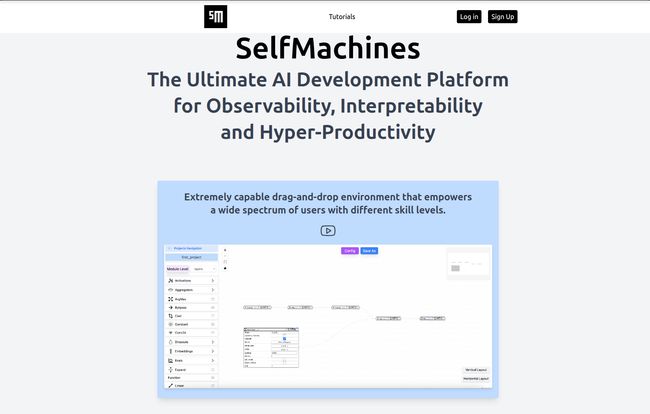
At its heart, SelfMachines is a no-code (or maybe more accurately, low-code) environment for designing and orchestrating machine learning agents. The keyword here is ‘graph-based’. Forget writing endless lines of Python to connect data sources to processing nodes and then to a model. Here, you drag and drop components onto a canvas and draw lines between them.
Visit SelfMachines
It’s like building a flowchart, but if that flowchart could come to life, analyze massive datasets, and make intelligent decisions. You can build ML agents from the ground up, starting from their individual layers, and then chain them together into compound, multi-agent systems. It’s this ability to create complex interactions that sets it apart. It’s not just about building one model; it’s about building an entire AI ecosystem.
The Power of Seeing Your AI’s Brain
The biggest problem with many AI models is interpretability. They’re black boxes. Data goes in, an answer comes out, and the ‘why’ is often a complete mystery. This is a massive headache for debugging and a dealbreaker for industries where you need to justify a model’s decision (think finance or healthcare).
SelfMachines tackles this head-on with its graph visualization. Because you built the system visually, you can see the entire data and logic flow. You can watch how data is transformed, where it’s being sent, and how different agents are interacting. It’s like being able to pop the hood on your car and actually see the engine running instead of just trusting the “check engine” light.
This visual orchestration, they claim, is all handled by their own in-house hierarchical graph engine. That’s a bold move. Building your own engine is no small feat, but it means the entire system is purpose-built for this one task. It’s a closed garden, sure, but it’s a garden designed to grow some very specific, very powerful plants.
Who Should Be Looking at SelfMachines?
This is not, in my opinion, a tool for a marketing manager who just wants to generate a few blog post ideas. Despite the “no-code” label, there’s a clear technical depth here. You need to understand the concepts of ML layers, data pipelines, and agent-based systems to really make it sing.
So who is it for?
- ML Engineers & Data Scientists: For this group, it’s a potential accelerator. A way to prototype and deploy complex systems without getting bogged down in boilerplate code. It lets you focus on the architecture, not the syntax.
- Tech-Savvy Founders: If you’re building a tech startup with a unique AI component, this could be your secret weapon for building a custom solution without a massive team of developers.
- Academics and Researchers: The ability to visually model and experiment with complex agent interactions seems perfect for a research setting.
It’s for the builder, the tinkerer, the architect who understands the blueprints but wants a faster way to build the skyscraper.
The Good, The Bad, and The Graphy
No tool is perfect, and from my analysis, SelfMachines has a clear set of trade-offs. It’s important to walk in with your eyes open.
The Bright Sides
The most obvious advantage is the no-code environment. It democratizes the process of building AI. The visual, drag-and-drop interface dramatically lowers the barrier to creating sophisticated pipelines. Then there’s the customization. This isn’t a one-size-fits-all solution. The platform seems geared toward creating bespoke AI solutions tailored to very specific business needs, something that generic cloud AI services can struggle with. Finally, that graph visualization is more than just a pretty picture. It’s a powerful tool for management, debugging, and that all-important interpretability I mentioned earlier.
The Potential Hurdles
Of course, there are potential downsides. Any powerful platform has a learning curve, and I suspect SelfMachines is no different. You’re not learning a coding language, but you are learning their way of doing things—their tools, their workflows, their philosophy. There’s also the question of being limited by the platform’s components. While it seems you can build from the layer-level up, you are ultimately playing in their sandbox. And that brings me to the biggest consideration: the reliance on their in-house graph engine. It’s probably highly optimized, but it’s also a form of lock-in. Migrating a complex system built on a proprietary engine to another platform would likely be a monumental task.
And What About the Price?
Ah, the million-dollar question. Or, perhaps, the “Contact Us for a Quote” question. As of my review, SelfMachines Inc. doesn’t list public pricing on its website. This is pretty standard for enterprise-grade B2B platforms that likely have custom pricing based on usage, support, and features.
It’s a bit of a black box itself, which is ironic. I did notice that the ‘Tutorials’ link on their homepage led to a 404 page, which suggests the platform might still be in a fairly early stage or focusing more on direct enterprise demos than broad public access. My advice? If you’re serious, reach out to them for a demo. That’s the only way you’ll know if it fits your budget and your needs.
My Final Take: A Powerful Workbench for the Serious AI Builder
So, is SelfMachines the revolution it claims to be? It’s too early to call it a revolution, but it is an incredibly interesting evolution. It’s not going to put ML engineers out of a job. What it might do is make them more powerful, more productive.
It strikes me as a tool for professionals. It’s a platform that respects the complexity of AI but offers a more intuitive, human-centric way to manage it. It’s for people who want to build something unique, not just plug into an API. If you’re tired of wrestling with code and want to focus more on the ‘what’ and ‘why’ of your AI architecture, SelfMachines is definately a name you should keep on your radar. I know I will be.
FAQs About SelfMachines
Is SelfMachines truly ‘no-code’?
It’s more of a ‘no-coding-required’ environment for system architecture. You still need a solid understanding of machine learning concepts. Think of it as being able to design a complex circuit board without needing to solder every connection by hand. You’re arranging pre-built but highly configurable components.
What does ‘graph-based AI’ actually mean?
It means the AI system—its models, data sources, and logic—is represented as a network of nodes (the components) and edges (the connections between them). This visual map makes it easier to understand, manage, and scale complex systems with many moving parts.
Can I build any kind of AI model with SelfMachines?
The platform is designed for building trainable ML agents and deep learning pipelines. It seems particularly well-suited for creating multi-agent systems where different specialized AIs work together. It might be overkill for a very simple, single-task model, and less flexible than pure code for highly experimental, from-scratch algorithm development.
Is SelfMachines good for a complete beginner in AI?
Probably not. A beginner would likely be better off starting with foundational courses and simpler tools. SelfMachines is for someone who already understands the ‘what’ and ‘why’ of AI and is looking for a better ‘how’.
How does this compare to platforms like TensorFlow or PyTorch?
TensorFlow and PyTorch are coding libraries; they are the raw materials. SelfMachines is an entire workbench and factory built on top of those concepts. It abstracts away the low-level code to let you work at the architectural level. You trade some granular control for a massive boost in development speed and clarity for complex systems.
What’s the big deal about their ‘in-house graph engine’?
It’s a classic trade-off. By building their own engine, they can ensure it’s perfectly optimized for their visual, agent-based approach, which could lead to better performance and stability. The downside is vendor lock-in; you are committing to their ecosystem, and your creations will live within their platform.
Reference and Sources
- SelfMachines Official Website
- For more on graph-based data models, the Wikipedia page on Graph Databases offers a good primer on the underlying concepts.


