
Categories: AI Agent, AI Copilot, AI For Finance, AI Productivity Tools
SymphonyAI Review: Is Vertical AI the Future for Business?

For the past couple of years, my inbox and social feeds have been absolutely buried under an avalanche of “AI-powered solutions.” Every other tool claims it will revolutionize my workflow, generate all my content, and probably make my morning coffee. It’s a lot of noise. Most of it feels… generic. Like a one-size-fits-all t-shirt that, let’s be honest, doesn’t really fit anyone perfectly.
And then you come across a company that zigs while everyone else is zagging. I stumbled upon SymphonyAI recently, and their whole pitch felt different. They’re not trying to be the Swiss Army knife of artificial intelligence. Instead, they’re crafting a set of surgeon’s scalpels. Their whole game is something they call “Vertical AI,” and it’s a concept that has me genuinely intrigued as someone who’s seen a lot of tech fads come and go.
So What Is SymphonyAI, Really?
In simple terms, SymphonyAI builds AI applications for specific business sectors. We’re talking retail, financial services, industrial manufacturing, enterprise IT—you get the picture. Instead of a broad, general-purpose model that knows a little bit about everything, their AIs are trained on industry-specific data, workflows, and problems. They’re designed to speak the native language of your business from day one.
It’s about going deep, not wide. And that, in my experience, is where you find real value and ROI. A general AI might be able to write a decent product description, but can it accurately forecast demand for that product based on supply chain disruptions and regional consumer behavior? That’s the kind of problem SymphonyAI aims to solve.
The Three Pillars of Their Tech
SymphonyAI isn’t just throwing one type of tech at the wall to see what sticks. They’ve built their platform on a powerful combination of three distinct types of AI, which work together to create these specialized solutions. It’s a pretty smart approach.
Predictive AI: The Crystal Ball
This is the classic, data-crunching side of AI that many of us in the SEO and traffic world are familiar with. Predictive AI is all about looking at historical data to forecast what’s coming next. Think trend analysis, demand forecasting, risk assessment, and identifying potential system failures before they happen. It’s the foundation—the part that gives the system its grounding in reality by constantly asking, “Based on what we know, what’s likely to happen?
Generative AI: The Creative Spark
This is the one everyone’s talking about right now. Generative AI creates new content. But in SymphonyAI’s world, it’s not about writing poems or generating funny cat pictures. It’s about generating meaningful, context-aware business content. This could be creating personalized marketing copy for a specific customer segment in retail, drafting a detailed incident report for an IT issue, or generating synthetic data to train other models without using sensitive customer information. It’s creativity with a very specific, corporate purpose.
Agentic AI: The Autonomous Doer
Now this is where things get really interesting for me. Agentic AI is the next step. These aren’t just passive tools that give you information; they are autonomous agents that can perform tasks. The homepage copy I saw said their agents “don’t just assist,” and that’s the key. An agentic system can take the forecast from the predictive AI, use the generative AI to formulate a plan, and then actually execute it. It could automatically adjust inventory levels, re-route a supply chain shipment, or resolve a network issue. This is about moving from decision support to decision automation. A bit scary, a bit exciting.
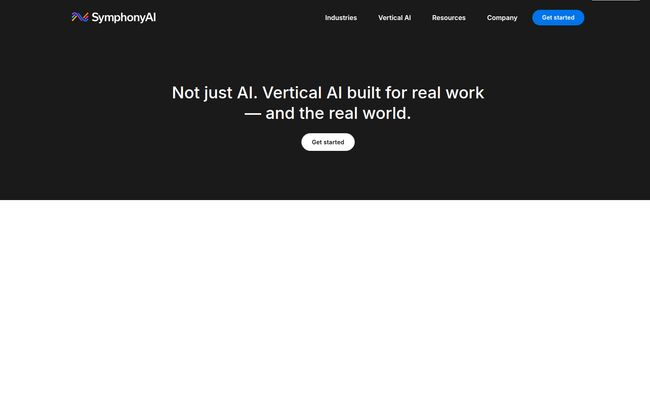
Visit SymphonyAI
Why “Vertical AI” Is More Than Just a Buzzword
I’ve seen my share of marketing buzzwords, and I’m naturally skeptical. But the focus on vertical integration makes a ton of sense. Generic AI models are impressive, but they suffer from a lack of deep domain knowledge. They can hallucinate, misinterpret industry jargon, and miss the subtle nuances that a human expert would catch instantly.
Speaking the Language of Your Industry
By focusing on a specific vertical like Retail CPG or Financial Services, SymphonyAI can build models that are pre-loaded with the right context. They understand the difference between “customer churn” in a subscription service and “spoilage” in a grocery supply chain. This specialization reduces the time-to-value. You’re not spending six months teaching a generic AI the basics of your business; you’re starting with a tool that already has its degree and is ready for on-the-job training.
All of this is powered by their underlying Eureka AI platform. Think of it as the foundry where these specialized tools are forged. It combines the data, the different AI models, and the workflows into a cohesive, ready-to-deploy application.
The Real-World Experience: High Potential, High Stakes
No tool is perfect, and it’s important to go in with eyes wide open. SymphonyAI looks incredibly powerful, but it’s not a magic wand. Here’s my honest take on the upsides and the potential hurdles.
What I Really Like
The biggest pro is the ready-to-deploy nature of the applications. Businesses don’t have time to build entire AI departments from scratch. Getting a solution that’s already 80% of the way there is a massive advantage. The blend of predictive, generative, and agentic AI is also very forward-thinking. It creates a comprehensive system that can analyze, create, and act. But the main selling point, without a doubt, is the industry specialization. It’s a clear, compelling differentiator in a very crowded market.
Some Potential Hurdles to Consider
Let’s be real, a solution this specialized isn’t going to be cheap. The website doesn’t list prices, which is typical for enterprise-grade software. This means you’re looking at a significant investment, not a simple monthly subscription. You’ll have to “talk to sales,” a phrase that can make anyone’s calendar feel suddenly, uncomfortably full. Furthermore, the effectiveness of any AI, no matter how advanced, hinges on the quality of your data. It’s the classic GIGO principle—Garbage In, Garbage Out. If your data is a mess, SymphonyAI can’t fix that. It’s like owning a Ferrari but only having a muddy field to drive it in. You have to have your data house in order to truly see the benefits.
So, What’s the Price Tag on SymphonyAI?
This is the million-dollar question, isn’t it? As mentioned, SymphonyAI doesn’t have a public pricing page. This is a “contact us for a demo and a custom quote” situation. This model is standard for high-end B2B solutions because the implementation, data integration, and support required can vary wildly from one client to another. Expect pricing to be tailored to your company’s size, the specific applications you need, and the scale of your operations. It’s an enterprise play, plain and simple.
FAQs About SymphonyAI
- What exactly is Vertical AI?
- Vertical AI refers to artificial intelligence solutions that are designed, trained, and optimized for a specific industry or business sector (a “vertical”). Instead of being a general-purpose tool, it has deep domain knowledge built-in, making it more effective for specialized tasks.
- How is SymphonyAI different from a tool like ChatGPT?
- ChatGPT is a general-purpose Large Language Model (LLM) designed for a wide range of tasks. SymphonyAI is a suite of business applications for specific industries. It combines generative AI with predictive and agentic AI to solve specific business problems like supply chain optimization or financial crime detection, rather than just generating text or code on command.
- What industries does SymphonyAI serve?
- SymphonyAI focuses on several key sectors, including Retail CPG, Financial Services, Industrial, Enterprise IT, Media, and Trading & Investing.
- Is SymphonyAI a good fit for a small business or startup?
- Based on its enterprise focus and custom pricing model, SymphonyAI is likely better suited for mid-to-large sized businesses with complex operations and the resources to invest in a significant technology solution. A small startup might find it to be overkill.
- What is the Eureka AI Platform?
- The Eureka AI Platform is SymphonyAI’s underlying technology foundation. It’s the platform where they integrate their predictive, generative, and agentic AI capabilities to build their various industry-specific applications.
- How can I find out the pricing for SymphonyAI?
- You need to contact their sales team directly through their website. They will likely schedule a demo to understand your needs and then provide a custom quote based on your requirements.
My Final Thoughts
I think SymphonyAI is a company to watch. In an era of AI hype, their focused, pragmatic approach is refreshing. They’re not selling a dream of artificial general intelligence; they’re selling functional, purpose-built tools designed to generate measurable results in complex industries. It’s a solution for businesses that have moved past the novelty of AI and are asking the hard question: “How can this actually make us better at what we do?”
While it’s clearly not a tool for everyone, for the right kind of company—one with a specific, high-value problem to solve and the data to back it up—it could be a genuine game-changer. The future of AI in business probably looks less like a single, all-knowing oracle and more like a team of specialized, vertical experts. And it looks like SymphonyAI is already there, building that team.


