
Categories: AI Assistant, AI For Data Analytics, AI Real Estate, AI Workflow
VergeSense Review: Is This The Future of Workplace AI?

It’s like showing up to a party where you’re not sure who else got the invite. On one floor, you’ve got a bustling hub of activity, every desk filled, the coffee machine working overtime. Two floors up? A ghost town. You could roll a bowling ball down the main corridor and not hit a thing. This is the new reality of hybrid work, and for the folks in charge of the real estate budget, it’s a multi-million dollar headache.
For years, companies made decisions about their office space based on headcount and a healthy dose of ‘gut feeling’. But gut feelings don’t work when half your workforce is at home on any given Tuesday. You’re paying for acres of prime real estate that might be sitting empty, while simultaneously having teams who can’t find a single meeting room when they do come in. It’s a mess.
I’ve been in the SEO and data game for years, and if there’s one thing I believe in, it’s that good data beats guesswork every single time. And that’s exactly where a platform like VergeSense comes into the picture. It promises to bring a whole new level of intelligence to our buildings, and frankly, I’m here for it.
What Exactly is VergeSense? (And Why Should You Care?)
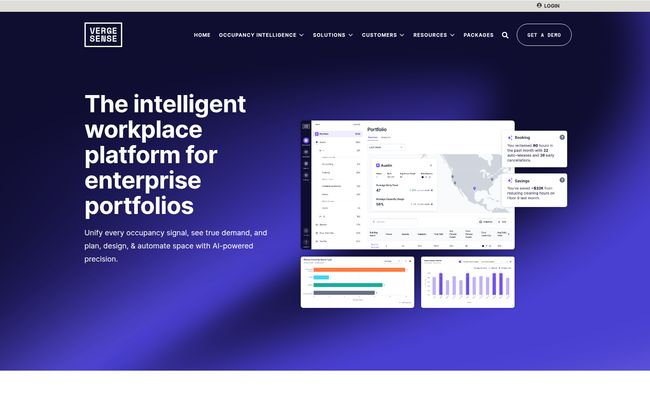
So, what’s the deal with VergeSense? In short, it’s an occupancy intelligence platform. Think of it less like a simple security camera that counts people and more like a Fitbit for your entire real estate portfolio. It’s designed to give you a deep, continuous understanding of how every square foot of your property is actually being used. Not how you hope it’s being used, or how it was used in 2019, but how it’s being used right now.
It achieves this through a combination of its own clever sensors—which can be installed to monitor everything from individual desks to large common areas—and by integrating with systems you already have. This is a big one. They have a “Bring Your Own Data” approach, meaning they can pull information from your existing Wi-Fi networks, space booking platforms, and other building systems to create a truly comprehensive picture. It’s about putting all the puzzle pieces together to see the final image.
Visit VergeSense
Peeking Under the Hood: The Core Features of VergeSense
Okay, so it collects data. A lot of platforms do that. Where VergeSense seems to differentiate itself is in what it does with that data. It’s not about handing you a massive, confusing spreadsheet and saying, “Good luck!”
The magic is in the AI-enabled analytics and recommendations. The platform sifts through all the occupancy patterns and turns that raw data into actionable insights. It moves beyond just telling you ‘what’ is happening and starts to explain ‘why,’ and even suggests ‘what you should do about it.’ For someone who spends their day trying to turn traffic data into marketing strategy, this resonates. It’s the difference between noise and signal.
They even have a feature called the Workplace Assistant, which sounds like having a personal data scientist on call, ready to answer questions about space utilization without you needing a PhD in statistics. For a busy facilities manager or HR leader, that’s huge.
Solving Real-World Problems, Not Just Counting Heads
The real value of any B2B tool is in the problems it solves. A shiny dashboard is nice, but if it doesn’t impact the bottom line or make someone’s job easier, it’s just a toy. From what I’ve seen, VergeSense is squarely focused on solving some of the biggest, most expensive problems in corporate real estate today.
Portfolio Evaluation and Right-Sizing
This is the big one. Companies are bleeding money on underutilized space. VergeSense provides the hard data needed to make tough decisions. Do we really need all 10 floors in this building? Could we consolidate onto 7 floors and sublet the rest? Which of our satellite offices are thriving and which could be closed? These are decisions that can save millions, but you can’t make them on a whim. You need proof, and this is what VergeSense aims to provide.
Designing Spaces People Actually Want to Use
I once worked in an office that spent a fortune on these futuristic-looking “collaboration pods.” They looked amazing in the architect’s brochure. In reality? Everyone hated them. They were awkward and echoey. They sat empty for two years. VergeSense is designed to prevent that kind of costly mistake. It can tell you that the small, quiet focus rooms are always booked, while the big open-plan ‘ideation zones’ are consistently empty. This allows you to design and reconfigure spaces based on actual employee behavior, creating a workplace that supports productivity instead of hindering it.
The End of the “Is This Desk Taken?” Dance
For employees, one of the most frustrating parts of a hybrid, hot-desking environment is just finding a place to work. You show up, schlep your laptop around for 15 minutes, and feel your productivity draining away. Through its real-time data and integrations, VergeSense can power dynamic workplace tools that show employees exactly what desks, rooms, and spaces are available right now. This small improvement in the daily employee experience is the kind of thing that makes people actually want to come to the office.
The Good, The Bad, and The Realistic: A Fair Look at VergeSense
No tool is perfect for everyone, and it’s important to look at things with a critical eye. The great thing about VergeSense is its comprehensive nature. The ability to pull data from multiple sources and layer it with powerful AI recommendations is its core strength. It’s a scalable solution that can work for a single, complex building or a global portfolio.
On the flip side, implementing a system like this is an investment. If you don’t have existing systems to integrate with, you will need to install their sensors, which comes with its own logistics and cost. This probably isn’t the solution for a small business with one office lease. But for the intended audience—large enterprises in finance, tech, and life sciences—the potential ROI from optimizing a massive real estate spend could make the initial cost seem trivial. The effectiveness also hinges on the accuracy of the data, so proper setup and calibration is obviously going to be important.
So, What’s the Price Tag on All This Intelligence?
This is the question on everyone’s mind, right? Well, if you go to the VergeSense website, you won’t find a neat little pricing table. And that’s typical for enterprise-level SaaS. There’s no “one size fits all” price.
The cost will depend entirely on your specific needs: the square footage you need to cover, the type and number of sensors required, the complexity of your integrations, and the level of service you need. It’s a bespoke solution. To find out what it would cost for your organization, you’ll need to do what the site suggests: Get a Demo. I’d view this less as a hard sales pitch and more as a consultation to see if the solution even fits your problem.
My Final Take as a Data-Obsessed Marketer
In my world, we stopped running marketing campaigns based on gut feelings a long time ago. We use data for everything. It’s wild to me that for so long, some of the biggest financial decisions a company makes—about its physical space—have been made with so little of it.
Tools like VergeSense represent a long-overdue shift. They’re turning facilities and real estate management from a reactive, cost-based discipline into a proactive, data-driven strategic function. For any company struggling to navigate the complexities of the modern hybrid workplace, investing in occupancy intelligence is rapidly becoming a non-negotiable. It’s not just about saving money; it’s about creating a better, more efficient, and more human-centric workplace.
Frequently Asked Questions (FAQ)
- Does VergeSense work with my existing building systems?
- Yes, absolutely. This is one of its key features. Through their “Bring Your Own Data” capability, VergeSense can integrate with existing building access systems, WiFi networks, and room booking platforms to enrich its data.
- Is VergeSense just for big tech companies?
- Not at all. While the tech industry was an early adopter, they serve a wide range of industries, including financial services, insurance, professional services, and life sciences. Any company with a significant real estate footprint can benefit.
- How does VergeSense handle employee privacy?
- This is a critical point. Occupancy intelligence platforms like VergeSense are designed to be anonymous. They track the presence of people in a space—the ‘how many,’ not the ‘who.’ The sensors detect bodies and movement, but they don’t use facial recognition or collect personally identifiable information (PII). It’s about understanding space usage patterns, not monitoring individual employees.
- What’s the difference between VergeSense and a simple door counter?
- It’s a world of difference. A door counter tells you how many people entered a building. VergeSense can tell you which floors they went to, what types of spaces they used (desks, meeting rooms, common areas), how long they stayed, and then use AI to predict future needs and recommend changes. It’s the difference between a single data point and true business intelligence.
- Do I have to use their sensors?
- While their sensors likely provide the most granular and accurate data, the platform is flexible. You can start by integrating your existing data sources to get a baseline understanding of your workplace. This allows for a more phased implementation if needed.
The Office Isn’t Dead, It’s Just Getting Smarter
The debate over the future of the office will rage on, but one thing is clear: the old way of managing workspaces is officially over. The future belongs to those who can adapt, and you can’t adapt without understanding. The office isn’t dead, it’s just being forced to evolve. And with powerful occupancy intelligence from platforms like VergeSense, that evolution can be a smart one.
Reference and Sources
- The official VergeSense website: www.vergesense.com
- Harvard Business Review, “Making the Hybrid Workplace Fair”: hbr.org/2021/11/making-the-hybrid-workplace-fair


